
Velvet mesquite (Prosopis velutina) is a Sonoran Desert native with soft gray-green leaves, a sculpted trunk and a wide, light canopy. It takes far less water than plants that aren’t desert adapted, and its flowers and seeds feed bees and birds. If you have room for a big shade tree, it’s one of the most local choices you can make.
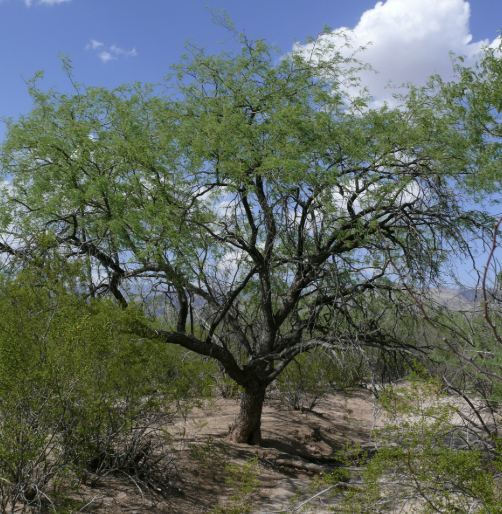
Quick Facts
- Sun: Full sun, including reflected heat
- Water use: Very low. It takes far less water than plants that aren’t desert adapted.
- Size: About 25 to 30 feet tall and wide, and 30 to 50 feet with plenty of water and deep soil
- Bloom: Pale yellow to cream, catkin-like flowers in spring
- Native or desert adapted: Native to the Sonoran and Chihuahuan Deserts
- Wildlife: Bees, other pollinators and birds
- Frost: Reliably hardy to at least 10°F, well below what a Zone 9B winter usually brings
Where It Works in Your Yard
Velvet mesquite does best in full sun, and it handles the heat that bounces off hot south and west walls and rock. That makes it useful in the spots where other trees struggle.
Give it room to spread. Keep it out of the lawn, too. The rapid crown growth and limited roots that come with lawn watering can make it unstable.
The shade is light and filtered. Velvet mesquite often acts as a nurse tree for slower growing cactus and shrubs, so you can plant under it. If you want a second native tree in the yard, take a look at our Desert Willow profile.
Planting It Right
Plant in fall or spring. Dig the hole no deeper than the root ball so the root flare sits at grade. Backfill with native soil and a little compost, lay compost on top, then mulch over it, keeping the mulch a foot back from the trunk.
A 15 gallon or smaller tree usually does better long term than a big boxed one. Mesquites grow fast in containers, and roots that circle the root ball can cause tree failure later, so cut circling roots when you plant.
Check the tag before you buy. Mesquites cross readily, and hybrids are often sold as Chilean or South American mesquite. Velvet mesquite may also be sold as Prosopis juliflora. I recommend native velvet mesquite over hybrids because it supports local wildlife.
Watering
Water deep and less often so roots grow down instead of out. Give a new tree extra attention for the first 8 weeks. Don’t skip watering after a rain, because desert rain rarely soaks in deep enough.
Where the water goes matters too. Emitters placed against the trunk keep roots bunched up close. Put them at the dripline and beyond so roots spread and anchor the tree. Frequent shallow watering is how you end up with a tree that topples.
Feeding the Soil
Build soil biology with quality compost, worm castings and a good organic fertilizer. No synthetic fertilizers. Ease off the feeding and watering late in summer. Heavily fertilized and watered trees handle cold worse than trees conditioned with less.
Care and Pruning
Keep pruning to what the tree needs. Slime flux and root rot get into mesquites through wounds, so fewer cuts means fewer entry points.
Mistletoe is the one to watch. Cutting it out by hand is the only practical control, and it keeps growing inside the wood, so remove it when a tree is heavily infested. A light amount is your call, since desert birds eat the berries.
Expect seasonal litter. The seed pods have long been ground into meal, and bees make honey from the flowers.
Watch-Outs
- Thorns. They’re medium sized on velvet mesquite. Young trees have small thorns that bother you less as the tree matures.
- Skin and allergies. The leaves can irritate skin, and AMWUA lists the tree as allergenic. Wear gloves and long sleeves when you handle it.
- Slime flux. Mature trees can ooze a dark, foul-smelling liquid from wounds. It’s mostly a nuisance, but it can stain patios and cars, so think about where you park.
- Shallow watering. It’s the mistake that costs the most trees, so water deep and less often.
Want help choosing a spot or building the soil before you plant? Book a consult with The Garden Nerd or join the Garden Nerd Club.
Sources
- Arizona Municipal Water Users Association, Landscape Plants for the Arizona Desert: Velvet Mesquite. https://www.amwua.org/plants/velvet-mesquite
- University of Arizona Cooperative Extension, Mesquite and Palo Verde Trees for the Urban Landscape (AZ1429, Schuch and Kelly, 2012). https://extension.arizona.edu/publication/mesquite-and-palo-verde-trees-urban-landscape