
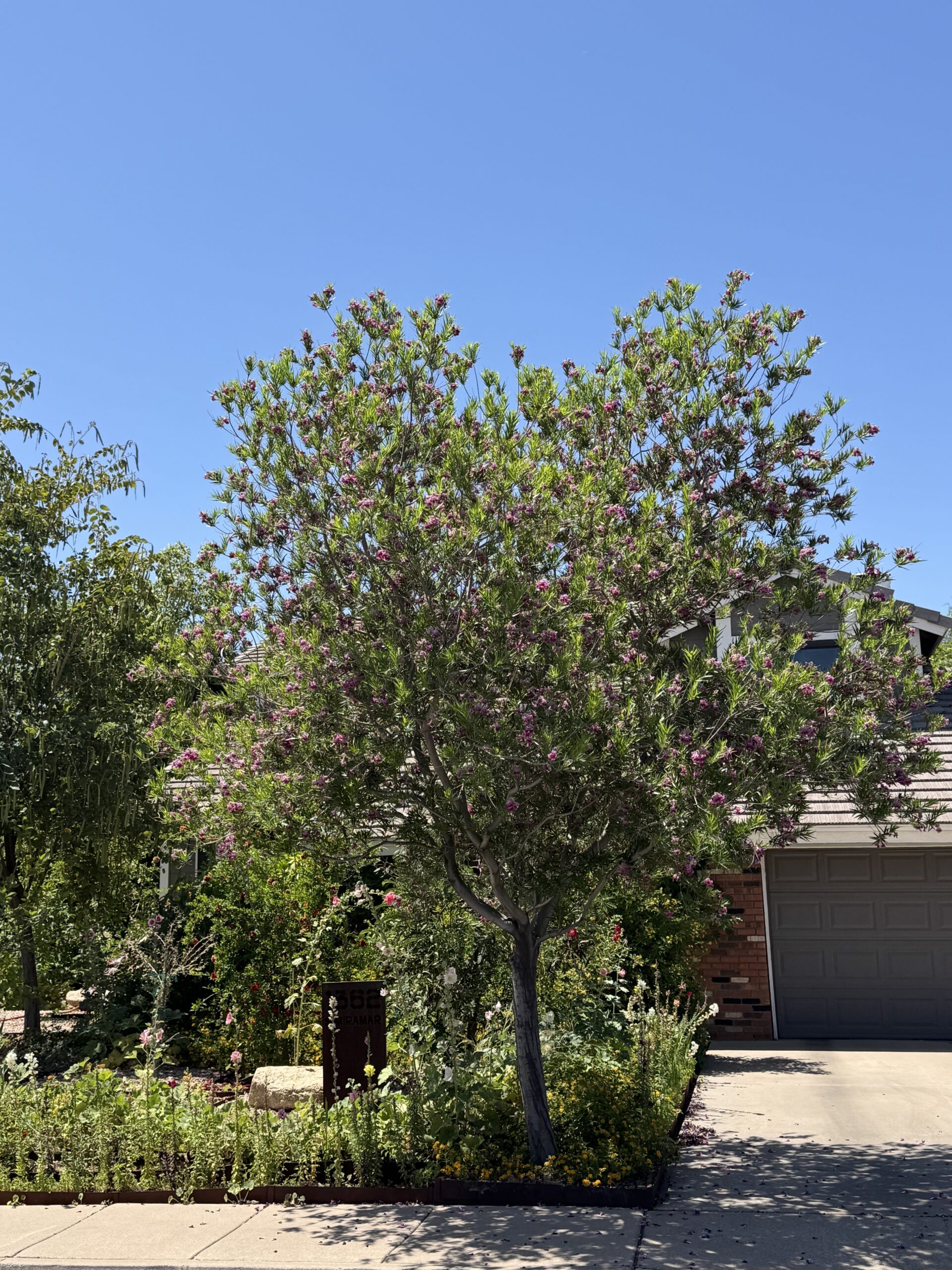
Desert willow isn’t a willow at all. It’s a native tree in the trumpet vine family, with narrow leaves that look like a willow’s and trumpet-shaped flowers that start in spring and keep coming into fall. If you want color, hummingbirds and a tree that takes less water than plants that aren’t desert adapted, it earns its spot in a Mesa or Phoenix yard.
Quick Facts
- Sun: Full sun
- Water use: Low. It takes less water than plants that aren’t desert adapted.
- Size: About 15-30 feet tall and 20 feet wide
- Growth rate: Fast
- Bloom: Pink, purple or white trumpet-shaped flowers, spring to fall
- Native or desert adapted: Native to the southwestern U.S. and northern Mexico
- Wildlife: Hummingbirds, carpenter bees, bumblebees and butterflies
- Frost: Hardy to 0°F, well below what we see in the Valley
- Leaves: Deciduous, dropping in late fall
Where It Works in Your Yard
Plant it in full sun and give it room. Plan on about 15-30 feet tall and 20 feet wide, and since it grows fast, it fills in quickly.
The canopy is airy and open. University of Arizona Cooperative Extension points out that it doesn’t make dense shade, so think filtered light rather than a heavy shade tree. It grows with multiple trunks naturally, but you can prune it to a single trunk if you prefer that look.
I like it near front entries, where you’ll see the flowers every day. It drops its leaves in late fall, so it helps to plant something that keeps its leaves nearby. Our Hopseed Bush profile covers a native option. If hummingbirds are the goal, Orange Jubilee is another one to look at.
Planting It Right
Fall or spring is the best time to plant. Dig the hole no deeper than the root ball so the root flare sits at grade. Backfill with your native soil and a little compost. Then lay compost on top and mulch over it, keeping the mulch a foot back from the trunk.
When you’re shopping, a 15 gallon or smaller tree usually does better long term than a big boxed one.
Watering
Water deep and less often so the roots grow down instead of staying near the surface. Give the tree extra attention for the first 8 weeks while it settles in. And don’t skip watering after a rain. Desert rain rarely soaks in deep enough.
AMWUA rates desert willow as low water use. UA Extension also notes that supplemental water during hot, dry stretches can extend the bloom season. If you want flowers well into summer, keep that in mind.
Feeding the Soil
A healthy tree starts with healthy soil biology. Build it with quality compost, worm castings and a good organic fertilizer. No synthetic fertilizers. The goal is to feed the life in the soil, and compost and organic fertilizer do that.
Care and Pruning
Desert willow has relatively few pests or diseases. In spring, aphids can show up on new leaves and blossoms. UA Extension suggests a strong spray of water to knock them back, and hummingbirds and other predators will help too.
If you train it to a single trunk, expect suckers at the base. They need to be pruned out from time to time.
Watch-Outs
Seed pods and litter. Long, narrow pods form after the flowers fade and stay on through winter. Then they split open and release fuzzy seeds. Expect a messy seasonal drop of pods, seeds and leaves. Seeds can sprout in a moist seedbed, so watch for seedlings. Some selections produce few or no pods, so ask your nursery about podless varieties.
Bare in winter. The leaves drop in late fall, so plan for a leafless tree through the cold months.
Want help picking the right spot or building the soil for a desert willow? Book a consult with The Garden Nerd or join the Garden Nerd Club.
Sources
- Arizona Municipal Water Users Association, Landscape Plants for the Arizona Desert: https://www.amwua.org/plants/desert-willow
- University of Arizona Cooperative Extension, Yavapai County, “The Desert Willow” (Backyard Gardener, Aug. 15, 2018): https://cales.arizona.edu/yavapai/anr/hort/byg/archive/desertwillow2018.html
- University of Arizona Cooperative Extension, Yavapai County Native and Naturalized Plants, Chilopsis linearis: https://yavapaiplants.extension.arizona.edu/chilopsis-linearis