
Desert ironwood (Olneya tesota) is a Sonoran Desert native that grows slowly into a multi-trunked, gray-green tree about 25 feet tall and wide. It gives you real shade, a spring show of dusty lavender flowers, and it takes less water than plants that aren’t desert adapted. It’s my first pick for front yard native trees.
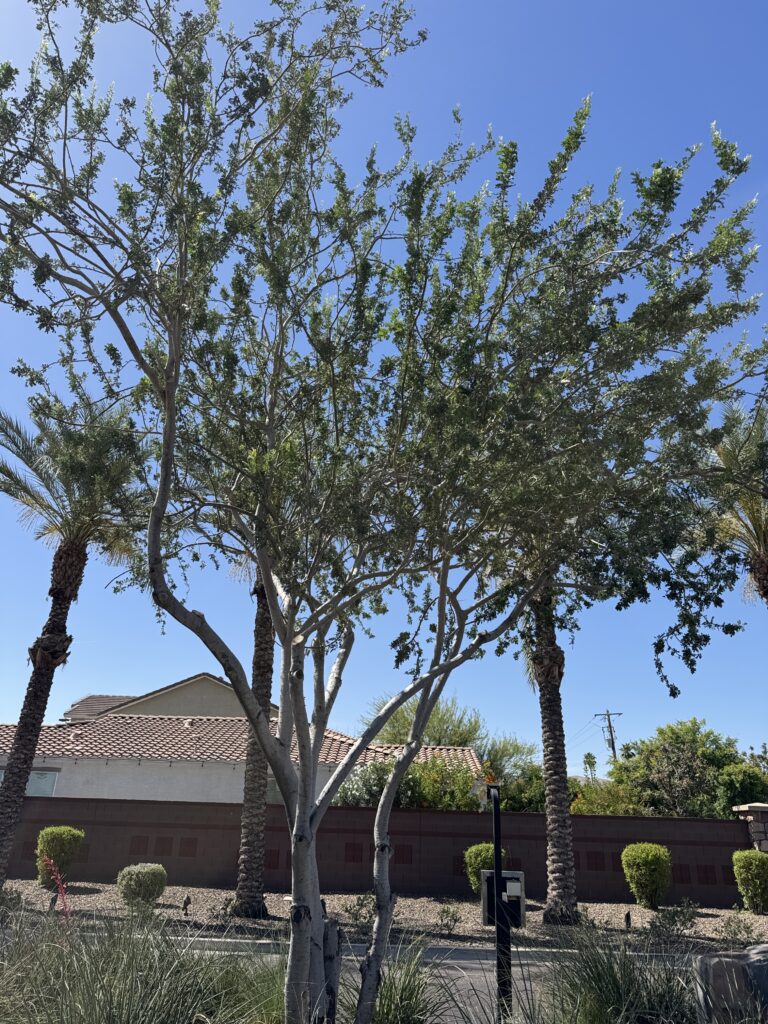
Quick Facts
- Sun: Full sun
- Water use: Very low
- Size: About 25 feet tall and wide, usually multi-trunked. University of Arizona Extension lists it reaching up to 30 feet.
- Bloom: Dusty lavender, late spring
- Native or desert adapted: Native to the Sonoran Desert
- Wildlife: Food and shelter for birds and other wildlife, and a favorite of pollinators
- Frost: Rated hardy to 20°F
- Growth rate: Slow
- Leaves: Evergreen and gray-green
Where It Works in Your Yard
Give ironwood full sun and room. At maturity you’re planning for a tree roughly 25 feet across, and the roots do the same thing underground. University of Arizona Extension notes that most tree roots sit in the top two feet of soil and can reach three to five times the width of the canopy. Think about what’s nearby, above and below ground, before you pick the spot.
Ironwood is a good front yard tree and a good accent. It’s slow, so you’re buying a tree that rewards patience. It also has thorns, so keep it back from the spots where people brush past.
If you’re weighing native trees for the same yard, take a look at our Velvet Mesquite profile and our Desert Willow profile.
Planting It Right
Fall is the best planting season here. Desert Botanical Garden reports about 95 percent survival for fall planting, compared with about 40 percent for summer planting. Cooler soil lets roots grow before the first summer arrives.
Here’s how I plant it:
- Dig the hole slightly wider than the root ball and no deeper than the root ball.
- Make sure the root flare, where the trunk widens into the roots, is visible and sits at or just above grade.
- Backfill with the native soil you dug out. University of Arizona Extension recommends leaving amendments out of the hole.
- Water as you fill to settle the soil and remove air pockets.
- Lay a layer of compost on the surface, then mulch over it, 3 to 4 inches deep. Keep the mulch a foot back from the trunk.
Watering
Water deeply and broadly so the roots head down and out, not stay shallow. For a new tree, water right after planting. Then water every three to four days at first, and stretch the time between waterings as the weather cools. Keep the root ball moist for the first few weeks.
Once it’s established, ironwood has very low water needs. That means it takes less water than plants that aren’t desert adapted, not that you can ignore it.
Feeding the Soil
I don’t feed a tree in the planting hole. University of Arizona Extension notes that desert soils are usually low in nitrogen and that surface applications are best made about a year after planting.
When the time comes, spread quality compost, worm castings and a good organic fertilizer on the soil surface under the canopy. That builds soil biology, and healthy soil biology is what feeds the tree over the long run. No synthetic fertilizers.
Care and Pruning
Leave a new tree alone. Desert Botanical Garden advises waiting at least a year before pruning anything beyond dead, broken or diseased branches, because the tree needs its leaves to feed its roots.
Stake only if the tree can’t stand on its own, and take the stakes off after the first growing season. If rabbits are a problem in your yard, protect the trunk with a guard.
Watch-Outs
- Thorns. Plan for them when you pick the spot.
- Seasonal litter. Expect some leaf and pod cleanup.
- Slow growth. It won’t be a shade tree in two summers. That’s part of the deal.
- Frost. It’s rated hardy to 20°F, so a lot of Phoenix-area winters won’t test it.
Ready to Plant One?
If you want help picking the spot and getting the soil right, book a consult with The Garden Nerd or join the Garden Nerd Club.
Sources
- Arizona Municipal Water Users Association, Ironwood (Olneya tesota): https://www.amwua.org/plants/ironwood
- University of Arizona Cooperative Extension, Olneya tesota – desert ironwood (Yavapai County Native and Naturalized Plants): https://yavapaiplants.extension.arizona.edu/olneya-tesota
- University of Arizona Cooperative Extension, Planting Guidelines: Container Trees and Shrubs (AZ1022, 2025): https://extension.arizona.edu/sites/default/files/2025-05/az1022-2025-05-02-25-Planting-Guidelines-Container-Trees-and-Shrubs.pdf
- Desert Botanical Garden, Celebrate Native Plant Month with Desert Botanical Garden’s Curated List of Top 10 Plants: https://dbg.org/blog/top-10-plants-native/
- Desert Botanical Garden, Fall Planting for Summer Success: https://dbg.org/blog/fall-planting-for-summer-success/