
Bougainvillea ‘Torch Glow’ | Also called: Torchglow Bougainvillea, Paper Flower
Most people in Phoenix have a complicated relationship with bougainvillea. They’re everywhere, they’re undeniably colorful, and they’re brutal to deal with — thorny vines that take over, dump bracts all over the ground for months, and fight back every time you try to keep them in bounds. So when someone says “bougainvillea” in the context of a commercial landscape, the instinct is usually to flinch.
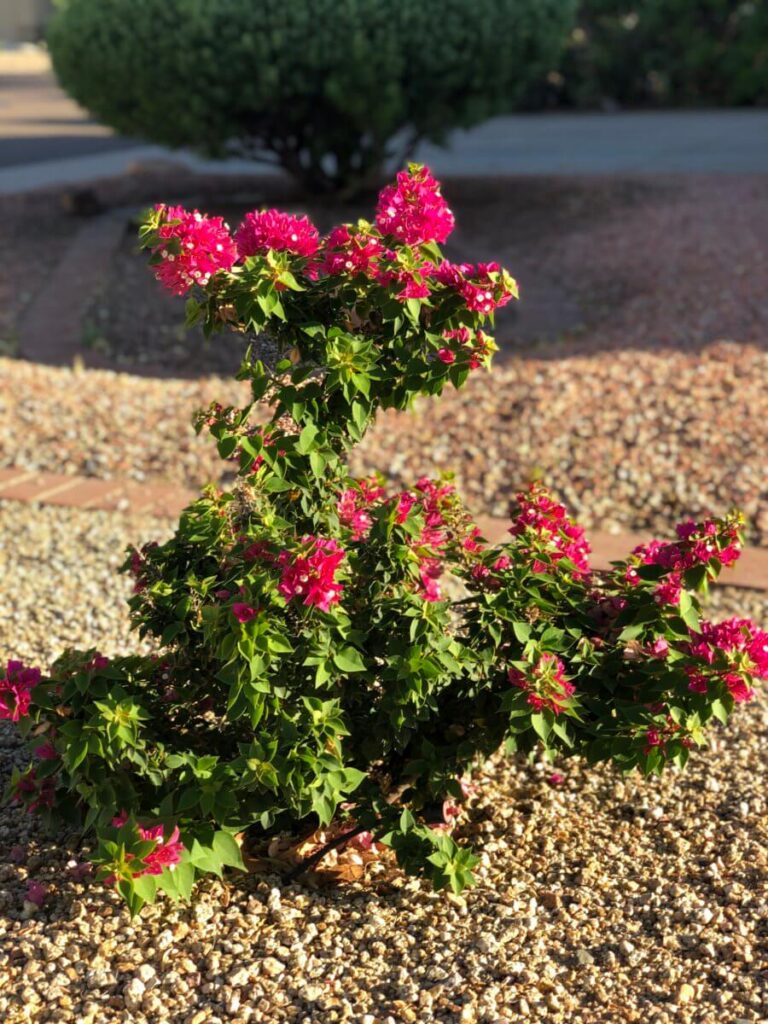
Torchglow is a different plant. It happened as a chance genetic mutation, was discovered and patented in 1988, and hasn’t behaved like a standard bougainvillea since. It grows upright as a freestanding shrub rather than sprawling as a vine. It produces its famous reddish-pink bracts in dense cylindrical clusters — like the head of a lit torch — along stiff, self-supporting branches rather than sprawling across every surface it can reach. It produces less litter than standard varieties. And while it does have thorns, they’re softer and less aggressive than typical bougainvillea thorns.
It’s still bougainvillea in the ways that matter — heat-tolerant, drought-tolerant once established, and capable of delivering more sustained color than almost anything else in a Phoenix landscape. But it’s been doing it in a form that actually fits into a planned, maintained landscape without requiring you to fight it constantly.
What Makes Torchglow Different From Standard Bougainvillea
Understanding the biology of what happened with Torchglow helps explain why it behaves differently than the vines you’re used to seeing.
A normal bougainvillea produces long, sprawling stems — thirty feet is not unusual — with flowers distributed along the length of the vine and spaced out by relatively long internodes (the stem segments between leaf nodes). That vining, sprawling habit comes from the plant’s native South American origin, where it climbs through other vegetation toward light using its thorns as purchase points.
Torchglow is the result of a mutation that dramatically compressed those internodes — the distance between flowering nodes along the stem is a fraction of what it is on a standard vine. The practical effect is that all that flowering energy that would normally be spread across thirty feet of sprawling vine gets packed into the tip of a six-foot upright stem. The result is those dense, cylindrical bract clusters that look like lit torches — and a plant that stays compact and upright rather than going everywhere.
This matters for landscape use in several specific ways. The plant doesn’t need a trellis or support structure to maintain its form — it’s genuinely freestanding. It doesn’t climb into adjacent plants or structures. It can be massed along a fence or corridor without the constant intervention required to keep a standard bougainvillea vine from taking over. And when planted on alternating sides of a fence — staggered so plants alternate rather than line up directly across from each other — it creates a continuous layered color effect that a vining form couldn’t achieve in the same way.
Appearance and Bloom Habit
Torchglow reaches 6 to 8 feet tall and 3 to 4 feet wide at maturity — a narrow, columnar shrub with stiff upright branches. The leaves are dark green, oval, and relatively modest in size. The bracts — what most people call the flowers — are reddish-pink to magenta, papery in texture, and produced in dense clusters at the stem tips and distributed down the upper portions of each branch. The actual flowers are tiny white tubes tucked inside the bracts; what you’re seeing when you see “bougainvillea flowers” is mostly modified leaf material, which is why the color holds so long after the true flowers have finished.
Bloom time in Phoenix is extensive — spring through fall, with peak flowering in spring and again in fall as temperatures moderate from summer heat. During the peak of Phoenix summer in June and July, flowering slows somewhat, but the plant stays colored up longer than most shrubs. In particularly mild winters in frost-protected locations, it can push color nearly year-round.
The bract drop is real but less severe than with standard bougainvillea. Some litter is inevitable — this is still bougainvillea — but the more compact, upright form and the denser bract clusters produce a cleaner drop pattern than a vine sprawling across ground and hardscape. For commercial settings where maintenance and appearance matter, this is a meaningful difference.
One thing to know about the color: what you’re seeing is bracts, not petals, and bracts respond to stress differently than petals do. A plant that’s getting consistent water and fertilizer will produce lush green vegetative growth and fewer bracts. A plant that’s running slightly lean on water — just enough stress to trigger the flowering response — produces dramatically more color. This is not a bug; it’s how bougainvillea works, and Torchglow follows the same pattern. More on this in the watering section.
Sun and Heat Tolerance
Full sun is the requirement, not the preference. Torchglow needs direct sun — at least six hours, and more is better. Part shade produces leggier growth and significantly reduced flowering. Against a south or west-facing wall that absorbs daytime heat and radiates it back overnight, this plant is in its ideal environment. It handles the reflected heat from concrete and asphalt in commercial settings without stress — in fact, those hot, exposed conditions tend to produce the best flowering.
Cold is the vulnerability. Torchglow is hardy to approximately Zone 9-10, which means Phoenix proper is right at the edge of its comfortable range. It survives normal Phoenix winters, typically with some leaf drop and tip damage during colder events, and recovers quickly as temperatures warm in spring. In exposed locations that collect cold air — open low areas, north-facing spots without the thermal benefit of adjacent structures — it can take more significant damage. Younger plants are more vulnerable than established ones. Site it with cold protection in mind: south or west walls, areas with hardscape heat retention, locations with good air drainage that prevents cold pooling.
In a genuinely hard freeze — the kind Phoenix sees every decade or so rather than every winter — Torchglow may freeze to the ground. Like Yellow Bells, it typically pushes back from the roots. But for a commercial property where year-round appearance matters, this risk is worth accounting for in site selection.
Water Needs — The Counterintuitive Part
This is the section most people get wrong, and getting it wrong is why their bougainvillea produces lots of leaves and not much color.
Torchglow — like all bougainvillea — flowers in response to mild stress. The plant’s native environment in South America includes distinct wet and dry seasons. During dry periods the plant conserves by reducing vegetative growth, and the biological trigger for flowering is the stress of reduced water availability. When you give bougainvillea consistent, generous irrigation, you’re essentially telling it that it’s in a wet season — which means grow leaves, not flowers.
The practical application for Phoenix: once established, water deeply but infrequently. Allow the soil to dry out significantly between waterings — to the point where the plant shows very slight stress, just short of wilting. In summer heat this might mean deep watering every week to ten days in the hottest months. In spring and fall it might mean every two weeks. In winter, minimal to no supplemental irrigation. The goal is a cycle of deep saturation followed by meaningful dry-down, not consistent moisture.
During establishment — the first growing season — water more frequently to develop the root system: every four to five days initially, tapering as the roots establish over the first two to three months. Don’t stress a newly planted shrub before it has the root infrastructure to handle it.
If your Torchglow is producing lush, full green growth and minimal color, the most likely culprit is overwatering combined with too much fertilizer. Reduce both, let the plant get a little lean, and flowering will follow.
One absolute: well-draining soil. Torchglow does not tolerate consistently wet or poorly draining ground. Root rot is a real risk in heavy clay or compacted soils with poor drainage. This is non-negotiable — sort out drainage before planting.
Soil and Fertilizing
Sandy, low-fertility soil is actually ideal for Torchglow — another counterintuitive fact about this plant. It evolved in conditions that were not particularly rich, and it performs best when it isn’t being overfed. The relationship between fertilizer and flowering is the same as with water: excess nitrogen produces vegetative growth at the expense of bracts.
If fertilizing, use a balanced, low-nitrogen formulation — a 5-5-5 or similar balanced slow-release in spring is appropriate. Do not apply high-nitrogen fertilizer expecting more growth or flowering; it will give you more growth and less flowering. If the plant is in the ground and performing reasonably well, it generally doesn’t need much fertilizer input at all.
Phoenix’s alkaline, low-organic-matter soils are reasonably compatible with bougainvillea’s needs as long as drainage is adequate. The main amendment worth making is organic mulch over the root zone — 3 inches, pulled back from the base — to moderate soil temperature and retain moisture between deep waterings. This is particularly valuable in commercial settings where soil compaction from foot traffic and maintenance equipment can reduce drainage over time.
One important note on transplanting: bougainvillea roots are finicky about disturbance. When planting from a nursery container, handle the root ball carefully and minimize any root damage during installation. Don’t break apart the root ball to “loosen” the roots at planting — this does more harm than good with this plant. Set it gently, backfill carefully, and let the roots find their own way into the surrounding soil.
Planting Guide
Best time to plant in Phoenix: Spring — March through April — after cold risk has passed and before peak summer heat. This gives the plant a full warm season to establish. Fall planting in September through October also works if you can provide consistent irrigation through the establishment period before winter.
Spacing for staggered fence planting: 4 to 6 feet between plants on each side of the fence, with the two rows offset so plants alternate rather than line up directly across from each other. This creates a continuous layered color effect — you see plants staggered on both sides of the fence rather than paired plants that create gaps between clusters.
For freestanding mass planting: 4 to 5 feet apart produces a dense screen effect within two growing seasons. The narrow, columnar form means plants fill vertically before they crowd each other horizontally.
Site selection: Full sun, south or west exposure where possible for maximum flowering and cold protection. Keep it away from walkways where the thorns create problems for pedestrians. Fence line applications work well — the fence provides a physical buffer, the plants grow against and above it, and a staggered two-sided planting puts color visible from both directions.
Depth and backfill: At grade — no deeper than the root ball. Disturb the roots as little as possible during planting. Native soil backfill with light organic amendment is appropriate. Good drainage is the priority over soil enrichment.
Pruning and Maintenance
Torchglow’s pruning requirements are lighter than standard bougainvillea, but the approach matters — the wrong pruning method destroys the architectural quality that makes this plant distinctive.
The cardinal rule: Don’t shear it and don’t prune it into a ball. The upright, torch-like form is the entire point of this plant. Hedging or shearing it into a rounded mass eliminates the characteristic shape and dramatically inhibits flowering, because flowering happens at stem tips and the sheered-off buds are where the next flush was coming from.
Annual late-winter pruning: February through March in Phoenix, after cold risk has passed. This is the time for any significant shaping — removing disproportionately long stems, cutting back freeze-damaged growth to live wood, and any structural corrections. Limit removal to no more than one-third of the plant at a time. After the late-winter prune, leave it alone and let it push into the spring flush with minimal interference.
Light shaping after bloom flushes: After the spring and fall bloom periods, selective trimming of the longest stems back to a lateral bud is appropriate to maintain the desired height and encourage branching. Keep it minimal — Torchglow doesn’t need constant management the way a vigorous vine does.
Rejuvenation: Every five years or so, a hard cutback to about one foot is appropriate to renew old wood and reinvigorate growth. This sounds severe but bougainvillea responds well to hard pruning at the right time of year. Late winter is the window.
Thorns: Wear heavy gloves every time. Torchglow’s thorns are softer and shorter than standard bougainvillea, but they’re still thorns and they cause injury. Make sure maintenance staff are equipped and aware.
Toxicity note: Bougainvillea is mildly toxic if ingested. Worth noting in settings with pets in close contact with the planting.
Common Problems
Not blooming / all leaves, no color: Almost always overwatering and/or overfeeding. Reduce irrigation frequency to allow meaningful dry-down between waterings. Cut back or eliminate fertilizer, particularly anything nitrogen-heavy. Give the plant a period of mild stress and flowering will follow. This is by far the most common issue with Torchglow in Phoenix landscapes.
Freeze damage: Leaf drop and tip dieback during cold winters is normal and temporary. Don’t cut freeze-damaged growth until new growth is actively emerging in spring — usually March. Cutting too early removes the dead material that provides some insulation to live wood below. Once growth is pushing, cut back to the live wood and let it go.
Whitefly and spider mites: Occasional pest pressure, more common during dry periods before monsoon. A strong blast of water handles small populations. Insecticidal soap is effective for moderate infestations. Manageable nuisances rather than serious threats to an established plant.
Root rot: From poor drainage or overwatering. Established plants with good drainage and appropriate irrigation schedules rarely have this problem. Young plants in heavy soil or overwatered during establishment are more vulnerable. Drainage at planting is the prevention.
Leggy, open growth: Usually from too much shade or too much water — both push vegetative growth at the expense of the characteristic upright, dense form. Ensure full sun, reduce irrigation to the appropriate dry-down cycle, and light corrective pruning of the most over-extended stems.
Using Torchglow Along Fences and Corridors
One of the best applications for Torchglow in a Phoenix landscape is along a fence line or property corridor — and the staggered planting technique is worth understanding if you’re doing this.
Rather than planting a single row on one side of the fence, plant on both sides with the plants offset — alternating so they’re staggered rather than lined up directly across from each other. From the street, you’re not seeing a row of plants with gaps between them; you’re seeing a continuous run of color with visual depth because plants are at different positions relative to the fence line. The upright, columnar form of Torchglow is particularly well-suited to this approach — the plants grow vertically above and through the fence line rather than sprawling horizontally along it.
If you already have existing bougainvillea on a fence that’s performing well, Torchglow is the natural choice to extend and formalize that planting. Using the same genus keeps the palette unified — you’re building on what’s already working rather than introducing a visual break with a different plant.
For multi-layer corridor plantings, Torchglow works well as the mid-height element. A lower ground cover on the street side and an ornamental grass or similar plant on the interior side gives you three different textures and heights in a continuous band — each plant suited to Zone 9B heat, none of them requiring the same irrigation schedule as a lawn or high-water planting, and the whole thing maintainable on a consistent routine.
Frequently Asked Questions
Is Torchglow really a shrub and not a vine?
Yes. The mutation that produced Torchglow compressed the internodes so dramatically that the plant grows upright and compact rather than sprawling. It’s freestanding — no trellis or support needed. It won’t climb walls or spread into adjacent plants the way standard bougainvillea vines do. This is the fundamental difference that makes it workable in a formal landscape setting.
Why isn’t my Torchglow blooming?
Almost certainly overwatering and/or too much fertilizer. Bougainvillea flowers in response to mild stress. If it’s getting consistent, generous irrigation and regular feeding, it has no reason to flower — it’s in permanent vegetative mode. Reduce irrigation frequency to allow meaningful dry-down between waterings, cut back on fertilizer, and the flowering response will come. This is the single most common Torchglow issue in Phoenix.
How does Torchglow handle Phoenix winters?
It survives normal Phoenix winters with some leaf drop and tip damage during colder nights, recovering quickly in spring. In hard freezes it may die back more significantly but typically pushes from the roots. It’s not as cold-tolerant as Desert Willow or Mulga Acacia — site it with thermal protection in mind and don’t prune freeze damage until new growth is actively emerging in March.
Does it really have fewer thorns than regular bougainvillea?
Softer and less aggressive thorns, yes — not no thorns. They’re real and will cause injury without proper gloves. The difference is meaningful in terms of how combative the plant is during maintenance, but anyone working with Torchglow should still wear heavy gloves every time. Never place it directly adjacent to pedestrian pathways.
How close to the fence should I plant it?
For the staggered fence planting, 2 to 3 feet from the fence base gives the plant room to establish and the root zone adequate soil volume. The upright habit means it grows vertically into and above the fence line rather than sprawling horizontally along it. On both sides of the fence, the same 2 to 3 foot setback applies before the next planting band begins.
How long until it reaches full height?
With appropriate establishment watering followed by the dry-stress cycle that encourages flowering over vegetative growth, most Phoenix plantings reach close to full size within two to three growing seasons. A plant grown with excessive water and fertilizer will push harder vegetatively and reach height faster but with fewer bracts — the tradeoff isn’t worth making. Let it grow at the pace that also produces the best color output.