
Cordia boissieri | Also called: Mexican Olive, Anacahuita, White Cordia
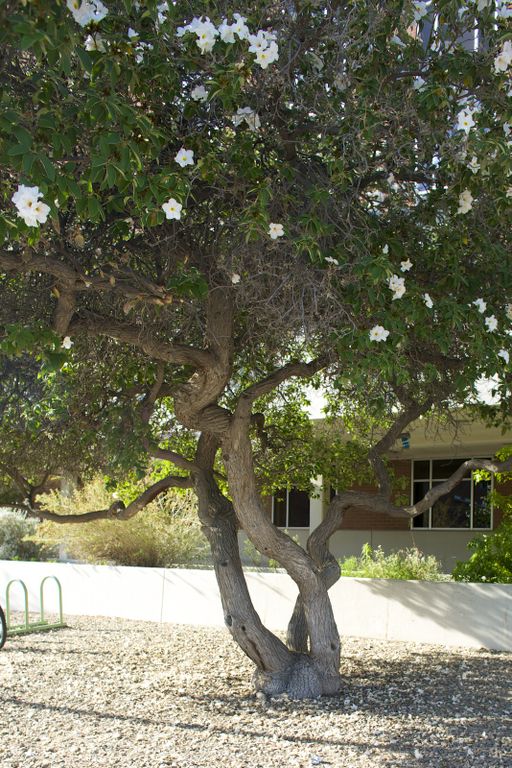
There are a handful of trees that stop people in their tracks when they’re in bloom, and the Texas Olive is one of them. Large, crepe-paper-white flowers with a yellow throat, clustered at the tips of every branch, on a tree that’s also handling full Phoenix sun without complaint. It doesn’t look like something that belongs in the desert. That’s part of the appeal.
If you’ve been searching for a small flowering tree that’s genuinely low-water once established, looks good year-round, and won’t turn your yard into a maintenance project – this is one to seriously consider. But it has some specific things it needs, and one thing it won’t tolerate. Read through before you plant.
What It Is and Why It Works Here
The Texas Olive isn’t actually an olive tree. It’s in the Boraginaceae family – the same family as borage and forget-me-not. The name comes from its small, olive-like fruit and the fact that it thrives in hot, arid climates where true olives also do well. Botanically, it’s its own thing entirely.
Native to southern Texas and northern Mexico, this tree evolved in conditions that closely mirror what we have here in the Phoenix area: alkaline soils, intense sun, low rainfall, and heat that would stress most ornamental trees. It’s not just tolerant of our conditions – it’s genuinely adapted to them.
It’s a Zone 9a tree, which is exactly where we sit in Phoenix. That means it belongs here. You’re not pushing the edge of its range.
Appearance and Growth Habit
The Texas Olive typically tops out at 15 to 20 feet tall and can spread 15 to 25 feet wide, though you’ll often see it smaller in residential settings depending on water and pruning. It has a naturally rounded, symmetrical crown and, over time, develops a gnarled, sinuous trunk with dark gray bark that becomes genuinely beautiful as the tree matures.
The leaves are large and oval, 4 to 5 inches long, with a rough, slightly sandpapery texture on top and fuzzy silvery-green undersides. It’s semi-evergreen to evergreen in Phoenix, meaning it holds its leaves through most winters and only drops them if temperatures dip hard enough to cause damage. In a mild Phoenix winter, it stays green and full.
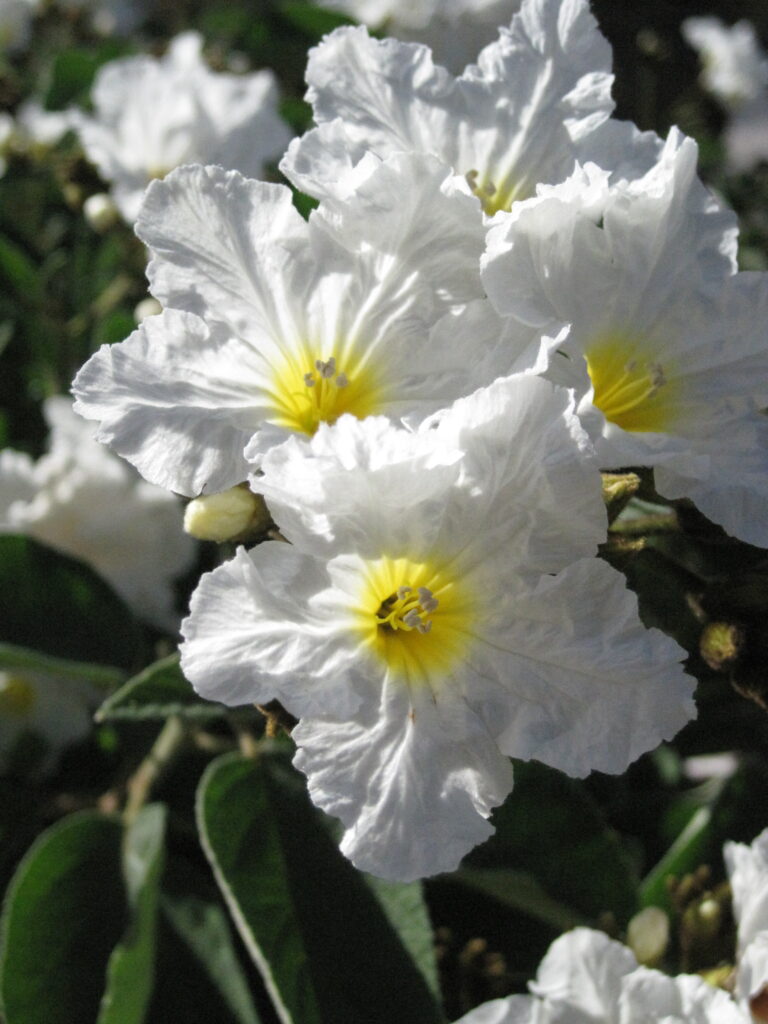
The flowers are the showstopper. White, funnel-shaped, about 2 inches across, with a dark golden-yellow throat. They appear in clusters at the branch tips and the texture really does look like crepe paper or chiffon when you get up close. Bloom season runs from spring through early summer as the primary flush, with additional flowering in fall if the tree is getting adequate water. In favorable conditions – and Phoenix summers with regular deep irrigation can provide this – you may see sporadic blooms throughout most of the year.
After the flowers come small, olive-shaped fruits, yellow-green when ripe, about an inch long. Birds eat them. Wildlife eats them. They’re technically edible for humans but mildly intoxicating in quantity, so they’re best left to the birds. The fruit litter under the tree is real – keep this one away from the pool.
Sun and Heat Tolerance
Full sun, and it actually wants reflected heat. This is one of those trees that gets planted near south or west-facing walls and thrives there when other plants would struggle. Six to eight hours of direct sun is the minimum; more is better.
Phoenix summers are not a problem for an established Texas Olive. It handles the extended weeks of 110°F+ heat that punish so many other ornamentals. What it does need during that heat is adequate soil moisture to keep flowering – more on that in the water section.
One thing to understand: more sun and heat generally means more blooms, provided water needs are being met. A Texas Olive parked in part shade will survive but won’t perform the same way.
Water Needs
This is the most important thing to get right, especially in the first two years.
During establishment (first 1–2 years): Water deeply and consistently. Once a week during the warm months is a reasonable baseline, adjusting based on heat and soil type. The goal is to develop a deep, wide root system. Shallow, frequent watering will produce a shallow root system that makes the tree dependent on irrigation indefinitely and more vulnerable to stress.
Once established: The Texas Olive is genuinely drought-tolerant. Mature trees can handle once-a-month irrigation and be fine. What “once a month” actually means in practice depends on your soil, your microclimate, and the time of year – a tree in heavy clay holds moisture longer than one in sandy mix. The rule of thumb is to water deeply, then let the soil dry out between waterings. You’re not trying to keep the root zone constantly moist.
If you want maximum flowering: Give it a bit more water during the bloom seasons. Flower production is linked to moisture availability. A Texas Olive in a very lean watering program will survive, but the flowering will be less abundant than one that gets deep, thorough irrigation every few weeks during the growing season.
What to avoid: The one thing this tree won’t tolerate is wet feet. Standing water, consistently soggy soil, or a planting spot with poor drainage is how you kill a Texas Olive. Good drainage isn’t optional – it’s the most important soil condition this tree has.
Soil and Fertilizing
Here’s where it gets interesting from a Phoenix perspective.
The Texas Olive is naturally adapted to alkaline, mineral-rich, low-organic-matter soils – which is exactly what we have here. It’s not demanding about soil fertility. It doesn’t need rich, amended planting beds to perform well. In fact, overly fertile soil or aggressive fertilizing can push too much leafy growth at the expense of flowers.
That said, Phoenix soil still has the challenges we deal with across the board: salt accumulation from irrigation water, chemical lockup of nutrients due to high pH, and low organic matter that limits soil biology. The Texas Olive handles these conditions better than most, but that doesn’t mean ignoring soil health altogether.
A few things worth knowing:
pH and nutrient availability: Our soil typically runs 7.5 to 8.5 pH. The Texas Olive handles this without complaint – it evolved in similar conditions. You’re unlikely to see the persistent iron chlorosis that shows up in plants that really struggle with alkalinity.
Salts: This tree is actually salt-tolerant, which is useful in Phoenix where irrigation water continuously deposits minerals in the root zone. That said, salt accumulation still affects soil biology and long-term plant health. The same deep, infrequent watering that builds a good root system also helps push salts below the root zone over time. Don’t ignore salt management just because this tree handles it better than a citrus or a rose.
Fertilizing approach: This is not a heavy feeder. A light application of organic compost in spring is enough to keep the soil biology active and the tree performing well. Think of it as feeding the soil rather than feeding the tree – building organic matter and biological activity so nutrients cycle naturally rather than dumping synthetic inputs that add to your salt load.
Avoid synthetic fertilizers on this one (and always). They’re not necessary, they add to the salt buildup in your soil, and they tend to push vegetative growth in a tree that doesn’t need it. Compost, worm castings, and a quality organic topdress are plenty.
Planting Guide
Best time to plant in Phoenix: October through March. Fall planting gives the root system time to establish during mild temperatures before the tree has to deal with its first summer. Spring planting works too, but you’ll be right up against heat stress season – plan to stay on top of watering through June and July in year one.
Planting hole: Dig wide, not deep. Two to three times the width of the root ball, and only as deep as the root ball itself. You don’t want the crown of the tree sitting below grade. In Phoenix soils, planting too deep – especially where caliche is present – leads to drainage problems and root stress.
If you hit caliche during digging, you need to address it. A shallow caliche layer that creates a bathtub effect in your planting hole will kill this tree faster than anything. Break through it, or choose a different planting location.
Amendments: Backfill with the native soil you dug out. You don’t need to create a rich planting mix – the Texas Olive doesn’t want it and abrupt soil transitions between a rich planting hole and your surrounding native soil actually create drainage issues. If your soil is very compacted, mixing in some compost is fine, but keep it modest.
Mulch: Apply 3 to 4 inches of organic mulch over the root zone, keeping it away from the trunk. Mulch is one of the best things you can do for any tree in Phoenix – it moderates soil temperature, retains moisture, reduces salt concentration at the surface, and feeds soil biology as it breaks down.
Form at planting: The Texas Olive naturally wants to grow as a multi-trunk shrub. If you want a single-trunk tree form, you’ll need to select your strongest central leader at planting and remove competing stems. Do this early – it’s much easier to establish tree form when the plant is young than to try to correct it later.
Pruning and Maintenance
The Texas Olive is not a high-maintenance tree once established. It doesn’t need aggressive pruning to stay healthy, and heavy pruning removes the flowering wood you want.
For tree form: If you’re growing it as a tree rather than a shrub, remove lower branches as the trunk develops. Do this gradually over a few years rather than all at once.
Timing: Prune after the main spring flowering flush, not before it. Pruning in late winter removes the buds that would have been your spring flowers. If you need to do structural or corrective pruning, wait until the first bloom cycle has finished.
Dead or damaged wood: Remove anytime. After a cold snap that causes leaf burn or branch dieback, wait until you can see clearly where live growth begins before cutting. It’s easy to cut too much too soon and remove wood that would have recovered.
General maintenance: Beyond keeping it in the shape you want, this tree largely takes care of itself. It’s not prone to crossing branches or structural problems that require regular intervention. An annual light tidy-up after spring bloom is usually sufficient.
Cold Hardiness – The One Real Limitation in Phoenix
This is the most important risk to understand before planting.
The Texas Olive is rated to about 20–25°F. In most Phoenix winters, that’s a non-issue – we rarely see nights that cold in the lower elevations. But Phoenix does occasionally get hard freezes, and when it does, the Texas Olive will show damage.
Here’s what to expect at different temperatures:
- 28–32°F: Leaf tip burn, some cosmetic damage. The tree recovers without intervention.
- 24–28°F: More significant leaf burn or drop. The tree will likely defoliate but come back from the wood in spring.
- Below 20°F: Potential die-back to the crown or roots. The tree may survive and regenerate from the root system, but you could lose significant structure.
In Phoenix proper, the freeze risk is low enough that most gardeners consider this an acceptable trade-off for everything the tree offers. In outlying areas – Queen Creek, Maricopa, far east and north Valley – you’re more exposed. In those locations, planting near a south-facing wall that radiates heat at night gives this tree meaningful protection.
After a freeze event, don’t panic and don’t start pruning immediately. Wait until you see new growth emerging to understand exactly where the living wood is. The tree often looks worse than it is in the weeks following cold damage – give it time before making cuts.
Common Problems and Pests
The Texas Olive is remarkably trouble-free compared to most ornamentals. That said, a few things come up:
Root rot: This is by far the most common way a Texas Olive fails in Phoenix. Poor drainage, overwatering during establishment, or planting in a low spot where water collects. The symptoms – yellowing, wilting despite adequate soil moisture, gradual decline – look like the tree needs more water, which leads people to water more, which makes things worse. If your Texas Olive is struggling and drainage is questionable, that’s the first thing to investigate.
Aphids: Occasional infestations, usually on new growth in spring. In a yard with healthy soil biology and beneficial insect habitat, these typically sort themselves out. Predatory insects – lacewings, parasitoid wasps, lady beetles – will find the aphids if the ecosystem is there to support them. Spraying is usually not necessary and disrupts the natural balance you’re trying to build.
Fruit and flower litter: This isn’t a pest problem, but it catches people off guard. This tree drops flowers, fruits, and occasional leaves with regularity. Near a pool or a pristine patio, that’s worth factoring into your placement decision.
Freeze damage: Covered above, but worth noting here as well. Blackened, wilted leaves after a cold snap are alarming-looking but usually not fatal. Patience is the right response.
Lack of flowering: The most common cause in Phoenix is insufficient water during the growing season, not a disease or pest problem. Bloom production is directly tied to moisture availability. If your tree is getting very minimal water and not flowering much, try increasing irrigation frequency during spring and fall.
Frequently Asked Questions
Does the Texas Olive need a lot of water in Phoenix?
Once established, no – it’s legitimately drought-tolerant and can get by on deep monthly irrigation. But during the first two years, it needs consistent, deep watering to build the root system it’ll rely on for the rest of its life. Don’t shortcut establishment watering and then wonder why the mature tree looks stressed.
Will a Texas Olive survive a Phoenix winter?
In most years, yes, without any protection or notable damage. Phoenix regularly stays warm enough that the tree barely notices winter. In years with an extended hard freeze – temperatures in the low 20s for several hours – you’ll likely see leaf burn or drop. The tree almost always recovers in spring. For extra cold pockets in the valley, plant near a south-facing wall.
How fast does a Texas Olive grow?
Slow to moderate. In Phoenix with decent irrigation, expect 1 to 2 feet of growth per year under good conditions. It’s not a tree you plant for fast shade, but it also won’t take decades to become a real presence in your yard.
Can I grow it as a shrub instead of a tree?
Left to its own devices, the Texas Olive wants to be a multi-trunk shrub. That form is perfectly valid and actually suits smaller spaces better than a trained tree. The flowers are just as abundant either way. shrub instead of a tree?
Do I need to fertilize it?
Not heavily. A light organic compost topdress in spring is enough. This tree doesn’t need aggressive fertilizing and will actually flower less if you push too much nitrogen at it. Feed the soil, not the plant.
Is the fruit edible on a Texas Olive?
Technically yes, in small amounts. Traditionally in Mexico, the fruit was made into a jelly used as a cough remedy. In larger quantities, the fruit is mildly intoxicating – this affects birds and other wildlife too, which is partly why the fruit can be entertaining to watch. Don’t eat a handful.
The Texas Olive is one of the better-kept secrets in Phoenix landscaping. It’s genuinely beautiful when it’s in bloom, it handles our heat and alkaline soils without complaint, and once established it’s about as low-maintenance as a flowering tree gets. The only real caveats are drainage – this tree will not tolerate wet feet – and the periodic freeze risk for those in colder pockets of the valley. Plant it in the right spot, give it what it needs during establishment, and you’ll have a tree that rewards you with white flowers for most of the year and essentially takes care of itself.