
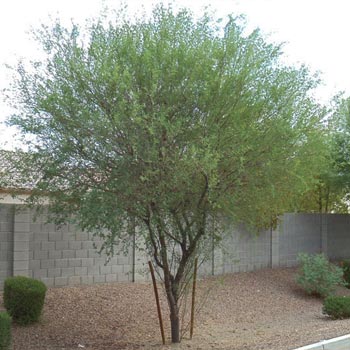
Vachellia farnesiana | Also called: Huisache, Sweet Vachellia, Perfume Acacia, Texas Huisache
In late winter, if you spend any time outside in the Phoenix area, you’ll catch the smell before you see the tree. Sweet Acacia flowers have a fragrance so strong and distinctive it carries through open air and across property lines – a warm, honeyed, almost violet-like scent that the European perfume industry has been extracting and bottling for centuries. The perfume made from it is called “cassie” and it’s been a commercial commodity since at least the 1600s. The fact that we can grow this tree casually in our front yards says something about how well-suited it is to our climate.
Beyond the fragrance, the Sweet Acacia is a genuinely capable desert tree. It’s drought-tolerant, alkaline soil-tolerant, cold-hardy enough for Phoenix, fast-growing relative to many desert trees, and attractive year-round. It also fixes nitrogen, which puts it in that useful category of trees that actively improve the soil they grow in.
But it comes with some real tradeoffs worth knowing about before you plant. The thorns are not casual. The lifespan is shorter than most ornamental trees. And the trunk has a specific vulnerability to sunscald that you need to manage actively. Read through the whole thing before deciding.
What It Is and Why It Works Here
The Sweet Acacia’s origin story is a little complicated. The species is widely considered native to the highlands of central Mexico and southern Texas, but it has naturalized so thoroughly across warm, arid regions worldwide – Africa, Australia, India, the Caribbean – that pinning down its exact original range is genuinely difficult. What is clear is that it evolved in conditions similar to what we have here: hot, dry, alkaline soils with periodic drought. It arrived in the Phoenix area through both natural spread and intentional planting, and it has made itself thoroughly at home.
It belongs to the Fabaceae family – the legume family – alongside Palo Verde, Cascalote, and Ironwood. That membership matters practically: Sweet Acacia fixes atmospheric nitrogen through root nodule associations with soil bacteria, meaning it improves the soil around it over time rather than depleting it. In Phoenix’s low-fertility desert soils, a nitrogen-fixing tree is contributing something real to the ecosystem it’s planted in.
A note on the taxonomy: you’ll see this tree labeled as both Vachellia farnesiana and Acacia farnesiana at different nurseries and in different references. The genus was split in recent decades and most current botanical sources use Vachellia, but the older name persists widely and the tree is the same either way. The species name farnesiana honors the Farnese family of Rome, whose famous gardens grew these plants from seeds collected in the Dominican Republic in 1611 – which tells you this tree has been captivating people for a very long time.
Appearance and Growth Habit
The Sweet Acacia typically grows 15 to 20 feet tall and equally wide at maturity in Phoenix. Growth rate is moderate to fast for a desert tree – you can expect 2 to 3 feet per year under decent conditions when young – though it tends to slow as it matures. One important caveat: this tree can be relatively short-lived compared to native Sonoran Desert trees. Where a Palo Verde or a Mesquite might anchor a landscape for 50 to 100 years, a Sweet Acacia may have a lifespan of 20 to 30 years in cultivation. That’s not a reason to avoid it, but it’s worth knowing if you’re planting something meant to be a long-term focal point.
The form is naturally multi-trunk with a rounded to spreading canopy and slightly drooping branches that give it a somewhat graceful, feathery appearance. The bark starts olive green and smooth when young, maturing to brown-gray and becoming furrowed and more textured with age. It’s mostly evergreen in Phoenix – holding its leaves through mild winters – but may drop foliage temporarily following a cold snap or during severe drought stress.
The leaves are bipinnate and compound, similar to other acacias – very fine and feathery, giving the tree a light texture that filters rather than blocks light. The overall visual character is delicate and airy, which contrasts nicely with the architectural plants common in desert landscapes.
The flowers are small, spherical, golden-yellow puffballs – classic acacia flowers – carried in clusters along the branches primarily on older wood. Bloom season in Phoenix runs from roughly late November through March, with the peak typically in late winter. The fragrance during peak bloom is genuinely remarkable. On a calm morning with a tree in full flower, the scent can fill an entire yard and beyond. If fragrance is something you want from a landscape plant, nothing in Phoenix matches this.
Following the flowers come dark brown, woody seed pods – thick, 1 to 3 inches long – that drop in quantity. The pod litter under a mature tree is notable. Keep this one away from pools and clean hardscape.
The Thorns – Take This Seriously
The Sweet Acacia has thorns, and they deserve more warning than they typically get in nursery literature.
These are white stipular spines up to an inch long that appear under the foliage along the stems. They’re not ornamental like the Cascalote’s curved thorns. They’re sharp, they point in multiple directions, and they break off in skin and can cause infection. ASU’s plant database specifically flags this: the spines “break off in skin and infect.” That’s a real concern, especially for households with children or dogs.
This is not a tree to plant along a path where people brush past it, near a gate or entry people regularly use, or in any spot where regular close contact with the canopy is likely. It works well as a background specimen with clearance around it, as part of a mixed planting where people don’t move through it, or in larger, more open settings where the tree has room and foot traffic stays clear.
If you love what the Sweet Acacia offers but the thorns are genuinely a problem for your site, the plant is not easily substituted within its own genus. The Cascalote’s ‘Smoothie’ cultivar shows how thornless options can be developed, but there isn’t an equivalent for Sweet Acacia currently in wide production. Placement is the solution, not a cultivar selection.
Sun and Heat Tolerance
Full sun. The Sweet Acacia doesn’t want shade and blooms best with maximum sun exposure. It handles Phoenix’s sustained summer heat well when established, and in fact performs better in the heat than in cool, moist conditions.
There is one specific sun-related vulnerability: the trunk is sensitive to sunscald. When major branches are removed or the canopy is thinned significantly, the exposed bark can be damaged by direct intense sun – particularly on west and south-facing surfaces. ASU’s plant database specifically notes that Sweet Acacia should not be used in median plantings or situations where “extensive crown manipulation is required because of the high sensitivity to trunk sunscald injury.” For residential settings, this means: avoid aggressive structural pruning that suddenly exposes trunk and major scaffold branches to direct sun. When raising the canopy or removing branches, do it gradually over several seasons rather than all at once.
Water Needs
The Sweet Acacia is drought-tolerant once established, but establishment itself requires consistent attention.
During establishment (first 1-2 years): Water deeply every 7 to 10 days during the warm months. Every 2 to 3 weeks in winter. The goal is deep root development. Given the tree’s naturally faster growth rate compared to many desert trees, it can establish relatively quickly under good conditions – but cutting irrigation short in the first summer is still a mistake.
Once established: Deep watering every 2 to 3 weeks in summer, monthly or less in winter. Mature specimens in Phoenix are largely self-sufficient, particularly in years with good monsoon activity. During extended dry stretches in summer and fall, supplemental deep watering keeps the tree from going into drought stress, which can accelerate the decline that short-lived specimens sometimes show.
What to avoid: Consistent overwatering and poor drainage invite root problems. The Sweet Acacia handles our dry conditions naturally – it doesn’t need constant moisture to perform well. Shallow, frequent irrigation produces shallow roots and keeps the tree dependent on irrigation in a way that a deep-rooted, well-established specimen wouldn’t be.
One worth noting: some sources describe Sweet Acacia as developing thicket-forming root suckers under stress or following damage. Consistent deep irrigation reduces drought stress, which reduces the tendency to throw suckers as a survival response.
Soil and Fertilizing
The Sweet Acacia is tolerant of alkaline soils in a way that makes it genuinely well-suited to the Salt River Valley. Unlike acid-preferring trees that constantly fight our pH, this tree handles our 7.5 to 8.5 range without the chronic chlorosis problems you see in, say, a Bottlebrush or a citrus. It’s also described as tolerating poor soils – it evolved in low-fertility conditions and doesn’t need rich soil to perform.
The nitrogen-fixing capability means it’s actively contributing to its own fertility and to the soil biology around it. The root nodules that host nitrogen-fixing bacteria are a real part of how this tree functions in the landscape – another reason not to over-fertilize it. Too much nitrogen from external inputs can actually suppress the nitrogen-fixing relationship, since the bacteria become less active when nitrogen is already abundant in the soil.
Fertilizing approach: a light organic compost topdress in spring supports soil biology and is sufficient. This isn’t a tree that needs to be fed regularly. Feed the soil, let the biology do the work, and let the tree’s own nitrogen-fixing system handle the rest. Skip synthetic fertilizers – they add salt to a soil that already accumulates it, and they’re not necessary for a tree that can produce much of its own fertility.
Drainage matters. The Sweet Acacia handles dry, rocky, poor soils but doesn’t want to sit in waterlogged conditions. Well-drained soil is the primary soil requirement.
Planting Guide
Best time to plant in Phoenix: Fall through early spring – October through March. Fall planting gives the root system the best runway before its first summer. Spring planting works but means you’re monitoring establishment watering right through the hottest months.
Planting hole: Wide and no deeper than the root ball. Two to three times the diameter of the root ball at minimum. Set the crown at grade or slightly above – don’t create a depression that holds water around the base. Backfill with native soil. This tree doesn’t need amended planting mix and handles Phoenix’s native soil well.
Caliche: If you hit a shallow caliche layer, break through it before planting. Caliche-impaired drainage under a Sweet Acacia will cause chronic root stress that shortens an already not-unlimited lifespan.
Spacing and placement: Plant with clearance in mind, both for the mature canopy spread and for the thorns. Fifteen feet from structures and other large plants is appropriate. Consider who and what moves through the area before deciding on placement – this tree’s thorns demand that you think through the site carefully.
Trunk protection: Given the sunscald sensitivity, consider wrapping the trunk with tree wrap or light-colored burlap for the first couple of seasons, especially on south and west-facing trunk surfaces. This isn’t always necessary but provides insurance while the canopy is still developing enough coverage to shade the trunk.
Mulch: 3 to 4 inches of organic mulch over the root zone, away from the trunk. Standard practice, and important here for moderating soil temperature and reducing salt concentration at the root zone surface.
Pruning and Maintenance
Timing: Prune in late winter or early spring before new growth begins – February through March in Phoenix. This is also right at or just after the bloom period ends, so timing pruning for after the flowers have finished protects the flower show.
The sunscald rule: This is the most important pruning consideration for Sweet Acacia in Phoenix. Never remove major scaffold branches or significantly thin the canopy in a way that suddenly exposes previously shaded trunk and bark to direct summer sun. Do structural pruning gradually – a little each year rather than significant cuts all at once. If you need to raise the canopy, remove one or two of the lowest branches per season rather than clearing them all at once.
Suckering: Sweet Acacia can throw suckers from the base and root zone, particularly when stressed. Remove suckers when young on any tree being grown in tree form – they’re easier to pull when small. Addressing drought stress through consistent deep irrigation reduces sucker production.
Form training: Left alone, Sweet Acacia tends toward a multi-trunk shrubby form. If you want a cleaner tree form, identify your strongest 3 to 5 trunks early and remove competing stems. This is easier to do in the first few years than to correct later on a mature specimen.
Pod and flower litter: Ongoing. The flower drop during bloom season and pod drop afterward are real. Factor this into placement decisions rather than trying to manage it through pruning.
Common Problems and Pests
Trunk sunscald: The most specific and avoidable problem with this tree in Phoenix. Caused by over-pruning that exposes bark to direct intense sun. The damage appears as cracked, discolored, sunken bark on south or west-facing trunk surfaces. Prevention through gradual pruning is far easier than dealing with the damage after it happens. Sunscald-damaged bark creates entry points for disease and wood-boring insects.
Texas root rot (Phymatotrichopsis omnivora): A fungal disease present in some Phoenix-area soils that affects a wide range of trees and shrubs. ASU notes that Vachellia farnesiana var. farnesiana may be slightly more susceptible than the base species. If you’ve had Texas root rot problems in your yard previously, this is worth knowing. The disease is soil-borne and persistent – there’s no cure, only management through healthy soil biology and good irrigation practices. Keeping organic matter levels up through regular mulching and compost inputs supports the competing beneficial fungi and bacteria that suppress Texas root rot naturally.
Pollen allergies: ASU’s plant database specifically notes that some people are allergic to Sweet Acacia pollen. The fragrance is one thing – the pollen is another. If you or someone in your household has known tree pollen sensitivities, this is worth being aware of during bloom season.
Pod and thorn litter: Not a pest issue, but a real maintenance reality. The tree drops pods in quantity and thorny branch tips occasionally as well. Near hardscape, pools, or high-barefoot-traffic areas, this is a genuine consideration.
Short lifespan compared to native trees: Worth repeating here. Sweet Acacia in cultivation typically lives 20 to 30 years. Signs of decline in older specimens – increasing deadwood, reduced vigor, dieback – are normal rather than a pest or disease problem. Planning for eventual replacement is part of owning this tree.
Frequently Asked Questions
What does Sweet Acacia smell like?
It’s hard to describe without referencing it as one of the best natural fragrances you can grow in Phoenix. The flowers have a warm, sweet, honeyed quality with a violet-like character. The European perfume industry has used it for centuries – the perfume made from these flowers is called “cassie” and it’s been commercially produced since at least the 1600s. During peak bloom in late winter, the fragrance carries well beyond the canopy. It’s one of the more remarkable things you can experience in a Phoenix garden.
Is Sweet Acacia a good shade tree?
Moderate shade at best. The fine, feathery foliage filters light rather than blocking it, and the naturally open canopy doesn’t create the deep shade of a large deciduous tree. It’s better characterized as a flowering accent tree that provides dappled light than a primary shade tree.
How thorny is a Sweet Acacia?
Very thorny, and the thorns deserve specific caution. The white spines can reach an inch long, they point in multiple directions, and they break off under skin and can cause infection. This is not a tree to plant where people regularly brush past it. Placement with clearance from foot traffic is important.
Is Sweet Acacia native to Arizona?
It’s present in Arizona and found naturally in parts of Maricopa, Pima, and Santa Cruz counties, though its status as truly native versus naturalized in the state is somewhat debated. Its origin is generally traced to the highlands of central Mexico and southern Texas. In Phoenix, it functions like a native-adapted plant in terms of how well it handles our conditions, even if its native status is complicated.
Does it lose its leaves in Phoenix?
Mostly no – it’s mostly evergreen in mild Phoenix winters. After a significant freeze or under severe drought stress, it may drop leaves temporarily before recovering. In normal Phoenix winters it holds its foliage without issue.
How do I manage the seed pod litter?
Placement is the best management strategy – don’t put this tree where pod litter is a serious problem, like directly over a pool or pristine patio. Beyond that, the pods can be raked up periodically during the drop period. There’s no practical way to prevent pod production on a mature tree without severely disrupting flowering, and that trade-off isn’t worth making.
The Sweet Acacia earns its place in Phoenix landscapes primarily through one thing that almost nothing else here can offer: fragrance. During late winter bloom, this tree perfumes an entire yard and beyond with one of the genuinely great natural scents you can grow in the desert Southwest. Add in real drought tolerance, nitrogen-fixing soil benefits, alkaline soil compatibility, and fast-enough growth for a desert tree, and the case for planting it is solid. The honest tradeoffs are the thorns – which require careful placement rather than casual siting – the shorter lifespan compared to native Sonoran trees, and the trunk’s vulnerability to sunscald from aggressive pruning. Plant it in the right spot, train it carefully, and prune it gradually. Do those things and this is a tree that will stop people in their tracks every February for a long time.