
Ruellia simplex | Also called: Mexican Petunia, Mexican Bluebell, Purple Ruellia, Wild Petunia
Ruellia is one of the most color-productive shrubs available for Phoenix landscapes. From spring through fall — and in warm microclimates pushing well into winter — it produces a near-continuous stream of trumpet-shaped purple, pink, or white flowers that don’t require deadheading, don’t slow down in summer heat, and attract butterflies and hummingbirds reliably. It handles full sun, tolerates alkaline soil, and grows quickly to fill space. On paper it checks almost every box.
The complication is that Ruellia also comes with one of the more important variety-selection decisions you’ll make in Phoenix landscaping. The wild-type standard form is a listed noxious weed in Arizona — prohibited from sale and cultivation under state law. The compact, dwarf cultivars are a different story: well-behaved, manageable, legally available, and genuinely excellent performers in the right applications. The difference between planting the wrong Ruellia and the right one is significant, and it’s worth understanding clearly before you buy.
This post covers both — what the species is, why the standard form is a problem, and why the dwarf cultivars like ‘Katie’ are the correct choice for Phoenix landscapes.
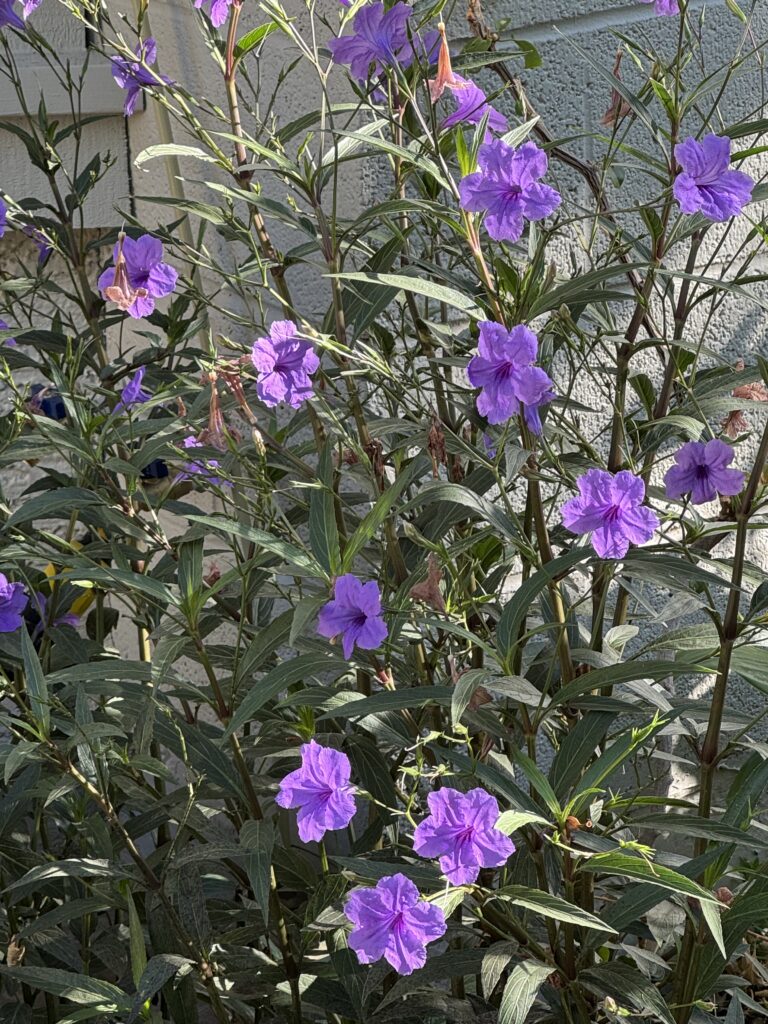
What It Is and Where It Comes From
Ruellia simplex is a herbaceous perennial native to Mexico, Central America, and South America. It belongs to the Acanthaceae family — the same family as shrimp plant and bear’s breech — and has been in cultivation as an ornamental in warm-climate landscapes across the southern United States for decades. You’ll encounter it under several names: Mexican petunia is the most common, though it’s not related to petunias at all. Mexican bluebell, purple ruellia, and Britton’s wild petunia are other common labels. In older nursery tags it may appear as Ruellia brittoniana or Ruellia malacosperma — these are synonyms. Ruellia simplex is the currently accepted name.
The plant evolved in conditions that translate well to Phoenix — hot summers, variable moisture, alkaline and rocky soils, and intense sun. That origin is part of what makes it so vigorous in cultivated landscapes here, and also part of what gives it invasive potential: a plant adapted to thrive in challenging conditions and reproduce prolifically is, by definition, one that doesn’t need much help establishing outside of cultivation.
The ASU plant database describes the standard form as “shrubby, spreading, and a bit unruly… aggressive, tropical” — which is accurate. The standard species grows 3 to 6 feet tall and wide, spreads by underground rhizomes to form expanding colonies, and self-seeds readily. In flood-irrigated Phoenix landscapes, it can literally take over a yard. That vigor is exactly why it was widely planted, and exactly why it became a regulatory problem.
The Variety Question — This One Is Non-Negotiable in Arizona
Arizona lists the standard wild-type Ruellia simplex — the tall, aggressively spreading purple-flowered form — as a noxious weed. It is prohibited from sale, transport, and cultivation under state law. If you find the standard tall form at a nursery in Arizona, that’s a compliance issue worth flagging, and planting it is not a defensible choice regardless of what the nursery label says.
The compact dwarf cultivars are a different legal and practical category. Cultivars like ‘Katie’, ‘Chi Chi’, and ‘Purple Showers’ are selected for compact habit, reduced rhizome spread, and significantly lower seed viability than the standard form. They remain legal to sell and plant in Arizona. The Arizona noxious weed designation does not apply to these cultivars.
For Phoenix landscape use, ‘Katie’ is the cultivar most commonly recommended and most widely available. Here’s the practical breakdown of the main options:
‘Katie’ (Dwarf Ruellia): The standard choice for Phoenix commercial and residential landscapes. Compact habit — 10 to 12 inches tall and 12 to 18 inches wide. Lavender-purple flowers. Fibrous, shallow root system without the aggressive rhizomes of the standard form. Heavy continuous bloom from spring through fall. This is the cultivar to specify when you say “Ruellia” in a Phoenix landscape context.
‘Chi Chi’: Similar compact habit to ‘Katie’ with pink flowers rather than purple. Good choice where warm pinks are preferred over lavender-purple. Same reduced invasive characteristics as ‘Katie’.
‘Alba’ / ‘Mayan White’: White-flowered dwarf cultivar. Slightly less common but available at specialty nurseries. Works well as a contrast plant in mixed border plantings where the purple and pink forms are also used.
The standard tall form — whatever it’s labeled — is not the right plant for a Phoenix landscape. The compact cultivars are. This is a case where variety selection is not a preference; it’s a legal and ecological requirement.
Appearance and Growth Habit
The ‘Katie’ cultivar and similar dwarf forms grow as low, dense, clumping mounds — 10 to 12 inches tall and spreading 12 to 18 inches wide. The leaves are long, narrow, lance-shaped, and dark green to purplish-green, arranged along upright to arching stems. The overall texture is fine and somewhat tropical in appearance — lush and full during the growing season, which gives it a quality that’s different from the gray-green or silver palette of most desert-adapted plants.
The flowers are the main event: trumpet-shaped, flared at the mouth, about 1.5 inches across, appearing in clusters along the stem. Each individual flower lasts only a day — they open in the morning and drop by evening — but the plant produces them in such continuous abundance that it appears to be in perpetual bloom. Purple is the most common color in the ‘Katie’ form (lavender to violet-purple), with pink and white available in other cultivars. Butterflies find them reliably throughout the bloom season. Hummingbirds visit consistently.
Bloom season in Phoenix runs from spring through fall — roughly April through November — with the heaviest production during the warm months. Unlike Yellow Bells, which eases up slightly during peak summer heat, Ruellia tends to accelerate in summer warmth and produce its most abundant flowering during the hottest months. This makes it particularly useful in August and September when many other flowering shrubs are at a low ebb and the landscape can look tired.
In Phoenix’s warm climate, the dwarf cultivars behave as evergreen to semi-evergreen perennials, holding their foliage through mild winters with some cold damage in harder freeze events. The plant pushes back vigorously from the root crown in spring.
Sun and Heat Tolerance
Ruellia performs in full sun to partial shade — one of the more flexible plants on this list in terms of light tolerance. Full sun produces the most abundant flowering and the most compact form. In partial afternoon shade, the plant grows somewhat looser and taller, flowering remains good, and the foliage tends more toward green than purple-tinged. For commercial planting strips and sunny borders, full sun is the right placement. For spots that get afternoon shade from a building or wall, Ruellia handles it better than most of the other plants in this palette.
Heat tolerance is excellent. Ruellia doesn’t just tolerate Phoenix summer heat — it responds to it with increased flowering. The combination of warm nights and hot days during monsoon season produces the plant’s peak performance window. This is one of the few plants that actually looks better in August than it does in May, which is a meaningful quality for commercial properties trying to maintain visual interest through the summer.
The ASU plant database notes that it thrives with regular irrigation especially during summer — more moisture-demanding than the Australian natives in this plant palette, but appropriate for a plant delivering this level of continuous color output during the hottest months.
Water Needs
Moderate water — more than Outback Sunrise Emu Bush or Mulga Acacia, comparable to Yellow Bells. Ruellia performs best with consistent moisture during the growing season, particularly in summer when it’s at peak bloom. Deep watering every week to ten days during summer maintains good appearance and flowering. In the cooler months, reduce frequency as the plant’s active growth slows.
Once established, the dwarf cultivars have reasonable drought tolerance and can handle gaps in irrigation better than their lush appearance suggests. A well-established ‘Katie’ plant doesn’t immediately decline if it misses a watering cycle. That said, chronic drought stress shows in reduced flowering and eventual tip dieback — this plant does better with regular moisture than with deliberate water restriction.
One important note from the ASU plant database: how water is delivered matters. In flood-irrigated landscapes, even the standard form’s rhizome spread becomes more aggressive — excess moisture encourages underground runners to expand rapidly. With drip irrigation, water is delivered to a defined zone and the plant stays within more predictable bounds. Drip is the right irrigation approach for Ruellia in any cultivated landscape setting, both for managing plant spread and for water efficiency.
Well-draining soil matters. Ruellia handles a range of moisture conditions but does not thrive in waterlogged or poorly draining ground. Crown rot is a risk in heavy clay soils that stay wet. Good drainage at the planting site is the baseline requirement.
Soil and Fertilizing
Ruellia is highly adaptable to Phoenix soil conditions — alkaline, rocky, low-organic-matter soils are not a problem. It establishes quickly in native soil without extensive amendment. The combination of heat tolerance, alkaline soil tolerance, and adaptability to variable moisture makes it one of the easier plants to establish in challenging commercial landscape conditions.
Light fertilizing in spring supports the push of new growth after any winter dieback. A balanced slow-release fertilizer or compost topdress in early March is appropriate. Avoid high-nitrogen inputs — they push excessive vegetative growth at the expense of flowering, the opposite of what you want from a plant chosen primarily for its bloom output.
Organic mulch over the root zone — 2 to 3 inches, pulled back from the crown — moderates soil temperature, retains moisture between irrigations, and reduces weed pressure in the gaps between plants during establishment.
Planting Guide
Best time to plant in Phoenix: Spring — March through April — after cold risk has passed. Ruellia establishes quickly in warm soil and will be in full bloom by summer. Fall planting in September through October also works, giving roots time to establish before the plant pushes into peak bloom the following summer.
Spacing for ‘Katie’ and dwarf cultivars: 12 to 18 inches apart for a dense border or edging effect that fills in within one growing season. 18 to 24 inches apart for a mass planting where slightly slower fill-in is acceptable. The compact habit means these plants don’t need as much room as the standard form — the 10 to 12 inch height and 12 to 18 inch spread stays manageable without constant correction.
Placement: Full sun for maximum flowering, though partial afternoon shade is workable. Well-suited for the front of planting beds as a low border, along pathway edges at appropriate distance from foot traffic, and as a color layer in front of taller shrubs. Works particularly well as the low-growing element in front of Yellow Bells or similar mid-height flowering shrubs — the complementary flower colors and overlapping bloom seasons produce a layered color combination that performs from spring through fall.
Always verify the cultivar at purchase: Before buying anything labeled “Ruellia” or “Mexican petunia” in Arizona, confirm it is a named compact cultivar — ‘Katie’, ‘Chi Chi’, ‘Purple Showers’, ‘Mayan White’, or similar. If the plant is tall (over 18 inches at the nursery), has no cultivar name on the tag, or is described as the standard species without a named cultivar, don’t buy it.
Pruning and Maintenance
The dwarf cultivars are low maintenance by the standards of flowering perennials. The main tasks:
No deadheading required: Individual flowers drop on their own each day and new ones replace them continuously. Unlike Yellow Bells, where removing seed pods improves performance, Ruellia doesn’t require deadheading to maintain its bloom cycle. This is one of its practical advantages for commercial settings where maintenance frequency matters.
Late winter cutback: Cut the clump back to 3 to 4 inches from the ground in February — after the coldest nights have passed and before new growth begins. This removes old woody stems, any freeze-damaged growth, and sets up the plant to push fresh dense growth into spring. Without this annual reset, the plant accumulates woody base material and becomes progressively less vigorous. With it, the plant performs almost like new each year.
Light shaping during the season: If the clump is getting wider than the planting space allows, trim the outer stems back to a lateral node to maintain the desired footprint. The compact cultivars don’t require constant management, but occasional light trimming keeps the planting looking intentional rather than sprawling.
Division: Well-established clumps that have been in the ground several years can be divided in late winter at the same time as the annual cutback. Dig and split the clump, replant the vigorous sections, and discard the center if it’s woody and unproductive. Division extends the plant’s productive life and generates additional plants for expanding a planting.
What to avoid: Shearing into a rounded ball or flat hedge form — same problem as with most plants in this palette. The natural clumping habit looks intentional. A sheared surface looks artificial, creates a dense outer shell over an empty interior, and reduces flowering by removing the stem tips where new buds form.
Common Problems
Wrong cultivar spreading aggressively: The most significant problem with Ruellia in Phoenix landscapes is not a pest or disease — it’s planting the wrong variety. If a Ruellia planting is spreading by underground runners well beyond its original footprint and producing seedlings throughout the surrounding landscape, it is almost certainly not one of the compact cultivars. Remove and replace with a named dwarf cultivar. This is a variety selection error, not a management challenge.
Reduced flowering in shade: Ruellia in too much shade produces fewer flowers and looser, taller growth. Relocate to a full sun position or accept reduced flowering as a characteristic of the shade placement. The plant survives in shade; it just doesn’t bloom at the same level.
Freeze damage: Leaf and stem damage in cold winters is normal. Don’t cut until new growth is emerging — usually February to March in Phoenix. The late winter cutback handles freeze cleanup at the same time as the seasonal reset. Established plants almost always push back from the root crown even after significant top kill.
Crown rot: In consistently wet or poorly draining soil. Drip irrigation, adequate drainage at planting, and keeping mulch pulled back from the crown all prevent this. Rare in well-managed drip-irrigated plantings.
Aphids on new growth: Occasionally appear in spring when new growth is pushing rapidly. Usually self-resolving as the season progresses and the growth hardens off. A strong water spray handles minor infestations. Not a persistent or serious pest concern for established plants.
Why Ruellia Works as a Color Layer in Phoenix Commercial Landscapes
The compact Ruellia cultivars fill a specific role in the Phoenix commercial landscape palette that very few other plants handle as well — a low, dense, continuous-blooming color layer that performs through summer heat rather than declining during it.
Most flowering shrubs in Phoenix have a reliable spring flush, a strong fall second wind, and a quieter summer period in between. Ruellia runs against that pattern. It blooms heavily in spring, continues through summer, and doesn’t taper off until fall temperatures drop. During August — when commercial properties often look their worst and the landscape can look uniformly tired and brown — a well-established mass planting of ‘Katie’ Ruellia is producing hundreds of fresh purple flowers daily.
Paired as the front layer in front of mid-height flowering shrubs, used as a continuous edging along planting strips and borders, or massed in the space between taller plants and a walkway edge, the dwarf cultivars add a level of color density and consistency that makes a commercial landscape look actively managed and intentional rather than surviving until cooler weather arrives.
Frequently Asked Questions
Is Ruellia illegal in Arizona?
The standard wild-type form — the tall, aggressively spreading purple-flowered species — is listed as a noxious weed in Arizona and is prohibited from sale and cultivation. The compact dwarf cultivars, including ‘Katie’, ‘Chi Chi’, and ‘Purple Showers’, are not covered by the noxious weed designation and remain legal to sell and plant. Always verify you’re buying a named compact cultivar.
Which cultivar should I use in Phoenix?
‘Katie’ is the most widely available and most commonly recommended compact cultivar for Phoenix landscapes — 10 to 12 inches tall, lavender-purple flowers, non-invasive habit, and available at most Valley nurseries. ‘Chi Chi’ is a good alternative where pink flowers are preferred. For any commercial application, specify the cultivar name on the plant order to ensure you’re getting the right plant.
Does it need deadheading?
No. Individual flowers open in the morning and drop by evening on their own. New flowers replace them continuously throughout the bloom season. This is one of the practical advantages of Ruellia for commercial settings — it delivers continuous color without requiring a deadheading maintenance pass.
How does it perform in summer heat?
Better than most flowering plants. Ruellia typically accelerates its flowering during the warm monsoon months rather than slowing down. August and September — when much of the landscape is at a low ebb — are often the peak bloom period for established Ruellia plantings. This is one of the key reasons it earns a place in a low-maintenance commercial color palette.
Can I plant it next to Yellow Bells?
Yes — and it’s a particularly good combination. The complementary flower colors (purple and yellow), similar heat tolerance and care requirements, overlapping bloom seasons, and different heights (Ruellia at 10 to 12 inches, Yellow Bells at 5 to 8 feet) produce a layered, high-color planting that performs across the full season. The ASU plant database specifically notes that Ruellia works well with Tecoma stans for exactly this reason.
How long does it live?
The compact cultivars are long-lived perennials — 10 to 20 years in Zone 9B conditions with appropriate care. The annual late-winter cutback and occasional division are the management practices that keep the plants vigorous across that lifespan. Without the annual reset, plants become increasingly woody and less productive over time, which is often mistaken for the end of the plant’s useful life when the correct response is division and renewal.