
Red Push Pistache is a hybrid shade tree with a wide, rounded canopy and fall color in reds and yellows. It’s desert adapted, and it’s my first pick when a west wall needs shade. If you have room for a big tree, it’s worth planting here.
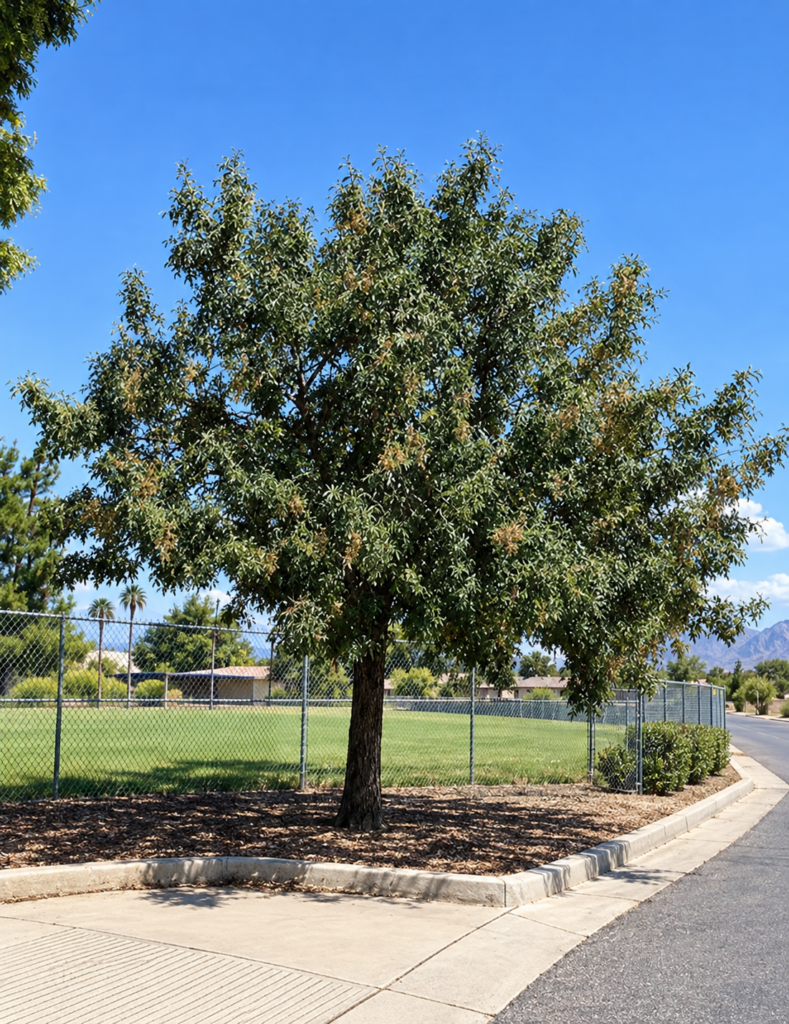
Quick Facts
- Sun: Full sun
- Water use: Moderate, and less than plants that aren’t desert adapted
- Mature size: About 40 feet tall and 35 feet wide
- Growth rate: Moderate
- Leaves: Deciduous
- Bloom: Not showy. Fall color in reds and yellows
- Native or desert adapted: Desert adapted
- Wildlife: None noted
- Frost: Handles our winters
Where It Works in Your Yard
Red Push wants full sun and room to reach its full size. Before you dig, check the space around overhead power lines, underground utilities, buildings, fences and walkways. Plan for about 40 feet of height and 35 feet of spread.
The west side of the house is where I like it best. A tree on the east or west side shades your home in summer. Because Red Push is deciduous, winter sun reaches your walls again once the leaves drop.
If you’re also planning a privacy hedge, our posts on Hopseed Bush and Arizona Rosewood cover two native options.
Planting It Right
Plant in fall or spring. Dig the hole no deeper than the root ball, so the root flare sits at grade. The root flare is where the trunk widens at the base.
Backfill with your native soil and a little compost. Lay compost on top, then mulch over it, keeping the mulch a foot back from the trunk.
Skip the big boxed tree. A 15 gallon or smaller tree usually does better long term. The University of Arizona’s tree irrigation study planted Red Push from 15 gallon containers, and the trees established well.
Watering
Water deep and less often, so moisture reaches the whole root zone instead of just the surface.
Give the first 8 weeks extra attention. Check the soil often. Don’t treat week 9 as the finish line. The University of Arizona kept its study trees well watered through their first year and a half.
Don’t skip watering after a rain. Desert rain rarely soaks in deep enough.
Red Push takes less water than plants that aren’t desert adapted. In that same study, established trees did well with summer watering every 8 to 14 days. Each watering was about 50 gallons, wetting a circle roughly 6 feet across and 2 feet deep. The trees also handled half as much water in winter.
That was one research site in Maricopa County, so your soil and exposure will shift the numbers. As your tree grows, widen the area you water. The roots reach well past the original root ball.
Feeding the Soil
A big tree runs on healthy soil. Build soil biology with quality compost, worm castings and a good organic fertilizer. Keep the compost layer under the canopy topped up as it breaks down. We don’t use synthetic fertilizers.
Care and Pruning
Keep the mulch refreshed, and keep it a foot back from the trunk.
On a young tree, pruning is about structure. Focus on building a strong, well-spaced branch framework. What you do early shapes the tree for decades.
Once the tree is mature, pruning is mostly basic maintenance. Cut out dead, broken or diseased wood. Remove branches that cross or rub against each other, and take out limbs that grow downward.
The best window is late fall through early spring, while the tree is dormant.
Watch-Outs
Red Push drops its leaves in winter, so plan on seasonal cleanup. Fall color also tends to show up late here. Expect it closer to December than October.
The most common mistake is planting too deep. Check the root flare before you backfill, and again after the tree settles.
Want help choosing the right spot or getting your soil ready? Book a consult with The Garden Nerd or join the Garden Nerd Club.
Sources
- Arizona Municipal Water Users Association, Chinese Pistache plant page: amwua.org/plants/chinese-pistache
- Arizona Municipal Water Users Association, Trees category page: amwua.org/plant-category/trees
- Arizona Municipal Water Users Association blog, “5 Trees To Shade Your Desert”: amwua.org/blog/5-trees-to-shade-your-desert
- University of Arizona Cooperative Extension, “A Study of Irrigation Requirements of Southwestern Landscape Trees” (az1741): extension.arizona.edu/sites/extension.arizona.edu/files/pubs/az1741-2017.pdf