
Your Yard, Planned Out
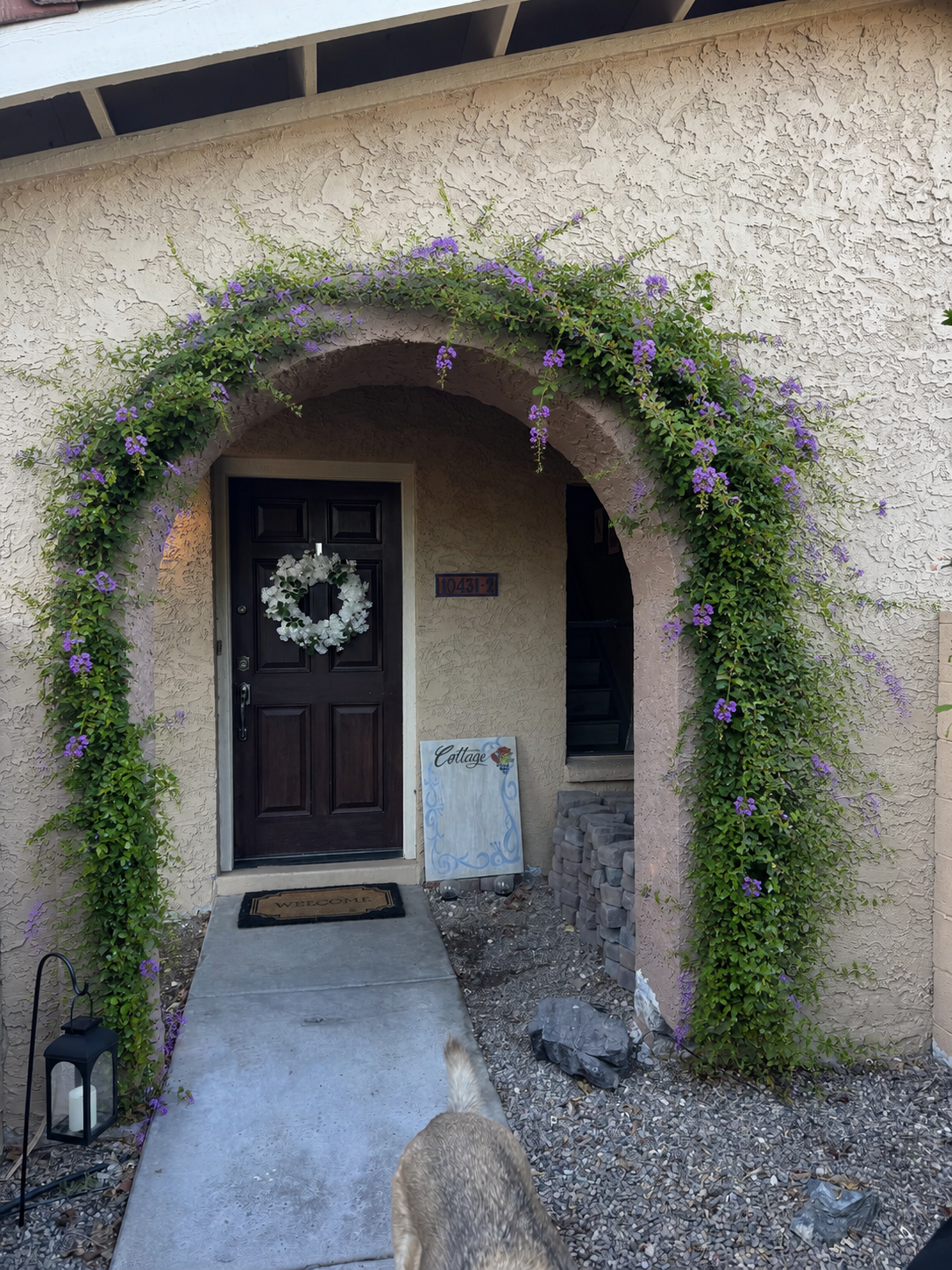
A look at where this plan is headed. Skyflower vine over the front archway.
Below is the plan we walked through together, zone by zone: what's going in, why that spot calls for it, and what it should look and feel like once it's grown in. Mockups are dropped in below so you can see a few key spots ahead of time.
A few of the plants recommended below are on your HOA's approved list, and a few aren't. None of them are invasive, messy, or visually out of the ordinary, so I'd be surprised if it drew any attention, but if you'd rather stay strictly within the HOA list, let me know and I can swap in alternatives.
I'm also happy to write a letter to the HOA about getting those trees trimmed properly and about proper irrigation, just say the word.
1Foundation Work
Before anything goes in the ground, we get the yard's systems right.
Irrigation Repair
Every zone below depends on water reaching it reliably. New plantings are at their most vulnerable in the first several months, so we're fixing irrigation first rather than working around a broken system and hoping it holds.
Mulch, Yard-Wide
Roughly 4 to 5 cubic yards to cover the full yard. This is what gives the whole property a consistent, finished look from day one, even before any new plant has filled in. Underneath that, it's protecting soil biology, holding moisture, and buffering soil temperature swings, which matters a lot in our heat.
2Trees First
Trees are the slowest thing in this plan to establish and they set the overall shape and shade pattern that everything else grows into, so we're handling them before the smaller plantings.
Moringa Maintain
Cut back hard each year. We'll do this cutback at fall planting time.
Guava Maintain
Prune at fall planting time.
3Trellis
Tangerine Crossvine New Planting
Why here: The trellis needs a vine with real climbing vigor and something that adds seasonal color and life above eye level, not just green coverage. Tangerine crossvine does both.
How it will look: As it matures, expect the trellis to fill in with dense evergreen foliage and clusters of orange-red trumpet flowers each spring, drawing hummingbirds regularly. Once established, it reads less like a bare structure and more like a living archway of its own.

Tangerine crossvine in bloom
4Front Walkway
Yellow Dot Ground Cover New Planting
Why here: The existing rock along the walkway doesn't need to be torn out to get a softer, greener look. Yellow Dot roots as it spreads, so it takes hold right over the rock instead of needing bare soil, which saves the cost and disruption of removal.
How it will look: Expect a low, spreading mat of green with small yellow blooms scattered through most of the year, gradually softening the hard edge of the rock underfoot as you walk to the front door. It handles the mix of sun and shade along the walkway well, so coverage should be even rather than patchy.

Yellow dot ground cover, established
5Existing Shrubs Near the Walkway
Barbados Cherry & Hibiscus Maintain
Both could use a good trim. We'll handle that at planting time, alongside the walkway work.
6Front Door Archway
Skyflower Vine, Both Sides New Planting
Why here: The archway is the first real framing moment at the front door, and a single vine planted on each side is what lets it eventually read as one connected feature rather than two separate plants.
How it will look: Over time, both plants grow up and over the archway and meet in the middle, forming a continuous arc of foliage and small purple-blue flowers over the entry. See the mockup below for roughly how that should look once it fills in.
Skyflower vine over the front archway
7Nook Behind the Archway
Statement Tropical Planting New Planting
Why here: This little nook, where the pavers currently sit, is unusually well protected compared to the rest of the yard. That kind of shelter is rare in a Phoenix landscape, and it opens the door to something more tropical than what would survive out in the open.
How it will look: A monstera keeps this feeling intimate and jungly at a smaller scale, staying tucked into the nook. A giant bird of paradise would read as a bigger architectural statement, with tall banana-like leaves visible as you round the corner past the archway. Either way, this becomes a small surprise moment rather than blending into the rest of the front yard.

Monstera

Giant bird of paradise
8Long West-Facing Wall
Queen's Wreath / Coral Vine New Planting
Why here: This is the longest wall in the yard, and it needed one cohesive treatment rather than a patchwork. A hedge would look good too, but it would eat noticeably into usable yard space along that whole length. A vine gets the same visual coverage while keeping the ground underneath open. This is also the vine you'd already flagged as a favorite, which lines up well with what the wall needs.
How it will look: Once established, expect the wall to disappear behind a wash of green covered in pink flower clusters through the warm months, essentially becoming a living backdrop for that whole side of the yard. It thins out and dies back some in winter, which is normal, and comes back strong in spring.

Vine coverage concept for the west wall (generic vine shown, gives a sense of coverage rather than the exact bloom)
9Shorter North-Facing Wall, Off the Back Patio
Star Jasmine New Planting
Why here: This wall's north orientation is a good match for star jasmine, and its position right off the back patio means the fragrance actually reaches you day to day, not just when you're standing next to it.
How it will look: A dense evergreen backdrop against that shorter wall, with small white star-shaped flowers in spring and early summer. On cooler days with the patio door open, that fragrance carries right into the house, which is really the point of putting it here.

Star jasmine in bloom
10Front of House
Existing Vine (Long & Lanky) Maintain
Why here: It's already in a good spot and doing its job. It just needs a hard prune and reset rather than a replacement.
How it will look: It'll look aggressively cut back for a little while right after, but that's what forces denser, healthier regrowth instead of it continuing to stretch out long and thin. Better to take that short-term hit now.
Remaining Trees & Shrubs Along the Front Maintain
All good candidates to keep as-is. The plan is a corrective prune on each to get them back into good shape, not a replacement.
11Possible New Tree
East-Facing Wall, Off the Back Patio Under Consideration
Why here: This is genuinely the only spot left in the yard where a tree might make sense, but it's a tight, awkward space right up against the house, so it's flagged as a maybe rather than a firm plan.
How it will look: If we go this route, a desert willow or another small ornamental would add some vertical interest and shade to that corner without overwhelming the space. Worth deciding once the rest of the yard fills in and we can see how much room actually feels available.
How it all fits together: Walking up, the yellow dot softens the walkway underfoot, leading to the skyflower-framed archway at the door, with the tropical nook as a small surprise just past it. Around back, the two treated walls do most of the work: the west wall becomes a long green and pink backdrop behind the coral vine, and the shorter north wall by the patio adds fragrance right where you'll actually be sitting. The front of the house stays largely as-is, just cleaned up. Once it's all in and grown a season, we'll have a much clearer sense of where, if anywhere, that east wall tree actually makes sense.
Perimeter border, roughly 2 feet deep, along the walls. Smaller shrubs here, more canna lily among them. This is a good longer-term addition. My suggestion would be to hold off until the vines and everything else has filled in, since adding it now would tighten the yard's usable space more than necessary, but happy to talk through moving on it sooner if you'd rather. If we do go this route, it's a possibility we'd bring in Garrett to help with, nothing set in stone yet.
Once the mulch is down and everything above is planted, we can also take a look at adding a walkway through the yard, flagstone of some sort is worth considering. Another good one to revisit once we see how the space feels with the new planting in.