
Cenchrus setaceum ‘Rubrum’ (formerly Pennisetum setaceum ‘Rubrum’) | Also called: Purple Fountain Grass, Red Fountain Grass
Few ornamental grasses do what Fountain Grass does in a Phoenix landscape — a dense, arching mound of deep burgundy-purple foliage topped with feathery rose-pink plumes from late spring through fall, moving with every breeze, catching morning and afternoon light in a way that few plants can match. It’s been a fixture in Valley landscapes for decades, and when it’s planted and managed correctly, it earns its place repeatedly.
But Fountain Grass also comes with more nuance than most landscape plants, and that nuance is worth understanding before you plant it. There are two very different plants that share the “fountain grass” name — one of which is a listed noxious weed in Arizona that can no longer legally be sold. The other — purple fountain grass, the ‘Rubrum’ cultivar — is still in active landscape use, still available at nurseries, and still a legitimate design choice when used thoughtfully. The difference between them matters, and so does the ongoing conversation about what “sterile” actually means in practice.
This post covers the purple cultivar specifically — what it is, how it performs, how to manage it well, and what you need to know about the invasive question before you decide whether it belongs in your landscape.
Two Plants, One Name — What You Need to Know
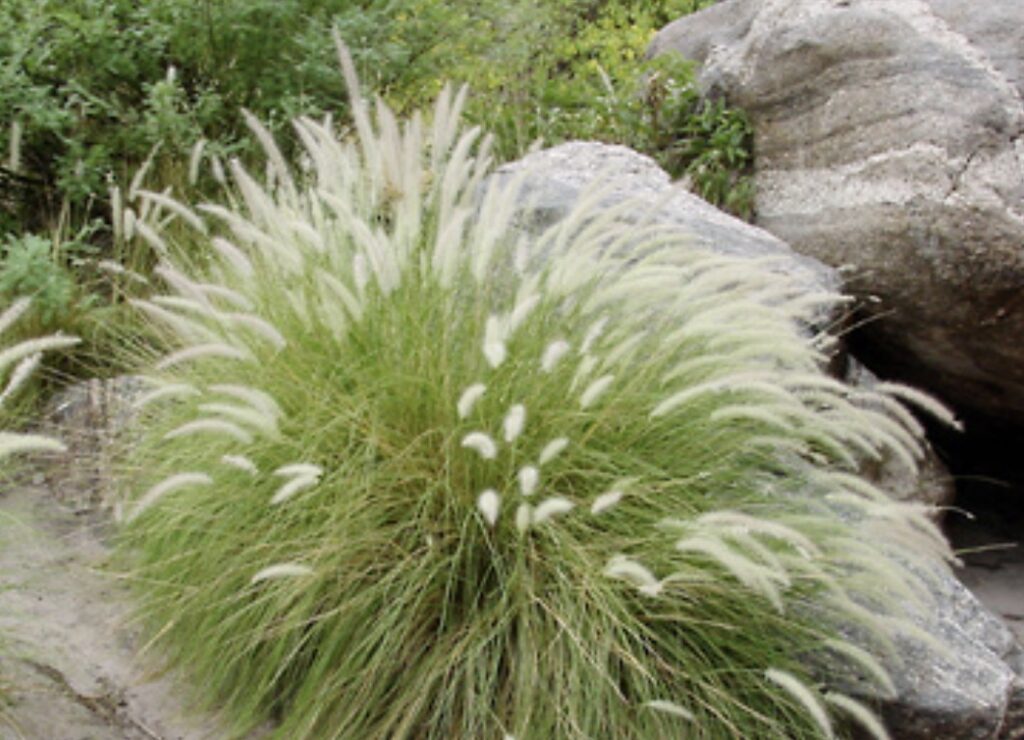
Green fountain grass (Cenchrus setaceum, formerly Pennisetum setaceum) was widely planted in Phoenix landscapes starting in the mid-20th century before its invasive potential was understood. It produces viable seed prolifically, spreads aggressively into the surrounding Sonoran Desert, and competes with and displaces native plants and grasses. Arizona officially listed it as a noxious weed in 2020. It can no longer legally be sold at nurseries in the state. If you see green fountain grass at a nursery in Arizona, that’s a problem worth flagging.
Purple fountain grass — the ‘Rubrum’ cultivar — is a different story, at least legally and in most practical contexts. It’s a selection with deep burgundy-purple foliage that is widely described as sterile, meaning it doesn’t produce viable seeds and therefore can’t naturalize outside of cultivation. The Arizona noxious weed ban does not apply to ‘Rubrum’. It remains legal to sell and plant in Arizona, and it’s in active use in commercial and residential landscapes across the Valley.
The sterility claim deserves honest treatment, though. The ASU plant database notes that the purple variety “tends to rarely reseed” — not that it never does. The Desert Botanical Garden has raised concerns that the sterility of ‘Rubrum’ has been overstated and that plants can still disperse viable seeds under some conditions. The National Park Service recommends against planting any variety of fountain grass near natural desert areas for this reason. The expert consensus is not “purple is completely safe” — it’s “purple is meaningfully less invasive than green, and legal, but use it with some awareness of context.”
The practical takeaway: purple fountain grass is a legitimate landscape choice in cultivated, maintained urban settings — commercial properties, residential yards, established landscape beds — where it’s being managed and isn’t adjacent to undisturbed natural desert. It is not the right choice for properties bordering open desert, riparian areas, or natural habitat. Context matters.
Appearance and Growth Habit
Purple Fountain Grass forms a dense, upright, arching mound — 3 to 5 feet tall and 3 to 4 feet wide — with narrow, linear blades in deep burgundy to reddish-purple that arch outward and downward from the crown in the characteristic fountain shape that gives the plant its name. The foliage color is one of the more dramatic available in a Phoenix landscape palette dominated by green and gray-green — it reads as a distinct accent from a distance and catches light differently than almost anything else at the same scale.
The flower plumes appear from late spring through fall — feathery, bottlebrush-shaped spikes 10 to 14 inches long in rose-pink to purple that sit above the foliage on arching stems and move visibly in even light wind. The plumes emerge in summer, mature through the season, and fade to a warm tan-buff by fall and winter. Even the faded winter plumes have a quiet visual quality — the movement and texture persist even without the summer color.
In Phoenix’s warm climate, purple fountain grass behaves as a perennial — it doesn’t die back to the ground each winter the way it does in colder climates. The foliage may look tired by late winter and the clump will benefit from being cut back at that point, but the plant itself persists and pushes fresh growth in spring. Over several years, established clumps get denser and larger — which is when division becomes useful.
The texture fountain grass provides — fine, linear, moving — is genuinely different from the broad-leaved shrubs and trees that dominate most Phoenix landscape palettes. This is its core landscape value: it introduces a visual quality that nothing else in the standard palette delivers, and it does it at a scale (3 to 5 feet) that fits between ground covers and the canopy layer without competing with either.
Sun and Heat Tolerance
Full sun is the requirement. Purple fountain grass needs at least six to eight hours of direct sun to develop its characteristic color and full, dense form. In part shade it grows, but the foliage color fades — the deep burgundy washes out toward green-bronze — and the plant gets looser and more open rather than the tight, dense mound that makes it visually effective. Full sun, including the reflected heat from hardscape in commercial settings, produces the best performance.
Heat tolerance is high. This is a warm-season grass — it thrives in summer and goes relatively quiet in winter — and Phoenix’s summer heat is not a problem for an established plant. It’s one of the better grasses for the combination of full sun and reflected heat that characterizes parking lot islands, street edges, and commercial planting strips.
Cold is the limit. Purple fountain grass is hardy to approximately Zone 9, which is the lower edge of Phoenix’s comfort zone. In normal Phoenix winters it stays evergreen or semi-evergreen with minimal damage. In harder cold events it may show significant leaf damage or die back to the crown. It almost always pushes back from the roots in spring — but the clump may look rough through late winter, which matters for commercial properties where year-round appearance is a priority. Siting it in locations with some thermal protection — adjacent to south or west walls, near hardscape that retains daytime heat — helps it through cold events.
Water Needs
Moderate drought tolerance once established — more than a lawn or tropical planting, less than a Desert Ironwood or Mulga Acacia. Purple fountain grass does best with regular deep watering every one to two weeks during the growing season. It handles gaps in irrigation better than most non-desert plants, but consistent moisture during the active growth period produces fuller, healthier clumps with better color and more abundant plumes.
During establishment — the first growing season — water more frequently, every few days initially, tapering as the root system develops over the first two to three months. Young plants are more vulnerable to heat stress before the roots have established the capacity to keep up with transpiration demand in Phoenix summer temperatures.
Well-draining soil is important. Purple fountain grass does not tolerate consistently wet or waterlogged conditions — root rot is a real risk in heavy clay soils with poor drainage or in planting areas with irrigation systems set to water too frequently. The goal is consistent moisture with good drainage between waterings, not chronic saturation.
In winter, reduce irrigation significantly. The plant is largely dormant or slow-growing in the cooler months and does not need the same moisture inputs as during the active growing season.
Soil and Fertilizing
Purple fountain grass tolerates a wide range of soil conditions — including Phoenix’s typical alkaline, low-organic-matter soils — as long as drainage is adequate. No heavy soil amendment at planting is required. Native soil backfill with modest organic amendment is appropriate.
Fertilizing needs are minimal. Most ornamental grasses, including fountain grass, perform well without regular fertilizer inputs once established. A light application of balanced slow-release fertilizer in early spring — or a compost topdress around the base — supports the push of new growth that follows the late-winter cutback. Avoid high-nitrogen fertilizers, which push excessive soft vegetative growth that flops and reduces the tight, dense form that makes the plant look good.
Organic mulch over the root zone — 2 to 3 inches, pulled back from the crown — moderates soil temperature, retains moisture between irrigations, and feeds soil biology as it breaks down. Standard good practice for any ornamental grass in a Phoenix landscape.
Planting Guide
Best time to plant in Phoenix: Spring — March through April — or early fall — September through October. Spring planting gives the plant a full warm season to establish before its first winter. Avoid planting in peak summer heat; young plants in their first weeks after transplant are vulnerable to heat stress before the roots are established.
Spacing: 3 to 4 feet between plants for individual specimens or accent groupings. For mass plantings where a continuous sweep of texture and color is the goal, 2 to 3 feet apart fills in within one growing season. The 3 to 4 foot mature spread means plants tighten spacing faster than expected — give them room.
Placement: Full sun locations with adequate air circulation. Don’t crowd fountain grass against walls or adjacent plants where airflow is restricted — good air circulation reduces the risk of fungal issues in the crown. In commercial settings, it works well as a mid-height accent between ground cover and tree canopy, in mass plantings along fence lines or property edges, and as a textural contrast to broad-leaved flowering shrubs.
Planting depth: At grade, no deeper than the root ball. Crown rot is a risk if the crown is buried. Set level with or very slightly above the surrounding soil and backfill carefully.
Pruning and Maintenance
The single most important maintenance task for purple fountain grass in Phoenix is the annual late-winter cutback, and the most common mistake is either skipping it or doing it wrong.
Annual cutback: Cut the clump back to 4 to 6 inches from the ground in late winter — February in Phoenix, after the coldest nights have passed and before new growth begins pushing. This removes the tired, faded foliage and plumes from the previous season and sets up the plant to push fresh, dense growth into spring. Without this annual reset, the clump accumulates dead interior growth, loses its tight form, and gradually becomes a ragged, open mound with flowering concentrated only at the outer edges.
How to cut: Gather the clump into a bundle and cut across with hedge shears or a reciprocating saw for large, dense clumps. The cut doesn’t need to be precise — 4 to 6 inches from the ground and clean. New growth emerges from the crown regardless of exactly where the cut lands within that range.
What not to do: Don’t shear the outer growth throughout the season to maintain a rounded shape — this produces the same problem it does with most plants: a dense outer shell of foliage over an increasingly dead interior, and a shape that looks artificial rather than the natural arching mound that makes fountain grass visually effective. The annual hard cutback and then leaving it alone for the growing season is the right approach.
Division: Established clumps that have been in the ground for three to five years get large and may begin to die out in the center — a normal pattern for ornamental grasses. Divide in late winter at the same time as the annual cutback. Dig the clump, split it into sections with a sharp spade or saw, and replant the vigorous outer sections. Division rejuvenates the plant and gives you additional plants for expanding a planting or filling gaps elsewhere.
Plume removal: Optional. The plumes are ornamental through summer and the faded tan-buff plumes add winter texture. If they become messy or the planting needs a cleaner look, remove individual plumes by pulling or cutting them at the base. The annual cutback handles the rest.
Common Problems
Faded foliage color: The deep burgundy color requires full sun. Plants in part shade or too much competition from adjacent plants show washed-out, greenish foliage rather than the characteristic purple-red. Relocate to a full sun position if foliage color is disappointing.
Open, floppy clump: Usually the result of skipping the annual cutback, too much shade, or overwatering that pushes excessive soft growth. The fix is the annual hard cutback in late winter, full sun positioning, and appropriate irrigation. A plant that’s been neglected for several seasons may need a hard reset — cut it back, reduce water, and let it rebuild from the crown.
Crown rot: From consistently wet soil, poor drainage, or a crown that was buried too deep at planting. Ensure good drainage at the planting site and keep the crown at or above grade. Don’t pile mulch against the crown.
Spider mites: Can appear during hot, dry conditions — May and June before monsoon are the most common window. Look for fine webbing and stippled, dull foliage. A strong water spray disrupts mite populations; insecticidal soap handles heavier infestations. Usually manageable without systemic treatment.
Winter dieback: In hard freeze events, the foliage may die back significantly. Don’t cut until new growth is emerging from the crown — usually February to March in Phoenix. The annual cutback timing handles freeze damage cleanup at the same time as the seasonal reset.
Slow regrowth after cutback: If a clump is slow to push after the late-winter cut, it’s either an older clump that would benefit from division, or it was cut too early while cold nights were still possible. Wait for consistent warm soil temperatures — mid-February through March in Phoenix — before cutting. Early cutting in January can slow the spring push if cold nights continue after the cut.
A Note on Responsible Use in Phoenix
Purple fountain grass is in wide active use in Phoenix commercial and residential landscapes, and for maintained, cultivated settings it’s a legitimate choice. The context that matters is proximity to natural desert. On properties that border undisturbed Sonoran Desert, open desert washes, or natural habitat areas, the conservative choice is to select an alternative that carries no invasive risk at all — deer grass (Muhlenbergia rigens), sacaton (Sporobolus wrightii), or other native or non-invasive ornamental grasses deliver similar texture and movement without the concern.
For urban commercial properties, established residential neighborhoods, and maintained landscape settings well separated from natural desert, purple fountain grass continues to be used effectively and legally. Know your site, know your context, and make the call accordingly.
Frequently Asked Questions
Is purple fountain grass invasive in Arizona?
Green fountain grass (Cenchrus setaceum) is a listed noxious weed in Arizona and can no longer legally be sold in nurseries. Purple fountain grass (‘Rubrum’) is a different cultivar widely described as sterile and is still legal to sell and plant. That said, some experts note that ‘Rubrum’ sterility has been overstated and plants can occasionally produce viable seeds. The conservative guidance is to use it in maintained urban settings and avoid planting it near undisturbed natural desert.
How do I tell green fountain grass from purple?
Foliage color is the clear distinguisher. Green fountain grass has green blades. Purple fountain grass (‘Rubrum’) has deep burgundy-red to purple foliage that’s visible from a distance. At the nursery, look at the plant tag carefully — it should say ‘Rubrum’ or purple fountain grass. If a “fountain grass” is green, don’t buy it in Arizona.
When should I cut it back?
Late winter — February in Phoenix, after the coldest nights have passed and before new growth begins. Cut the clump to 4 to 6 inches from the ground. This is the single most important maintenance task for keeping fountain grass looking good year after year.
How long do the plants last?
In Phoenix conditions, purple fountain grass typically performs well for three to five years before clumps begin to open up and die out in the center — a normal pattern for ornamental bunch grasses. Division at that point rejuvenates the plant and extends its useful life. Some well-managed plants last longer; the annual cutback and occasional division are the keys.
Can I plant it near natural desert in Arizona?
The conservative answer is no — or at minimum, use a native alternative instead. Even though ‘Rubrum’ is described as sterile, local invasive species experts have noted that sterility isn’t guaranteed under all conditions, and fountain grass is closely related to buffelgrass, one of the most damaging invasive species in the Sonoran Desert. For properties adjacent to natural desert, deer grass or sacaton are better choices that carry none of the invasive risk.