
Russelia equisetiformis | Also called: Coral Fountain, Coral Bush, Fountainbush, Firecracker Bush
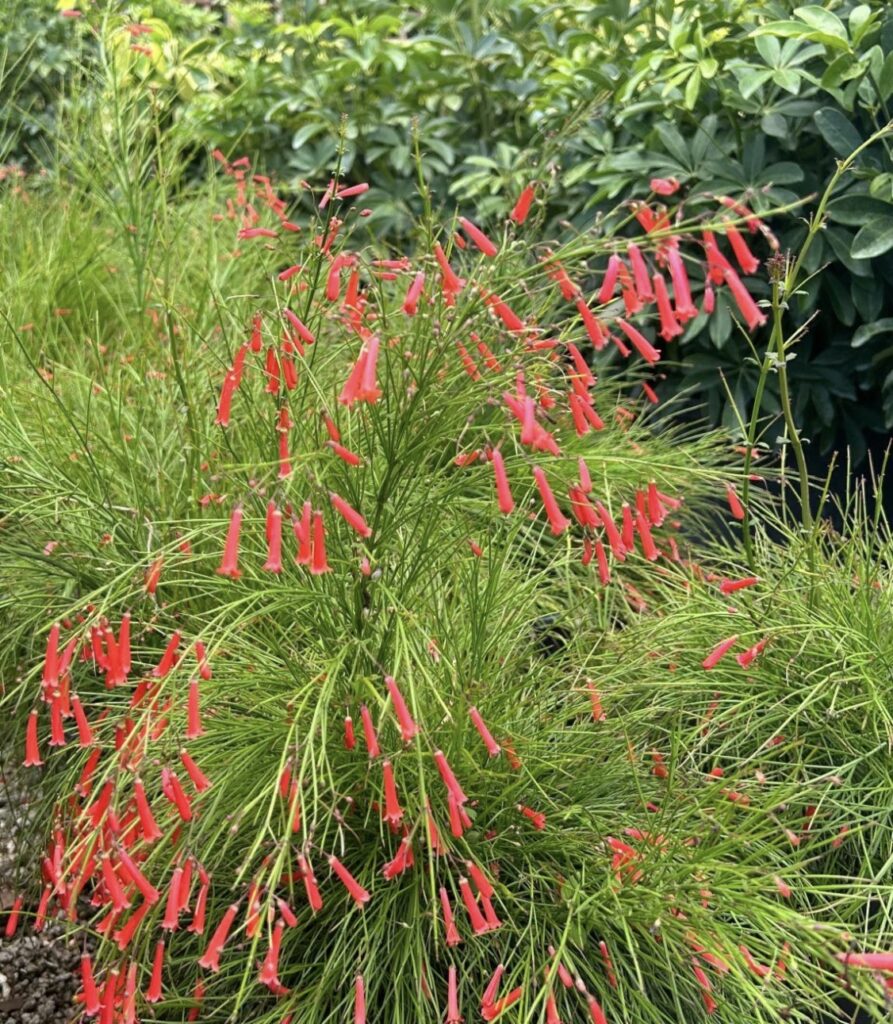
The first time most people see a well-established Firecracker Plant in full bloom, they stop and look twice. The form is unlike anything else in a typical Phoenix landscape — long, arching, rush-like stems that cascade outward and downward from the center, covered in hundreds of small scarlet-red tubular flowers from spring through fall. It reads as movement even when there’s no wind. The ASU plant database describes its character as “wispy, arching and spreading, cascading, informal, free spirit” — which is accurate, and also explains why it requires a different approach than most of the plants in this palette.
Firecracker Plant is not a plant you prune into a shape and maintain. It’s a plant you place correctly, give the right conditions, and let express itself. When you work with its nature rather than against it, it’s one of the most visually distinctive and low-maintenance shrubs available for Phoenix landscapes. When you fight it — trying to shear it into a rounded form or keep it tightly contained — you lose exactly the quality that makes it worth planting.
Understanding that distinction is most of what you need to know about this plant.
What It Is and Where It Comes From
Russelia equisetiformis is native to Mexico and Guatemala, where it grows in warm, seasonally dry conditions. It belongs to the Plantaginaceae family — the same family as snapdragons and plantain — and has naturalized across tropical and subtropical regions worldwide, which speaks to its adaptability and vigor. The genus name honors 18th-century English physician Dr. Alexander Russell. The species name equisetiformis means “having the form of horsetail” — a reference to the wirey, jointed stems that lack visible leaves for most of the growing season, resembling the stems of horsetail ferns (Equisetum).
The plant is known under several common names depending on who you ask and where you are. Firecracker Plant and Firecracker Bush emphasize the small, tubular red flowers that do resemble firecrackers or small Roman candles clustered along the arching stems. Coral Fountain and Coral Bush emphasize the cascading form and the coral-red color of the flowers — Civano Nursery in Tucson argues that “coral fountain” better captures the visual character of the plant than “firecracker,” and they have a point. Both names are in common use in Phoenix nurseries and landscape specifications.
Unlike most of the other plants in this palette, Firecracker Plant is not an Australian native — it came from the other direction, from Mexico and Central America. What it shares with the Australian plants is adaptation to intense heat, alkaline soil tolerance, and the ability to perform in low-water conditions once established.
Appearance and Growth Habit
This is the plant’s defining quality and the thing that makes correct placement so important. Firecracker Plant grows as a weeping subshrub — a dense cluster of long, arching, rush-like green stems that radiate outward from the crown and cascade toward the ground. The stems are photosynthetic, angular, and finely textured, with leaves that are technically present but so small and scale-like that the plant appears nearly leafless for most of the season. The visual effect is more like an ornamental grass or a weeping willow at small scale than a typical flowering shrub.
Mature size is 3 to 5 feet tall with a similar or greater spread — the cascading stems extend outward and can create a footprint wider than the plant is tall. This spreading, arching habit means placement matters. Given room to spread naturally, the plant looks graceful and intentional. Crammed into a tight space between other plants or against a wall, it looks like it’s trying to escape.
The flowers are the main seasonal event and one of the best hummingbird draws available in a Phoenix landscape. Small, tubular, scarlet to coral-red, appearing in hanging clusters along the arching stem tips — they bloom from spring through fall in near-continuous succession, with the peak production during the warm monsoon months. A well-established plant in full bloom is covered in hundreds of flowers simultaneously, and the hummingbird activity it generates is immediate and consistent. Butterflies visit regularly as well.
The winter behavior varies with site and temperature. At the cold edge of Phoenix winters, stems may die back partially or completely when temperatures drop below 25 degrees F — the Civano Nursery notes this gives the plant “a short winter rest” before new growth resumes quickly in spring. In warmer, sheltered microclimates it may remain evergreen through mild winters. Either way, the plant pushes back vigorously from the crown once temperatures warm, and the late-winter cutback handles any dead stems at that point.
Sun and Heat Tolerance
Full sun to partial shade — one of the most flexible plants on this list for light conditions. The ASU plant database and Green Things Nursery both confirm it performs well across a range from full sun to medium shade. In full sun it flowers most abundantly and develops its most vigorous form. In partial shade — particularly afternoon shade from a wall or adjacent canopy — it grows somewhat looser and taller with slightly reduced flowering, but remains a strong performer. This flexibility makes it useful in landscape situations where other high-flowering shrubs would struggle with too much shade.
Heat tolerance is excellent. Firecracker Plant handles Phoenix summer heat and reflected hardscape heat without meaningful stress — in fact, it tends to accelerate its flowering during the warm monsoon months, making it one of the plants that looks most alive in August when many landscapes look their most tired. The combination of fine-textured cascading stems and continuous coral-red flowers moving in summer breezes is one of the more dynamic visual qualities available in a Zone 9B palette.
Cold hardiness is the vulnerability. Rated to Zone 9B, which places Phoenix right at the boundary of its comfortable range. In normal Phoenix winters it survives with minimal damage. Below 25 degrees F, stems die back — sometimes significantly. The roots are hardier than the top growth, and the plant almost always pushes back. But for commercial properties where winter appearance matters, site it with thermal protection: south or west walls, locations with hardscape heat retention, spots that don’t collect cold air. Young plants in their first winter are more vulnerable than established ones.
Water Needs
The ASU plant database is direct on this: “deeply and at regularly infrequent intervals is the operating mantra for growing coral bush in the desert.” It goes further — “regular frequent irrigations will cause firecracker plant to rapidly grow crazy.” That’s a useful description of what overwatering produces: excessive, ungainly vegetative growth that sprawls and loses the graceful cascading form that makes the plant worth having.
Once established, deep watering every seven to ten days during the summer growing season is the right target. The plant should be allowed to dry out meaningfully between waterings — not to the point of severe stress, but enough that the root zone cycles through a dry period before the next deep watering. In spring and fall, extend the interval as temperatures moderate. In winter, minimal supplemental irrigation.
Establishment irrigation — the first growing season — requires more consistency. Water every five to seven days initially, tapering as roots develop through the season. Young plants before roots are established are more vulnerable to heat stress than mature plants, and Firecracker Plant in particular needs consistent moisture in its first summer to develop the root system that will allow it to handle drier conditions going forward.
Green Things Nursery notes that it “handles low to high water applications” — which is true in the sense that it survives a range of irrigation levels. The quality point is that low to moderate water produces the elegant, cascading form the plant is known for, while high water produces rank, floppy growth that requires constant intervention. Aim for the lower end of the range once established.
Well-draining soil is important. The same principle applies as with most plants in this palette — chronic moisture in poorly draining ground invites root rot. The plant tolerates variable soil moisture conditions but not sustained saturation.
Soil and Fertilizing
Firecracker Plant tolerates Phoenix’s alkaline, low-organic-matter soils without significant issues. It is notably salt-tolerant — Green Things Nursery lists this explicitly — which makes it useful in commercial settings with water quality concerns or where road salt spray is a factor. No heavy soil amendment at planting is needed. Native soil backfill with modest organic amendment is appropriate.
Fertilizing needs are minimal. A light balanced slow-release application in early spring supports the push of new growth after the late-winter cutback. Avoid high-nitrogen inputs — they produce the same excessive vegetative growth that overwatering does, at the expense of the flowering and graceful form that make the plant worth using. If the plant is growing and flowering well, fertilizer is largely unnecessary.
Organic mulch over the root zone — 2 to 3 inches, pulled back from the crown — moderates soil temperature and retains moisture between deep waterings. Particularly useful during establishment and in the first summer.
Planting Guide
Best time to plant in Phoenix: Spring — March through April — after cold risk has passed and before peak summer heat. This gives the plant a full warm season to establish before its first winter. Fall planting in September through October also works with consistent establishment irrigation.
Spacing: 4 to 5 feet between plants, accounting for the 3 to 5 foot spread at maturity. The cascading stems extend outward significantly — give plants room to spread naturally rather than immediately crowding adjacent plants. For island edge planting, position so the cascading stems have room to arch toward the hardscape rather than growing into adjacent plant material.
Placement is critical: The cascading, arching form requires space to express itself. Firecracker Plant works best at the edges of planting islands where stems can cascade outward over hardscape, in raised planters where the arching stems can spill over the edge, or in open planting areas where it has room to spread without competing against neighboring plants for space. It does not work well in tight, confined spots between other shrubs — the form needs room, and fighting it into a contained space produces a plant that looks wrong and requires constant correction.
The ASU plant database places it in “oasis and xeric landscape gardens (but not desert gardens)” — meaning it works best with some supplemental irrigation rather than in pure no-water desert planting zones. Plan the irrigation zone accordingly.
Planting hole: Wide and no deeper than the root ball. Good drainage from the planting site. Standard practice consistent with the rest of this plant palette.
Pruning and Maintenance
The ASU plant database puts it plainly: “Firecracker plant cannot be trained formally; it will resist you.” That’s the most important pruning note for this plant, and it applies directly to how it should be managed in commercial landscape settings.
Formal pruning — trying to cut Firecracker Plant into a rounded ball, a flat hedge, or any defined geometric shape — destroys the cascading, arching quality that defines the plant. The stems regrow quickly after cutting and will immediately attempt to return to their natural form. Fighting that growth habit is a maintenance cost that produces worse results than working with it.
Late winter cutback: February through March in Phoenix, after cold risk has passed. Cut the entire plant back to 6 to 12 inches from the crown — this removes dead or frost-damaged stems, clears the previous season’s growth, and sets up a full fresh push of new stems and flowers for the coming season. The plant responds to this cutback with vigorous regrowth and tends to be covered in flowers within a few months. This is the primary maintenance event of the year.
Size management during the season: If stems are extending beyond the desired footprint, use reduction cuts — cutting individual stems back to a lateral branch or junction — rather than shearing. The ASU database recommends “heading and/or reduction cuts to control or reduce shrub size all the while preserving its informal, natural” character. Cut specific overlong stems, leave the overall cascading structure intact.
What not to do: Don’t shear the outer perimeter. Don’t try to maintain a rounded form. Don’t cut it hard mid-season during peak bloom — you’ll remove the flowering stems and set back the bloom cycle. Work with the plant’s natural rhythm: let it grow and flower through the warm season, cut it back hard in late winter, repeat.
Minimal intervention between cutbacks: Outside of the late-winter reset and occasional reduction of overlong stems, Firecracker Plant doesn’t need regular shaping attention. The form is self-sustaining when placed correctly. The lower the maintenance intervention, the better the plant looks.
Common Problems
Rank, floppy growth: The most common issue, and almost always a result of overwatering or over-fertilizing. Excess moisture and nitrogen push rapid, soft vegetative growth that flops and sprawls rather than holding the graceful arching form. Reduce irrigation frequency and cut back on fertilizer. The late-winter cutback gives the plant a fresh start, but the irrigation and fertilizer adjustments need to happen to prevent the same problem from recurring.
Freeze damage: Stem dieback below 25 degrees F is normal and the plant recovers reliably. The late-winter cutback handles dead stem cleanup at the same time as the seasonal reset. Don’t cut until temperatures have consistently warmed and new growth is emerging from the crown — usually February through March in Phoenix.
Poor placement: Not a pest or disease, but worth naming because it’s the most common reason Firecracker Plant fails to look good in a landscape. A plant in too tight a space, against a wall with no room to cascade, or crowded by adjacent plants develops an awkward, compressed form that no amount of pruning fixes. Site selection is the prevention — adequate spread room from the start.
Root rot: In poorly draining or chronically wet soil. Same prevention as with the rest of this palette: good drainage at planting, appropriate infrequent deep irrigation, no chronic saturation. Rare in well-managed drip-irrigated settings.
Reduced flowering in shade: Too much shade produces leggier growth and fewer flowers. The plant handles partial shade reasonably well, but deep shade — under a dense canopy or against a north-facing wall with minimal direct light — reduces the flowering that makes it worth using. Full sun or partial shade with direct morning or afternoon sun is the target.
Where It Fits in a Phoenix Landscape Palette
Firecracker Plant fills a specific visual role that few other plants in a Phoenix commercial palette handle as well — a cascading, fine-textured, continuously flowering shrub with a form that reads as movement and organic energy rather than the static mounded form of most flowering shrubs.
It pairs particularly well at the edges of larger planting islands, where the cascading stems can arch over the border between planting bed and hardscape. At island edges, it softens the transition between planted area and concrete or decomposed granite — a quality that makes a planting look designed rather than planted-and-left. Little John Dwarf Bottlebrush provides the dense, tidy interior coverage in the same island; Firecracker Plant handles the edge with its looser, more expressive form.
The near-continuous coral-red flowers from spring through fall deliver color in a specific range — warm coral to scarlet — that works visually alongside the yellow of Yellow Bells and the purple of Ruellia without competing. These are complementary colors rather than matching ones, and the combination produces a planting that reads as deliberately designed rather than accidentally assembled.
The hummingbird draw is consistent and immediate. In commercial settings where wildlife activity adds life and interest to a landscape, Firecracker Plant generates more hummingbird visits per square foot than almost anything else in this palette.
Frequently Asked Questions
What’s the difference between Firecracker Plant and Coral Fountain?
Same plant, different common names. Russelia equisetiformis goes by both names depending on the nursery and region. Firecracker Plant or Firecracker Bush emphasizes the small tubular flowers. Coral Fountain emphasizes the cascading form and coral-red color. Both names are in common use in Phoenix — check the botanical name on the tag to confirm you have the right plant regardless of what it’s called.
How much space does it need?
Plan for 4 to 5 feet of spread at maturity, with the cascading stems extending outward significantly from the crown. This is not a plant for tight spaces. At the edges of planting islands where stems can arch outward over hardscape, or in open planting areas with room to spread, it looks excellent. Crammed between other plants or against a wall with no room to express its natural form, it fights the space and looks wrong.
Why does my Firecracker Plant look floppy and overgrown?
Almost always overwatering or over-fertilizing — excess moisture and nitrogen push rapid, soft vegetative growth that loses the graceful arching form. Reduce irrigation to a deep, infrequent schedule. Cut back or eliminate fertilizer. The late-winter hard cutback gives the plant a reset, but the irrigation adjustment is what prevents the same result next season.
Can I shape it into a ball or hedge form?
You can try, but the ASU plant database puts it directly: “Firecracker plant cannot be trained formally; it will resist you.” The stems regrow quickly toward their natural cascading form after shearing. Fighting the growth habit is a losing battle that produces a worse-looking plant and more maintenance work. Place it where its natural form is an asset and let it grow as it wants to.
When does it bloom?
Spring through fall in Phoenix — roughly March through November — with flowering accelerating during the warm monsoon months. A well-established plant is rarely without flowers during the warm season. The late-winter cutback followed by the spring growth push produces a plant covered in flowers by April, and the bloom continues through the season with only minor ebbs.
Does it really attract hummingbirds?
Consistently and reliably. The tubular coral-red flowers are structured for hummingbird feeding and produce abundant nectar. In Phoenix landscapes with multiple flowering plants competing for hummingbird attention, Firecracker Plant is typically one of the most-visited during its bloom season. If hummingbird activity in a commercial or residential landscape is a priority, this plant delivers it as well as anything in the Zone 9B palette.