
Olneya tesota | Also called: Ironwood, Tesota, Palo de Hierro
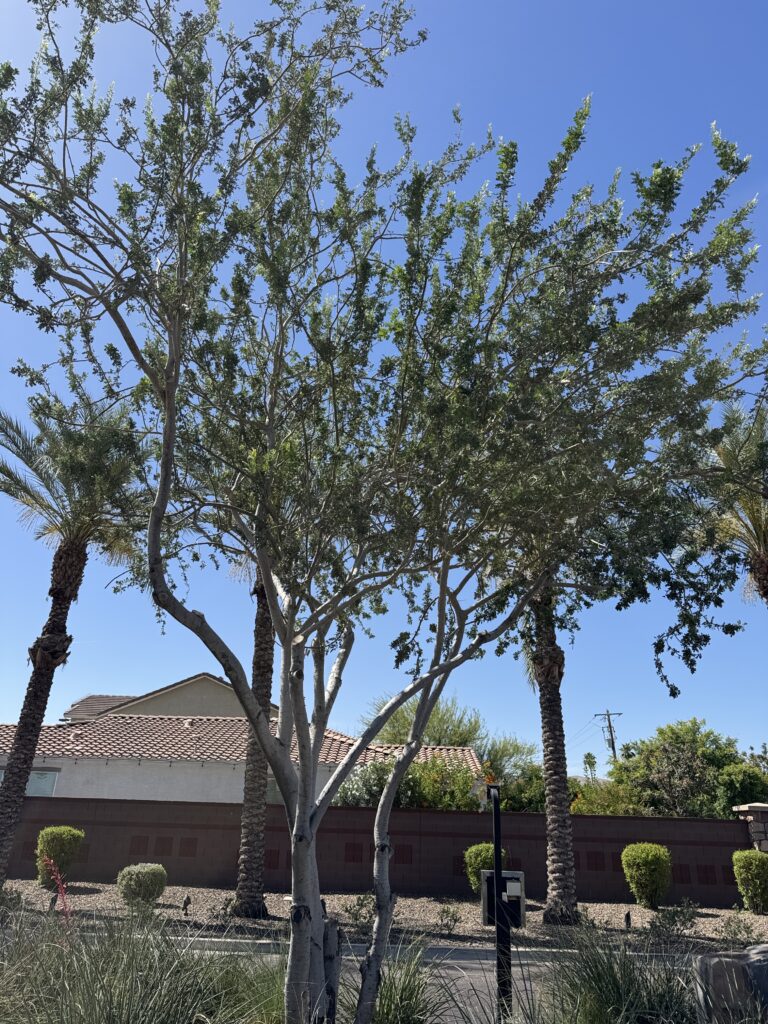
There’s a difference between a tree you plant and a tree you steward. Most ornamental trees are the first kind – you plant them, they grow, they do their thing, and eventually they’re gone. The Desert Ironwood is the second kind. Individual specimens in the wild have been documented living over 1,000 years. The tree you put in the ground today will outlive your house, your neighborhood as it currently exists, and many generations of your family. That’s not a metaphor – it’s a biological fact about this species.
That kind of time scale changes how you think about planting one. It also explains why the Desert Ironwood is legally protected in Arizona and Sonora – you cannot remove or destroy one without a permit. This is not a tree you casually replace. It’s a commitment, and a long one.
For the right yard and the right person, it might be the most meaningful tree you ever plant.
What It Is and Why It Belongs Here
The Desert Ironwood is the only species in the genus Olneya – a monotypic genus, meaning there is nothing else like it. Its entire range is the Sonoran Desert: southern Arizona, southeastern California, Baja California, and Sonora, Mexico, almost always below 2,500 feet elevation in sandy washes, rocky slopes, and desert valleys. Phoenix sits squarely in that range. This tree didn’t evolve somewhere else and get transplanted here. It evolved here, in conditions that mirror exactly what Phoenix delivers – extreme summer heat, low rainfall, alkaline soils, and mild winters.
It belongs to the Fabaceae family – the legume family – alongside Palo Verde, Sweet Acacia, Mesquite, and Cascalote. Like those relatives, it fixes atmospheric nitrogen through root nodule associations with soil bacteria, meaning it actively improves the soil around it over time. But the Ironwood goes further than most of its legume relatives in its ecological role. Its deep taproot draws water and nutrients from far below the surface and releases them into the surrounding soil as leaves drop – effectively acting as a nutrient pump for neighboring plants. Its dense, evergreen canopy creates a microclimate underneath that is measurably cooler than the surrounding desert, providing a nurse tree environment where other plants – including saguaro cactus – establish more readily under its protection. In the Sonoran Desert, the Ironwood is considered a keystone species, one whose presence supports dozens of other species that would otherwise struggle to survive.
The genus is named for Stephen Thayer Olney, a 19th century Rhode Island businessman and botanist. The species name tesota likely comes from the Spanish tieso meaning stiff, or from an indigenous Southwestern name for the tree. The Spanish common name palo de hierro – “iron tree” – and the English “ironwood” both refer to the same thing: the wood, which is so dense and hard it sinks in water and was historically used as a substitute for metal in tools and as extraordinarily hot-burning firewood. That last use led to significant over-harvesting in the past, which is part of why the tree is now protected.
Appearance and Growth Habit
The Desert Ironwood typically reaches 20 to 30 feet tall in Phoenix with a roughly equal spread – a broadly rounded, dense canopy on a short trunk with wide-spreading scaffold branches. In exceptional conditions in larger protected washes, wild specimens can exceed that significantly. In cultivation with supplemental irrigation, you can expect steady growth over time, though “steady” here means patient – this is a genuinely slow-growing tree.
The slow growth is worth understanding before you buy one. The Ironwood does not give you quick results. If you need meaningful shade within a few years, this is not the tree that delivers it. If you’re thinking in decades – which is the right time scale for this tree – then the slow growth is simply part of the deal.
The form changes with age in a way that becomes increasingly beautiful. Young trees are more upright, with visible thorns on the younger branch tips. As the tree matures, the canopy broadens and spreads, the thorns disappear from the mature wood, and the bark develops from smooth gray to rough, furrowed, sometimes shredding texture with a reddish-brown to gray-brown color. Old ironwoods have a sculptural quality that no young tree can approximate.
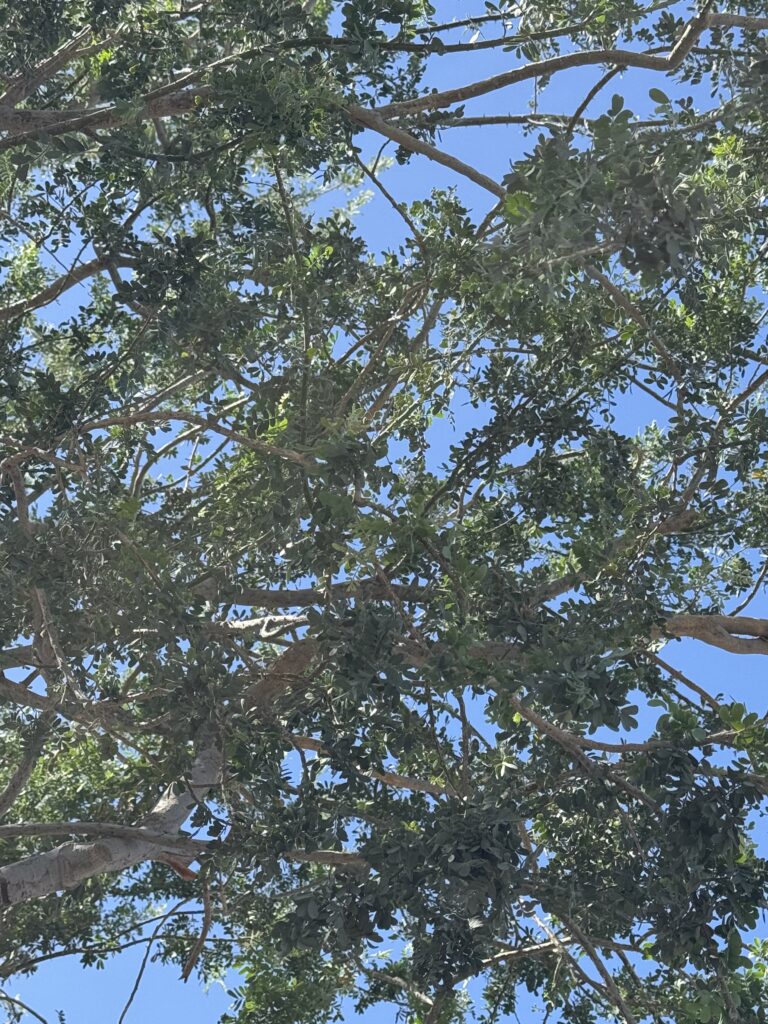
The leaves are small, leathery, blue-green to gray-green, covered with fine hairs that serve to reflect intense solar radiation. The overall foliage color reads as a soft blue-gray-green from a distance – cooler looking than most trees, which is fitting for something that literally creates cooler microclimates beneath it. The tree is evergreen when irrigated. In natural conditions without supplemental water, it drops leaves during severe drought to conserve moisture, then leafs back out when water becomes available. In a Phoenix yard with regular irrigation, it stays evergreen year-round.
The flowers are the annual reward for patience – and they’re genuinely worth waiting for. Lavender to pale pink-purple, pea-shaped, covering the tree in masses of bloom in late spring, typically May. The display only lasts 10 to 18 days. And here’s something most guides skip over: the Ironwood does not bloom reliably every year. In a span of five years, it may bloom twice, or three times, or sometimes more. Bloom is triggered by specific weather conditions – a cool, dry spring followed by warming temperatures produces the best displays. In years where conditions don’t align, the tree may produce very little flower. Don’t plant an Ironwood expecting an annual reliable flower show. Plant it for everything else it offers, and treat the bloom years as a bonus.
After flowering, edible brown seed pods develop and mature in summer. The pods contain 1 to 4 seeds that have a long history of use as food by Sonoran Desert peoples – the seeds can be eaten fresh when green, dried and roasted, or ground into flour. The pods are also an important food source for Gambel’s quail, doves, and various small mammals.
The Thorns
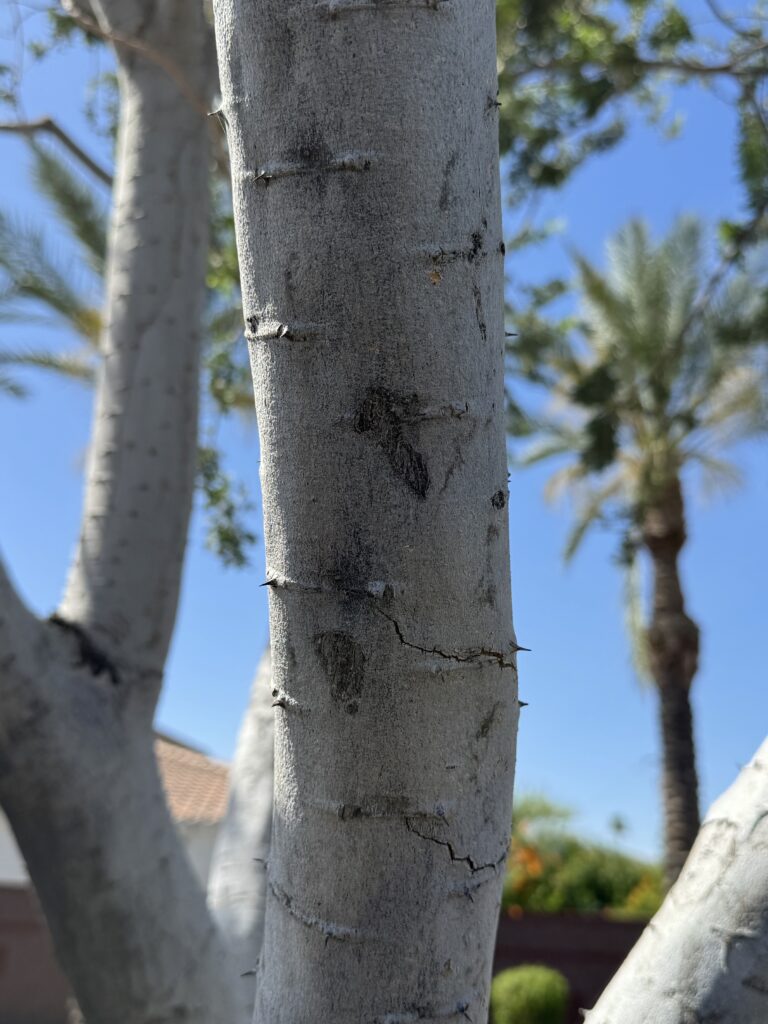
Young Ironwood branches carry small, paired, curved thorns – similar in character to the description of the tree’s bark as “armed with small, somewhat curved, twin spines.” These thorns are most prominent on younger growth and become less significant as the wood matures. Established scaffold branches on older trees lose their thorns over time.
This means the thorn situation improves with age, which is the opposite of some trees. A newly planted Ironwood in a 15-gallon container will have more visible thorns than a mature, established specimen. Placement with some clearance from foot traffic during the first several years is still sensible, but this isn’t a lifetime management issue the way it is with a Sweet Acacia.
Sun and Heat Tolerance
Full sun, and authentic Sonoran Desert heat tolerance. This tree evolved here. It handles sustained weeks of 110-plus degree temperatures, reflected heat from walls and hardscape, and the combination of intense UV radiation and low humidity that characterizes Phoenix summers. The waxy, hair-covered leaves are specific adaptations for managing that environment – less water loss, less solar absorption.
The one temperature vulnerability is on the cold end. Young trees are hardy to about 25 degrees F; established older trees to around 20 degrees F. In Phoenix proper, this is rarely tested, but hard freeze events do happen. Young trees in their first winter are the most vulnerable. Planting in fall and giving the root system time to establish before the first cold season helps. In particularly cold pockets of the Valley, some protection during the first winter or two is reasonable insurance.
The Ironwood is considered an indicator species for favorable citrus growing conditions in the Sonoran Desert – historically, its presence in a location was used as a sign that winters were mild enough for citrus orchards. That’s a useful correlation to keep in mind when thinking about cold risk.
Water Needs
The Desert Ironwood’s relationship with water is one of its most remarkable qualities. Established specimens in Phoenix essentially run on natural rainfall once their deep taproot system is in place – the tree is designed to find water far below the surface without depending on irrigation.
Getting to that point requires patience with the establishment phase.
During establishment (first 2-3 years): Water deeply and consistently. The tree is building the taproot and lateral root system that will sustain it for potentially centuries. In the first couple of months, more frequent deep watering helps the root system get started. Through the first two summers, deep watering every 7 to 14 days during hot months, tapering to monthly or less in winter. This is the phase where you’re investing in the tree’s future self-sufficiency.
Once established: Deep watering every 2 to 4 weeks in summer, monthly or less in winter. After 2 to 3 years of good establishment, many Ironwood trees in Phoenix need very little supplemental irrigation beyond what monsoon season provides. In extended dry spells with no monsoon activity, supplemental deep watering prevents the drought-stress leaf drop the tree uses as a survival mechanism in the wild.
What to avoid: Root rot from overwatering and poor drainage is the main risk. The Ironwood is a dry-wash tree – it tolerates periodic flooding but expects the soil to drain quickly between water events. Consistently wet soil is incompatible with this tree. Good drainage is essential.
Do not use nitrogen fertilizer on an Ironwood. This is one of the few trees where multiple sources specifically call this out. The nitrogen-fixing root system handles the tree’s nitrogen needs, and external nitrogen inputs suppress that biological relationship without providing anything the tree actually needs.
Soil and Fertilizing
The Desert Ironwood handles the full range of Phoenix soil conditions – alkaline pH, low organic matter, clay or sandy or rocky texture – without complaint. It evolved in these conditions. You don’t need to amend the soil heavily or create special planting conditions to give this tree what it needs.
The deep taproot is a key part of why this tree is so tolerant. It reaches moisture and nutrients from deep soil layers that surface-rooted trees can’t access. It also brings those resources up and releases them through leaf litter and root exudates, benefiting the soil ecosystem around it. Over decades, an Ironwood improves the ground it grows in rather than depleting it.
The nitrogen-fixing bacterial associations in the root nodules handle most of the tree’s nitrogen needs. Adding nitrogen fertilizer suppresses this relationship – the bacteria become less active when nitrogen is already abundant, which defeats the purpose. Skip synthetic fertilizers entirely.
Organic matter inputs in the form of mulch and light compost topdress support the soil biology that benefits all trees, including the Ironwood. But this tree is at the low-maintenance end of the spectrum when it comes to soil management – a light spring compost topdress and consistent organic mulch over the root zone is sufficient.
The sawdust from Ironwood wood is a known respiratory hazard – if you ever have pruning work done that involves cutting live wood, make sure whoever is doing it has appropriate protection. This isn’t a day-to-day concern but worth knowing.
Planting Guide
Best time to plant in Phoenix: Fall is the clear choice – October through November. Warm soil encourages root development while cooler air temperatures reduce stress. The tree gets two mild seasons – fall and winter – to establish roots before its first real summer.
Planting hole: Wide and no deeper than the root ball. Two to three times the diameter of the root ball. Set at grade. Backfill with native soil – a modest addition of organic amendment (around 20%) is fine, but don’t create a heavily amended planting pocket. Native soil is what this tree is built for.
Spacing: 15 to 20 feet from structures and other large trees for standalone plantings. For privacy screening, 15 to 20 feet between trees allows the canopies to eventually touch without crowding. The mature canopy spread – up to 30 feet – needs room to develop. Don’t plant it where you’ll be forcing constant corrective pruning to keep it out of structures.
Near pools: Relatively pool-compatible for a desert tree. Leaf and pod drop is modest compared to Palo Verde or Mesquite. Plant at least 15 to 20 feet from the pool edge to give the root system room. The thorns on young trees are worth thinking about for positioning relative to foot traffic around a pool area.
Mulch: 3 to 4 inches of organic mulch over the root zone, pulled back from the trunk. Gravel mulch over the root zone of an Ironwood is common in Phoenix but organic mulch is a better long-term choice – it moderates soil temperature, retains moisture, and feeds soil biology as it breaks down. The root zone needs to breathe and exchange gas; deep gravel can impair this over time.
Pruning and Maintenance
The Ironwood is genuinely low-maintenance, which is fitting for a tree that in the wild maintains itself for centuries without any human intervention. The pruning work that matters is structural and done gradually.
Form training: The tree naturally grows as a multi-trunk shrub or short-trunk wide-spreading tree. If you want a cleaner tree form with a raised canopy, select your scaffold branches early and gradually raise the canopy over several years by removing the lowest branches one at a time per season. Do not rush this. Aggressive pruning that removes large portions of the canopy at once is hard on the tree and creates large wounds.
Sucker removal: Water sprouts and suckers from the base and trunk are more common when the tree is getting supplemental irrigation, especially if it’s receiving more water than it needs. Remove them when small. Reducing overwatering often reduces sucker production.
Never top this tree. Topping – cutting off the top of the canopy to reduce height – is inappropriate for any tree and especially damaging for a long-lived species like the Ironwood. It creates massive wounds that invite disease and structurally compromises a tree that could otherwise stand for centuries. If size is a concern for a planting site, choose a different tree for that location.
Monsoon season: The Ironwood’s wood is dense and strong, which makes it more wind-resistant than many Phoenix trees. It handles the microbursts common in our monsoon season well. Remove any obviously dead or crossing branches during late winter pruning to reduce storm risk, but the tree doesn’t need aggressive management to be storm-ready.
Timing: Late winter to early spring – February through March in Phoenix – is the primary pruning window. Before new growth, after cold risk has passed.
Common Problems and Pests
Multiple sources list the Ironwood as having no known pests or diseases of significance. That’s a remarkable statement for any tree, and it holds up – this is one of the more problem-free trees you can plant in Phoenix.
Frost damage on young trees: The most relevant vulnerability. Young trees below 25 degrees F can experience leaf damage or dieback. Established trees are more tolerant. In Phoenix proper, serious freeze events are infrequent, but they happen. Young trees in their first winter benefit from some protection during hard freezes.
Drought-stress leaf drop: Without supplemental irrigation, the Ironwood will drop leaves during extended dry periods as a survival mechanism. In a cultivated landscape with irrigation, this is rarely an issue. In lean monsoon years without supplemental watering, it can happen. The tree recovers when water becomes available again.
Suckers from overwatering: More water than the tree needs tends to produce water sprouts and basal suckers. This is the tree’s response to more energy than it needs for normal growth. Reducing irrigation to appropriate levels and removing suckers while small is the management approach.
Sawdust hazard: As noted in the soil section – if cutting live wood, the sawdust is a known respiratory irritant. This applies to anyone doing structural pruning or removal work. Standard precaution for the person doing the cutting, not a concern for being near the tree.
Protected status reminder: The Desert Ironwood is protected under Arizona Native Plant Law. It cannot be removed, transplanted, or destroyed without a permit. This applies to trees on your property as well as on public land. If you’re doing significant landscape work that would affect an existing Ironwood on your property, check with the Arizona Department of Agriculture before proceeding.
The Ironwood’s Role in Your Soil and Landscape Ecosystem
This deserves more than a mention in passing because it’s genuinely unusual and connects directly to why the Ironwood is worth thinking about differently than most ornamental trees.
The deep taproot accesses water and nutrients from soil depths that surface-rooted trees can’t reach. As leaves drop throughout the year, those nutrients enter the surface soil, benefiting neighboring plants. The root system works in association with mycorrhizal fungi and nitrogen-fixing bacteria to improve soil nutrition not just for the Ironwood itself but for the plants growing in its root zone. And the canopy creates a measurably cooler microclimate – in the wild, saguaro cacti, palo verdes, and other Sonoran Desert plants establish more readily under an Ironwood’s protection than in open desert.
In a home landscape, this translates to a tree that makes the soil and the plants around it better over time – a fundamentally different dynamic than most ornamentals, which are simply neutral to their surroundings. If you’re building a long-term landscape with good soil ecology, an Ironwood is an asset to the system, not just an element within it.
Frequently Asked Questions
How fast does a Desert Ironwood grow?
Slowly. This is one of the slowest-growing trees commonly planted in Phoenix. Expect modest annual growth, especially in the first few years while the taproot system is establishing. Growth picks up somewhat with supplemental irrigation, but this is not a tree you plant for quick results.
Does the Ironwood bloom every year?
No – and this surprises many people. Bloom is triggered by specific weather conditions, and in a given five-year period the tree may bloom two or three times rather than annually. The flowers last only 10 to 18 days when they do appear. Plant it for its year-round qualities and enjoy the bloom years when they come rather than expecting a reliable annual show.
Are the thorns a long-term problem?
Less so than with some other desert trees. The thorns are most prominent on younger growth and diminish as the wood matures. An established tree with a raised canopy has little thorn presence at normal human-encounter height. During the first several years while the tree is young, some clearance from high-traffic areas is sensible.
How much water does an established Ironwood need?
Very little. After 2 to 3 years of good establishment, most Ironwoods in Phoenix run largely on monsoon rainfall with minimal supplemental irrigation. During extended dry stretches with no monsoon activity, a deep monthly watering prevents drought-stress leaf drop. This is genuinely one of the most water-efficient shade trees you can grow here.
Is the Desert Ironwood protected?
Yes. It is a protected native plant under Arizona Native Plant Law. It cannot be removed, destroyed, or transplanted without a permit, including on private property. If you have an Ironwood on your property and are planning significant landscape work, check with the Arizona Department of Agriculture first.
Can I eat the seeds?
Yes. The seeds have a long history of use as food by Sonoran Desert peoples. Green seeds can be eaten fresh. Dry seeds can be roasted and eaten whole or ground into flour. The flowers are also edible – they can be eaten raw or used as a garnish. The pods have a slightly sweet, nutty flavor that becomes more developed as they ripen on the tree.
The Desert Ironwood is in a different category from the other trees in these guides. It’s not just a good landscape tree – it’s one of the most ecologically significant plants in the entire Sonoran Desert, a keystone species that improves everything around it, genuinely slow-growing but potentially thousand-year-lived, legally protected because it’s recognized as irreplaceable. Planting one in a Phoenix yard is less like buying a piece of furniture and more like making a contribution to the landscape that will outlast you by centuries. The tradeoffs are real – slow growth, unreliable annual bloom, thorns on young wood, protected status that limits what you can do with it later – but for someone who understands what they’re planting and has the space for it, the Desert Ironwood might be the most meaningful tree you ever put in the ground.