
Callistemon viminalis ‘Little John’ | Also called: Dwarf Bottlebrush, Little John Bottlebrush
Little John is the kind of plant that earns its place quietly. It doesn’t grow fast, it doesn’t demand attention, and it doesn’t make a scene when conditions get difficult. What it does is stay attractive year-round, produce bright crimson-red bottlebrush flowers repeatedly through the warm months, stay exactly the size it’s supposed to be without constant corrective pruning, and give hummingbirds and pollinators something worth visiting nearly every time they come through the landscape.
In a plant palette designed around low maintenance and consistent color, Little John handles the understory role in larger planting islands particularly well. It’s dense enough to suppress weeds, compact enough not to overwhelm adjacent plants, and distinctive enough in flower color and foliage texture to earn visual interest on its own merits. The blue-green leaves are unusual among Phoenix shrubs — a cool, slightly silvery tone that reads differently than the gray-greens of desert natives and the medium greens of most flowering shrubs.
Like most of the best performers in Phoenix landscapes, it came from Australia.
What It Is and Where It Comes From
Little John is a dwarf cultivar of Callistemon viminalis — the weeping bottlebrush — an Australian native tree that typically reaches 15 to 20 feet in the desert southwest. The ‘Little John’ selection was bred to stay compact, topping out around 3 feet tall and spreading 3 to 5 feet wide over time at a notably slow growth rate. The parent tree is fast-growing. Little John is not — it grows deliberately, and that restraint is part of its value in a managed landscape.
You’ll sometimes see it labeled Callistemon citrinus ‘Little John’ at nurseries — that’s a naming inconsistency in the trade rather than a different plant. The correct botanical name is Callistemon viminalis ‘Little John’, a cultivar of the weeping bottlebrush species. A few improved cultivars have also reached Phoenix nurseries — ‘Better John’ is quicker to establish with denser, more silver-blue foliage, and ‘Green John’ is more compact with truer green leaves and less tendency to develop woody interior growth. If you find them, both are worth considering alongside the original. The care requirements are the same.
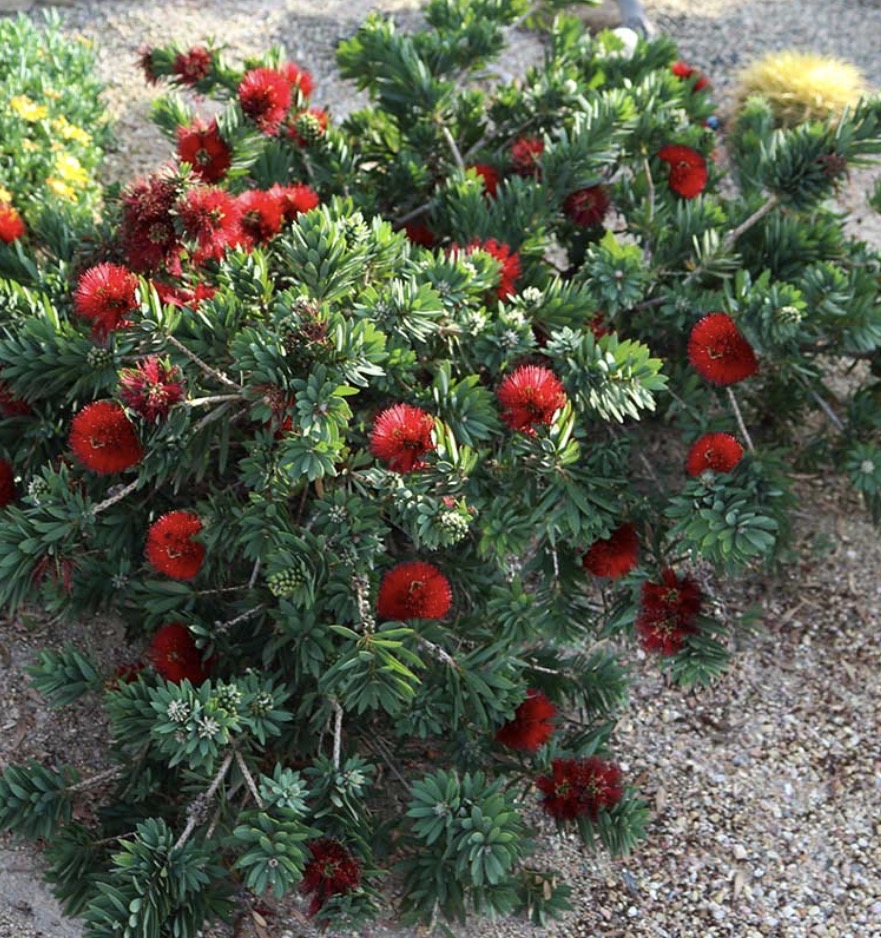
The bottlebrush name is purely descriptive — the flower spikes are cylindrical clusters of stamens with no visible petals, resembling a bottle brush exactly, in a bright crimson-red that’s hard to mistake for anything else. The genus name Callistemon comes from the Greek for beautiful and stamens — accurate on both counts.
Like the Mulga Acacia, Outback Sunrise Emu Bush, and Torchglow Bougainvillea, Little John belongs to the broader group of Australian natives that have found a compatible second climate in the Sonoran Desert. The arid Australian interior and the Phoenix Valley share enough in common — alkaline soils, intense sun, low rainfall, and a monsoon-style wet season — that plants evolved in one tend to adapt well to the other. Little John has been used in Phoenix commercial and residential landscapes long enough to have a proven track record across the range of conditions the Valley presents.
Appearance and Growth Habit
Little John forms a dense, mounding, multi-stemmed evergreen shrub — low and spreading rather than upright. Mature size is typically 2 to 3 feet tall and 3 to 5 feet wide, though it grows slowly enough that it takes several years to reach those dimensions. The slow growth rate is one of its defining characteristics — it fills its intended space gradually and stays there without the constant aggressive management that faster-growing shrubs demand.
The foliage is one of the more distinctive qualities in the palette. The leaves are narrow, pointed, and densely arranged along the stems — fine-textured and blue-green in color, with a slight silvery cast that changes subtly in different light conditions. They’re aromatic when crushed, releasing a faint citrus scent — a quality you notice during pruning or maintenance work but not in normal landscape conditions. The foliage is evergreen, holding through Phoenix winters with minimal cold damage in typical years.
The flowers appear as dense cylindrical spikes — the classic bottlebrush form — in bright crimson-red, emerging at the tips of branches and covering the plant during peak bloom. The primary bloom period is spring, with the heaviest flush in March through May. In Phoenix’s warm climate, intermittent flowering continues through summer and often into fall — the plant is rarely completely out of bloom during the warm months. Spent flower spikes develop into small, woody seed capsules that persist on the stems and add a subtle textural quality to the plant even between bloom periods.
Hummingbirds find the crimson flowers reliably and visit with consistent frequency during the bloom periods. The dense, low form makes it accessible to ground-feeding pollinators as well — bees in particular work Little John heavily during the spring flush.
Sun and Heat Tolerance
Full sun to partial shade — one of the more flexible placements on this plant list. Little John performs best and flowers most abundantly in full sun, where at least six to eight hours of direct light produces the dense form and reliable bloom cycles the plant is known for. In partial afternoon shade, growth becomes slightly more open and flowering reduces somewhat, but the plant stays healthy and attractive. This flexibility makes it useful in spots that get afternoon shadow from a building, wall, or adjacent canopy tree.
Heat tolerance in Phoenix conditions is solid for an established plant. Like the other Australian natives in this palette, Little John evolved in conditions not meaningfully different from the Sonoran Desert and handles summer heat without the stress response many non-desert plants show. The combination of dense foliage and slow growth that comes with adequate sun and appropriate water allows the plant to maintain its appearance through the hottest months.
Cold is the more relevant limit. Little John is hardy to approximately 20 to 25 degrees F — right at the lower edge of Phoenix’s typical winter range. In normal Phoenix winters it comes through with no meaningful damage. In hard freeze events that push below 20 degrees — rare in most Valley locations but not unheard of — the plant can take significant foliage damage. Young plants in their first winter are more vulnerable than established ones. Siting in locations with some thermal mass nearby — south or west walls, areas with hardscape heat retention — improves cold resilience in exposed situations.
Water Needs
Once established, Little John has good drought tolerance — deep watering every seven to ten days during the summer growing season is the right target in Phoenix. During spring and fall, you can extend the interval as temperatures moderate. In winter, minimal supplemental irrigation is needed.
The establishment phase — the first full growing season — requires more consistent moisture. Water every five to seven days during the first summer to develop the root system. Little John is notably slow to recover from water stress during establishment compared to faster-growing shrubs, so don’t let newly planted specimens dry out significantly before roots are well-established. Once they’re in and rooted, the drought tolerance becomes reliable.
The most common mistake with Little John in Phoenix landscapes is overwatering. This plant responds to excess moisture the same way most Australian desert natives do — poorly. Chronic overwatering causes two problems: iron chlorosis, where the leaves yellow while the veins stay green due to iron uptake being disrupted in saturated alkaline soil, and root rot in heavy or poorly draining ground. Both are preventable with appropriate irrigation scheduling and drainage. Once iron chlorosis appears, reduce irrigation frequency first. If yellowing persists after irrigation correction, chelated iron applied to the soil resolves it quickly.
Well-draining soil is non-negotiable. Little John should never sit in saturated ground. In heavy clay soils with poor natural drainage, either improve drainage before planting or choose a different location — the plant will not perform in conditions that don’t drain.
Soil and Fertilizing
Little John tolerates the range of Phoenix soil conditions — alkaline, sandy, rocky — as long as drainage is adequate. Native soil backfill at planting is fine. No heavy amendment is needed or beneficial.
Fertilizing needs are minimal. Like most Australian natives, Little John is adapted to nutrient-poor soils and does not require or benefit from heavy fertilizer inputs. A light application of balanced slow-release fertilizer in early spring — or a compost topdress — supports the spring growth push and bloom flush. Avoid high-nitrogen formulations, which push soft vegetative growth at the expense of flowering and can worsen iron chlorosis issues in alkaline conditions. If iron chlorosis appears, chelated iron is the targeted correction — not general fertilizer.
Organic mulch over the root zone — 2 to 3 inches, pulled back from the base — moderates soil temperature, retains moisture between deep waterings, and reduces weed pressure. Consistent with good practice for most shrubs in Phoenix landscapes.
Planting Guide
Best time to plant in Phoenix: Fall — October through November — is ideal. Warm soil supports root development while cooler air temperatures reduce transplant stress. The plant gets a mild establishment period before its first Phoenix summer. Spring planting in March through April also works well.
Spacing: 3 to 4 feet apart for a mass planting or border effect, accounting for the eventual 3 to 5 foot spread at maturity. Because Little John grows slowly, it will take several years to fill that spacing — plan for it at planting rather than placing too close and fighting overcrowding later. For understory planting in larger landscape islands with canopy trees, 3 foot spacing produces a full, dense effect at maturity without crowding.
Placement in islands: Little John’s compact scale and mounding form make it a strong candidate for the understory layer in larger planting islands — below a Desert Willow or similar canopy tree, filling the mid-level space with a different texture and flower color. It stays low enough not to compete with the canopy, dense enough to suppress weeds in the island, and attractive enough year-round to earn that prominent placement.
Planting hole: Wide and no deeper than the root ball — two to three times the root ball diameter. Set at grade. Good drainage from the hole into the surrounding soil is the priority. If water pools in the hole after filling, drainage is inadequate and the site needs improvement before planting.
One caution: Little John is slow to recover from root disturbance or transplant shock compared to faster-growing shrubs. Handle the root ball carefully at planting, minimize root damage, and maintain consistent establishment irrigation for the full first growing season. Patience during establishment pays off — once it’s rooted and growing, it’s one of the more reliable plants in active Phoenix use.
Pruning and Maintenance
Little John is one of the lower-pruning-demand shrubs in Phoenix landscape use — which is appropriate for a slow-growing plant where every cut matters more than with a fast grower that bounces back quickly.
Minimal intervention is the goal: The natural mounding habit looks intentional and attractive without constant shaping. Left alone, Little John stays dense and compact on its own. The main pruning tasks are light and infrequent.
Prune after flowering, not before: The most important pruning timing rule for Little John. Prune after the spring bloom flush has finished — typically late May through June in Phoenix — to remove spent flower spikes, shape any wayward growth, and encourage new growth that will carry the next bloom cycle. Pruning before the spring bloom removes the buds that were about to open and costs you the flush. This is the most common pruning mistake with bottlebrush in commercial settings — maintenance crews trimming on a schedule rather than watching where the plant is in its bloom cycle.
Light shaping: Trim back any branches growing significantly out of proportion to the overall form, cutting to a lateral node or branch junction. Keep cuts light — Little John does not respond well to heavy pruning into old wood. Unlike Yellow Bells or Ruellia, which bounce back vigorously from hard cutbacks, Little John is slow to recover from significant pruning and may develop bare or woody sections that don’t fill back in as expected. Less is more.
Never shear: Cutting the entire outer surface to a flat or rounded shape destroys the natural mounding form, stimulates dense growth over an increasingly woody and open interior, and removes the branch tips where flowering occurs. The natural form is the right form — work with it, not against it.
Interior dead wood: Occasionally remove dead or crossing branches from the interior of established clumps to maintain air circulation and keep the plant vigorous. This is a minor periodic task, not a regular maintenance concern.
Common Problems
Iron chlorosis (yellow leaves, green veins): The most common issue in Phoenix, and almost always related to overwatering in alkaline soil. Reduce irrigation frequency first — often this alone resolves the problem within a few weeks as the soil dries and iron becomes available again. If yellowing persists after reducing water, apply chelated iron to the soil. This is a management correction, not a disease, and it responds predictably to the right intervention.
Root rot: From consistently wet or poorly draining soil. Prevention is the only real solution — good drainage at planting and appropriate irrigation scheduling. A plant that’s declining despite reasonable care in heavy clay soil with drainage problems needs either drainage improvement or relocation.
Not flowering: Usually caused by one of four things — too much shade, pruning at the wrong time (before the spring flush), overwatering that stresses the root system, or excess nitrogen fertilizer that pushes vegetative growth at the expense of blooming. Check all four before assuming the plant has a disease or pest problem. Most non-flowering Little Johns have a correctable management issue rather than a health problem.
Scale insects and mealybugs: Occasional pest pressure on stems and foliage. Usually manageable with horticultural oil applied during the cooler months when the plant is less heat-stressed. These are periodic concerns rather than persistent problems for well-maintained plants.
Spider mites: Can appear during hot, dry conditions before monsoon. A strong water spray disrupts populations. Insecticidal soap handles heavier infestations. Monitor in May and June when conditions favor mite activity.
Slow establishment: Little John takes longer to establish than most shrubs in Phoenix use. This is normal — not a sign the plant is failing. Consistent establishment irrigation for the full first growing season and patience through the second year are the requirements. The plant accelerates once its root system is developed, but pushing establishment too hard with excess water causes more problems than the slow pace does.
Why Little John Works as an Understory Plant in Phoenix Islands
Larger planting islands in commercial landscapes — the kind with a canopy tree anchoring the center and space to fill between the tree and the island edge — present a specific challenge: what goes in the understory that looks good year-round, doesn’t compete with the canopy tree for resources, doesn’t outgrow the space, and provides enough visual interest on its own merits to justify the planting?
Little John handles that role well. Its scale — 2 to 3 feet tall — keeps it below the canopy without crowding it. Its slow growth means it won’t push outside the island boundary and require constant correction. Its dense, fine-textured foliage in blue-green provides a distinct visual quality different from the canopy above and the surrounding landscape. And the crimson-red flowers during spring and the intermittent bloom through summer deliver seasonal color at the island level, where it reads as a ground-plane accent rather than a mid-height shrub competing for attention at eye level.
Paired with a more textural accent plant like Firecracker Plant at the island edges, Little John provides the dense mid-island coverage while the lighter, more open form of the companion plant softens the transition to the surrounding hardscape.
Frequently Asked Questions
How big does Little John get?
Typically 2 to 3 feet tall and 3 to 5 feet wide at maturity in Phoenix conditions. It grows slowly — reaching full size takes several years — which is part of what makes it valuable in contained planting situations. Plan spacing based on the mature spread rather than the size at planting.
When does it bloom in Phoenix?
The primary bloom flush is spring — March through May — with the heaviest flowering in April. In Phoenix’s warm climate, intermittent blooming continues through summer and often into fall. It’s rarely completely without flowers during the warm months, though the spring flush is the most visually dramatic period.
Why are the leaves turning yellow?
Almost certainly iron chlorosis from overwatering in alkaline soil — the most common Little John issue in Phoenix. The pattern is yellow leaves with the veins staying green. Reduce irrigation frequency first. If yellowing persists after a few weeks, apply chelated iron to the soil. This is a chemistry issue caused by waterlogged alkaline conditions blocking iron uptake — it’s correctable, not a disease.
Can I prune it hard to reduce the size?
No — Little John does not recover well from severe pruning into old wood the way Yellow Bells or Ruellia do. Keep pruning light — trim after the spring bloom flush to shape and remove spent flowers, remove any obviously dead or crossing interior growth, and otherwise leave it alone. The plant’s slow growth rate means it stays at a manageable size without aggressive cutting. If a Little John has significantly outgrown its space, the better solution is replacing it with a correctly-sized plant than attempting a hard renewal prune.
Is it the same as the regular bottlebrush tree?
Same genus, different cultivar and growth habit. The parent plant — Callistemon viminalis — is a fast-growing tree that reaches 15 to 20 feet in Phoenix. ‘Little John’ is a dwarf cultivar selected for compact, slow-growing, mounding habit that stays at 2 to 3 feet. They share the same flower form and color, but the scale and growth rate are completely different. For landscape island and border applications, the dwarf cultivar is the right plant — the tree form is too large and too fast for most contained planting situations.
Do hummingbirds actually visit it?
Consistently. The crimson-red bottlebrush flowers are a reliable hummingbird draw during the bloom periods, particularly the spring flush. The low, mounding form means hummingbirds feed lower than they typically would — some are initially hesitant and prefer taller plants first — but once established in a garden or landscape, Little John gets regular hummingbird activity through the bloom season.