
Eremophila glabra ‘Mingenew Gold’ | Also called: Outback Sunrise Emu, Emu Bush, Mingenew Gold
Most ground covers in Phoenix are compromises. They either look good and need too much water, or they’re truly drought-tolerant but spend half the year looking burnt and brown. Outback Sunrise Emu Bush is the exception — a low, sprawling evergreen that stays green through our summers, produces a blanket of bright yellow tubular flowers starting in late winter, and runs on almost no supplemental irrigation once it’s established.
The genus name says it plainly: Eremophila comes from the Greek words for desert and loving. This plant didn’t adapt to arid conditions — it evolved in them. The Australian outback isn’t meaningfully different from the Sonoran Desert in terms of the challenges it presents to plants, and Outback Sunrise has been handling those challenges on its home continent long before it found its way into Phoenix landscapes.
It’s still underused compared to how well it performs. Part of that is availability — it can be harder to find than the standard landscape staples — and part of it is that a lot of gardeners aren’t sure what to do with a true ground cover in a desert setting. Once you see it massed across a slope, lining a street corridor, or spilling over a low wall with yellow flowers in February, the question answers itself.
What It Is and Where It Comes From
Eremophila glabra is a widespread species native to the dry regions of all mainland Australian states. The cultivar ‘Mingenew Gold’ is a naturally occurring form discovered near the town of Mingenew in Western Australia — named for the location where it was found, selected and propagated for its reliably yellow flowers and vigorous spreading habit. You may also encounter it labeled as Eremophila prostrata at some nurseries — this is the same plant. According to the Australian Native Plant Society, E. prostrata and E. glabra are considered the same species, and the prostrata labeling is a naming error that shows up occasionally with US growers. If you’re buying what looks like Outback Sunrise and it’s labeled either way, you likely have the same plant.
The Eremophila genus is large — over 200 species — and ranges from low ground covers to upright shrubs. What they share is adaptation to extreme aridity, poor soils, and intense heat. Several members of the genus have found a strong second home in the desert southwest, where the climate closely matches their native conditions. Outback Sunrise is among the best performers in the group for Phoenix-area landscapes specifically because of its low profile, spreading form, and willingness to bloom in winter when almost nothing else is.
The common name “emu bush” comes from the Australian emu’s habit of eating the berries of various Eremophila species and dispersing the seeds. In Phoenix landscapes you won’t be managing emu traffic, but the name has stuck.
Appearance and Growth Habit
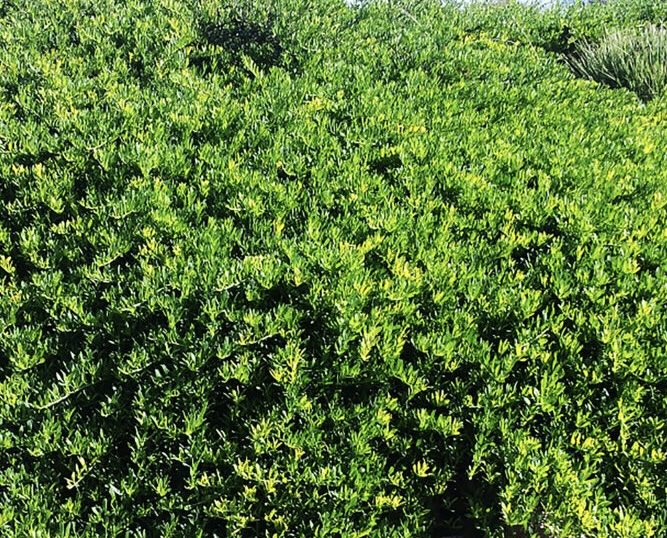
Outback Sunrise is a low, spreading, woody ground cover — one foot tall and spreading 6 to 10 feet wide at maturity, though some sources cite up to 12 feet in ideal conditions with good establishment. The growth habit is prostrate — stems spread outward along the ground rather than growing upward — creating a dense, weed-suppressing mat of small, bright green leaves. The foliage is evergreen, staying green through summer heat and mild Phoenix winters, which gives it year-round presence in the landscape even outside of bloom season.
The flowers are the main seasonal event: small, tubular, bright yellow blooms that look like tiny lipstick tubes clustered along the stems. Bloom season starts in late winter — February in Phoenix, sometimes as early as January in warmer microclimates — when very little else in the landscape is flowering. This early bloom window is one of Outback Sunrise’s most valuable qualities. It’s delivering color at exactly the time most desert landscapes look their most dormant and washed-out. The flowering continues through spring and pops up intermittently into summer, with the heaviest flush concentrated in late winter through April.
Hummingbirds find the tubular flowers immediately. If hummingbird activity in your landscape matters to you, Outback Sunrise in late winter is one of the best draws available — it’s blooming at the start of their migration window and the flower form is perfectly suited to their feeding style.
The spreading, low habit makes it useful as a weed suppressor in open areas. A well-established mass planting of Outback Sunrise shades the soil enough to significantly reduce weed germination — a practical benefit in commercial settings where weed management in open ground covers is an ongoing maintenance cost.
Sun and Heat Tolerance
Full sun is where it performs best. The Arizona-Sonora Desert Museum’s plant care information is direct on this: Outback Sunrise withstands full sun and reflected heat from hardscape and handles it without meaningful stress. It can also perform in light or filtered shade, which gives it some flexibility for locations that get afternoon shadow from a wall or adjacent structure — but if you’re choosing between a full sun spot and a part-shade spot, full sun produces denser growth and heavier flowering.
Heat tolerance is genuinely high. This is a plant that evolved in the Australian outback, where summer temperatures are comparable to Phoenix’s. It doesn’t show the summer stress symptoms — leaf scorch, browning edges, partial dieback — that afflict plants that are merely tolerant of heat rather than adapted to it. In Phoenix’s hottest months, a well-established Outback Sunrise just keeps growing.
Cold hardiness is rated to 15 degrees F — the same threshold as Mulga Acacia — which means it’s comfortable through normal Phoenix winters and at risk only in the genuinely hard freezes that hit the Valley every decade or so. In most Phoenix locations most winters, cold is not a meaningful concern with this plant.
Water Needs
Once established, Outback Sunrise is one of the lower water-demand ground covers available for Phoenix landscapes. The Arizona-Sonora Desert Museum classifies it as low water use and notes that fertilization is not necessary. Deep, infrequent irrigation is the right approach — the same principle that applies to most Australian desert natives in Phoenix: saturate deeply, let the soil dry significantly before watering again.
During establishment — the first growing season — water more frequently to develop the root system. Every five to seven days during the hot months for the first season is appropriate, tapering as roots establish. Once the plant is in the ground and growing actively, you can reduce to a low-frequency summer schedule supplemented by monsoon events, and little to no irrigation in winter.
Outback Sunrise does not like consistently wet or poorly draining soil. Like most Australian desert natives, it evolved in conditions where water comes, soaks in, and then the soil dries out. Chronic moisture or standing water causes root problems. Well-draining soil is the baseline requirement — the plant can handle poor, rocky, sandy, or alkaline soil conditions as long as it drains.
One practical note for slopes and banks: Outback Sunrise is well suited to sloped ground covers precisely because slopes drain quickly and don’t hold moisture. The plant’s spreading habit also helps stabilize soil on gradients. If you’re looking for a low-water, low-profile ground cover for a sloped area in a Phoenix landscape, this is a strong candidate.
Soil and Fertilizing
The Arizona-Sonora Desert Museum’s care sheet is unusually clear on this: any soil will do, and fertilization is not necessary. That’s about as simple as plant care guidance gets, and it holds up in practice. Outback Sunrise tolerates the full range of Phoenix soil conditions — alkaline, sandy, rocky, low organic matter — without complaint as long as drainage is adequate. It doesn’t need enriched planting mixes, soil amendments at planting, or ongoing fertilizer inputs.
Heavy nitrogen fertilization — the instinct many gardeners have to “feed” a plant that seems slow to establish — is counterproductive. Like most plants adapted to nutrient-poor soils, Eremophila species are not built to handle high fertility inputs. Excess nitrogen pushes vegetative growth without improving the overall health or flowering of the plant. If you feel compelled to fertilize, a light application of balanced slow-release fertilizer in spring is the ceiling. More than that is unnecessary and can be harmful.
Organic mulch over the root zone — 2 to 3 inches, kept back from the crown — moderates soil temperature and reduces moisture loss between irrigations. This is useful during establishment and in the first summer particularly. As the plant spreads and its canopy covers the ground, the foliage itself provides most of the soil shading benefit that mulch would.
Planting Guide
Best time to plant in Phoenix: Fall — October through November — is ideal. Cool air temperatures reduce transplant stress while soil is still warm enough to support root development. The plant gets two mild seasons to establish before its first Phoenix summer. Spring planting in February through March also works. Avoid planting in peak summer heat unless you’re prepared to irrigate very carefully during the establishment period.
Spacing: Individual plants spread 6 to 10 feet wide at maturity. For a continuous ground cover effect, space plants 4 to 5 feet apart — they’ll fill in and connect within two growing seasons. For a faster fill in high-visibility areas, tighten spacing to 3 feet. For slopes or large open areas where budget is a factor, 5 to 6 foot spacing works if you can accept a longer establishment period before full coverage.
Planting depth: At grade — no deeper than the root ball. The crown of the plant should sit at or very slightly above the surrounding soil level, not buried. Good drainage from the planting hole out is important — if the hole holds water, amend the backfill or choose a different location.
Corridor and street edge planting: Outback Sunrise works well as the low band in a multi-layer street corridor planting. Planted on the street side of a sidewalk — where it gets full reflected heat from pavement — it stays low enough not to obstruct sight lines, spreads to cover open soil, delivers yellow flowers in the early spring when the corridor would otherwise look bare, and requires very little irrigation once established. This is one of its strongest commercial landscape applications.
Slopes and banks: The spreading, root-anchoring habit makes it a good choice for stabilizing sloped ground covers. Plant across the slope rather than in rows running up and down the grade to maximize coverage and soil retention.
Pruning and Maintenance
Outback Sunrise is genuinely low maintenance — one of the easiest plants in active Phoenix landscape use. The main things to know:
Minimal pruning needed: The spreading, prostrate habit doesn’t require ongoing shaping the way an upright shrub does. Left alone, it forms a clean, dense mat. If stems are getting too long at the edges of a planting area, trim them back to a lateral node. Light edge trimming once a year — typically in late winter before the main bloom flush — is sufficient for most plantings.
Avoid heavy cutting during bloom season: The main bloom flush in late winter through spring is the plant’s best feature. Don’t prune during or immediately before this period. If shaping is needed, do it after the spring bloom has finished.
Dead stem removal: Occasionally older stems in the interior of an established planting die back. Remove these cleanly to the base to keep the planting looking fresh. This is a minor task, not a regular management challenge.
No shearing: The same principle that applies to most desert shrubs — shearing into a flat or rounded form destroys the natural spreading habit that makes this plant look good, and stimulates dense outer growth over an increasingly empty interior. Selective trimming is the right approach.
Weed management during establishment: Before the plant has spread enough to shade the soil, weeds can establish in the gaps. Hand-pull or spot-treat weeds during the first two seasons. Once the canopy has filled in, weed pressure decreases significantly.
Common Problems
Root rot from poor drainage: The most common serious problem, and almost always a site issue rather than a plant issue. Outback Sunrise evolved in fast-draining desert soils and does not tolerate chronic moisture. If a planting is declining despite reasonable irrigation, check the drainage first. Compacted clay soil that holds water is the usual culprit. Improve drainage at planting rather than trying to compensate after the fact.
Slow establishment in summer heat: Plants installed during peak summer heat (June through August) can struggle to establish before the roots develop enough to handle the stress. Fall or spring planting avoids this. If summer installation is unavoidable, consistent irrigation every few days during the first weeks is critical, and afternoon shade during the most intense heat helps young transplants survive the adjustment period.
Sparse coverage on poor sites: In heavily compacted, extremely poor, or very rocky soil with minimal water-holding capacity, plants may spread more slowly than expected. This is usually not a health problem — the plant survives fine — it just fills in more slowly. Supplemental irrigation slightly above the minimum during the establishment phase helps accelerate coverage in these conditions.
Stem dieback in hard freezes: In the rare hard freeze that hits Phoenix below 15 degrees F, stems may die back. The roots typically survive, and the plant pushes back in spring. Cut dead stems to the base after the freeze event once new growth is emerging. This is a rare occurrence in most Phoenix locations.
Pest pressure: Minimal. Eremophila species are generally resistant to the common pests that affect Phoenix landscapes. Occasional aphid or whitefly activity on new growth is possible but rarely significant. A strong water spray handles minor infestations. This is not a plant that requires regular pest monitoring or treatment.
Availability Note
Outback Sunrise is worth seeking out, but it’s not as consistently available at every Phoenix nursery as the standard landscape staples. Mountain States Wholesale Nursery carries it, and it appears regularly at Civano, Elgin, and other independent nurseries that stock a broader Australian native palette. If your local nursery doesn’t carry it, call ahead before making a special trip — availability fluctuates by season and year. The effort to source it is worthwhile. Once you have it in the ground and established, it’s one of the most rewarding low-maintenance ground covers available in our climate.
Frequently Asked Questions
How big does Outback Sunrise Emu Bush get?
Low and wide — typically 1 foot tall and 6 to 10 feet across at maturity, with some sources citing up to 12 feet in ideal conditions. It’s a ground cover, not a shrub, and its value is in horizontal spread rather than height. Plan for at least 6 feet of spread per plant when spacing.
When does it bloom in Phoenix?
Late winter is the main event — February through April, sometimes starting in January in warm microclimates. This early bloom window is one of its most valuable qualities — it’s delivering color when most of the landscape is at its most dormant. Flowers pop up intermittently through spring and into summer, but the heaviest flush is in late winter.
Does it need fertilizer?
No. The Arizona-Sonora Desert Museum’s care guidance says it plainly: fertilization is not necessary. It evolved in nutrient-poor soils and performs best without heavy feeding inputs. If you’re seeing poor growth or pale foliage, the issue is almost always drainage or irrigation — not a nutrient deficiency.
Can it handle full reflected heat from pavement?
Yes — this is actually one of its ideal settings. Outback Sunrise handles reflected heat from concrete and asphalt without stress, making it well suited to street-edge and parking lot adjacent plantings where reflected heat rules out many other ground covers.
Is it the same as the plant labeled Eremophila prostrata?
Yes. According to the Australian Native Plant Society, Eremophila prostrata and Eremophila glabra are the same species. The prostrata labeling is a naming error that shows up occasionally with US growers. If you’re buying a low, spreading emu bush with yellow flowers labeled either way, you likely have the same plant.
How far apart should I plant them for ground cover?
4 to 5 feet apart for a continuous ground cover effect that fills in within two growing seasons. Tighten to 3 feet for faster coverage in high-visibility areas. In large open areas where budget is a factor, 5 to 6 feet works if you can accept a longer fill-in period and manage weeds in the gaps during establishment.