
Tecoma stans | Also called: Yellow Trumpet Flower, Yellow Elder, Esperanza
If you want one shrub that delivers consistent color in a Phoenix commercial or residential landscape from spring through fall with minimal fuss, Yellow Bells is the answer most experienced desert landscapers reach for first. It’s a fast grower. It blooms in waves rather than one burst. It handles reflected heat off hardscape and concrete that would cook most plants. Hummingbirds and pollinators find it constantly. And it’s tough enough to cut to the ground after a hard winter and come back full and flowering by summer.
The reason Yellow Bells shows up in so many well-designed Phoenix landscapes is not because it’s the default option — it’s because it genuinely earns its place. The challenge isn’t finding reasons to use it; it’s making sure you’re using the right variety for your specific situation, planting it where it has room to perform, and managing it so it stays looking intentional rather than overgrown and ragged.
When it’s managed well, there’s almost nothing that delivers more consistent color for less effort in our climate.
What It Is and Where It Comes From
Tecoma stans has one of the broader native ranges of any desert shrub — from the extreme southwestern United States south through Mexico, Central America, and all the way into Argentina. It’s native to the Arizona-Sonora desert region in its angustata form, which matters for Phoenix gardeners because it means the plant didn’t just adapt to our conditions — it evolved here, or close enough to here that the climate is familiar territory.
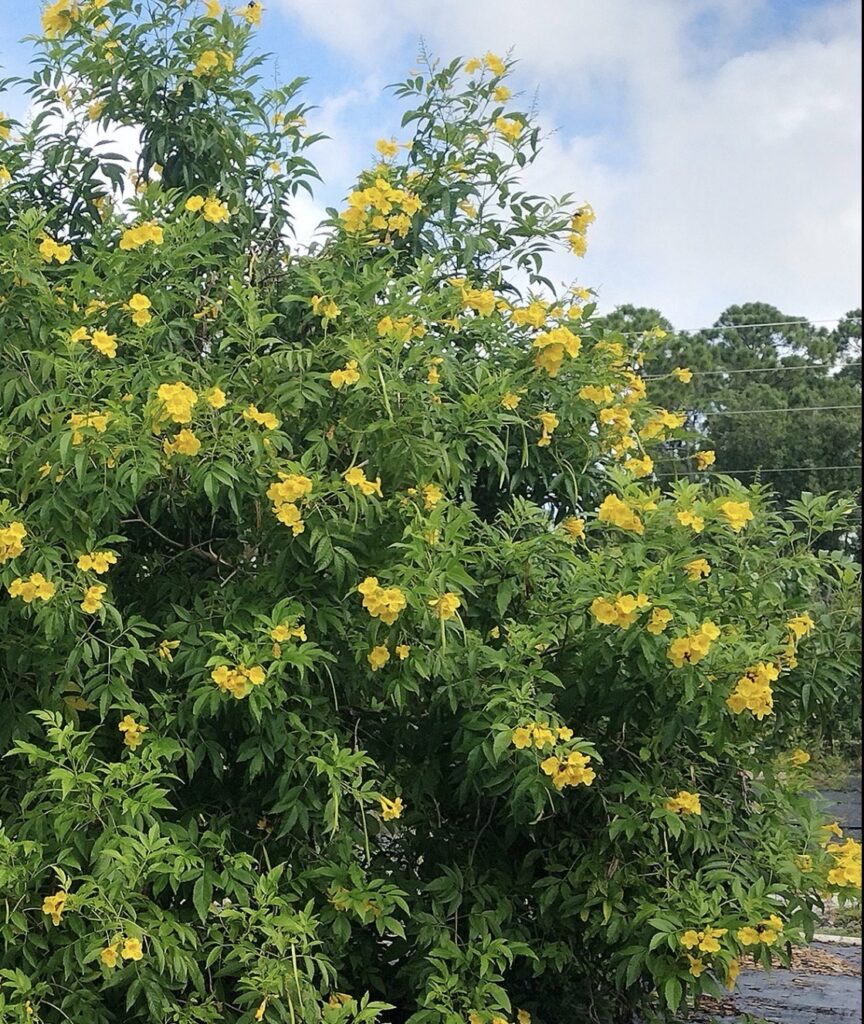
The name “esperanza” — hope — is one of its Spanish common names, widely used in Texas and northern Mexico. Yellow Elder comes from its resemblance to the elderberry flower clusters. Yellow Trumpet Flower is the most visually literal name. Whatever you call it, the plant itself is hard to miss when it’s in bloom: dense clusters of bright yellow, flared trumpet-shaped flowers on a fast-growing, upright shrub that can reach ten feet or more if you let it.
It belongs to the Bignoniaceae family — the trumpet creeper family — which also includes Desert Willow (Chilopsis linearis) and Catalpa. The family connection shows in the flower form: all of them produce tubular, flared blossoms that are structured to reward pollinators, particularly hummingbirds, that can reach nectar at the base of the tube.
One worth noting: Tecoma stans is considered invasive in south Florida and Hawaii, where the climate allows it to escape cultivation and naturalize aggressively. That’s not a concern in Phoenix — our winters and dry-season conditions keep it well-behaved in cultivated landscapes. But it’s worth understanding that this is a vigorous plant in the right environment, and the right environment includes our warm summers.
Varieties — Which One for Phoenix
The variety question matters more with Yellow Bells than with most shrubs, because the options perform differently and are suited to different situations.
Tecoma stans var. angustata — This is the Arizona native form, with narrow, fine-textured leaves and a more compact growth habit than the tropical variety. It reaches roughly 8 to 10 feet tall and 6 feet wide. More drought-tolerant than the wider-leafed form, and generally the better choice for low-water landscape applications. The tradeoff: it’s more susceptible to Texas root rot in formerly agricultural soils — an important consideration if your property sits on ground that was farmed. This is the variety most commonly recommended for Phoenix xeriscapes and water-wise commercial landscapes.
Tecoma stans var. stans — The tropical, wider-leafed form native to Central and South America. Larger in every dimension — can reach 20 feet in frost-free conditions. Denser clusters of flowers, lusher green foliage, more tropical feel. More cold-sensitive than the Arizona native variety and more prone to freeze damage in exposed locations during hard winters. Best suited to sheltered microclimates in Phoenix where cold air doesn’t pool. Can be selectively pruned into a small tree form in the right setting.
Dwarf cultivars (‘Gold Star’, ‘Sundance’) — Compact selections that stay in the 4 to 6 foot range and flower prolifically. More manageable in tight spaces and smaller planting areas where the standard varieties would overwhelm the scale. ‘Gold Star’ in particular is widely used in Phoenix commercial landscapes for its consistent size and heavy flowering. Worth considering anywhere the standard varieties would be too large for the planting space.
For most Phoenix commercial and HOA applications, the angustata variety or a compact cultivar is the right starting point — manageable scale, low water, and reliable repeat flowering without the cold sensitivity of the tropical form.
Appearance and Growth Habit
Yellow Bells grows upright and fast — one of the faster shrubs in active use in Phoenix landscapes. In a single growing season with appropriate irrigation, young plants can put on several feet of growth. The stems are semi-woody with brownish-gray bark, somewhat brittle on the hardened older growth. The leaves are pinnately compound — multiple leaflets arranged along a central stem — with coarsely toothed edges, medium green to gray-green depending on the variety.
The flowers are the main event: bright yellow trumpets in dense terminal clusters, flared at the mouth, appearing in waves from spring through fall. The spring flush is typically the heaviest. A second strong flush follows in fall, often September through November, coinciding with cooling temperatures. Throughout summer, there’s steady blooming between flushes — not as dense as the peak periods, but consistent enough that the plant almost always has something going on. Long, narrow brown seed pods follow the flowers — not particularly ornamental, and usually removed during maintenance to keep the plant looking clean and redirect energy back into flowering.
The growth habit is vigorous enough that Yellow Bells can look unkempt quickly if it’s not managed. That’s not a criticism — it’s just the nature of a fast-growing, heavily flowering shrub. The plants that look best in commercial settings are the ones that get regular selective pruning to maintain shape and a manageable size, rather than being left to their own devices for a full season and then cut back hard.
Sun and Heat Tolerance
Yellow Bells is genuinely heat-loving in a way that’s unusual even among Phoenix-adapted plants. It handles full sun and reflected heat off concrete and asphalt — conditions that stress many other flowering shrubs — without significant decline. The ASU plant database describes it as thriving where it receives reflected heat, and nurseries in the Valley consistently note it performs well in the hardscape-intensive planting environments common in commercial settings.
The cold end is the vulnerability. Yellow Bells is freeze-sensitive. In Phoenix proper it typically survives winter intact, with some leaf and tip damage during colder winters, and recovers quickly in spring. In exposed locations that collect cold air — low spots, north-facing areas, open areas without radiant heat from walls or structures — it can take more significant freeze damage. In particularly cold winters across the Valley, it may freeze to the ground entirely. The plant almost always comes back from the roots, but this is something to account for in site placement, particularly for commercial properties where appearance matters year-round.
Exposed locations in the East Valley and higher elevation parts of the metro deserve a bit more thought about placement. A Yellow Bells against a south-facing wall that absorbs daytime heat is in a better position through winter than one in an open median with no thermal buffer.
Water Needs
Drought-tolerant once established — but “drought-tolerant” here means low to moderate water, not the near-zero irrigation of a Desert Ironwood or Mulga Acacia. Yellow Bells performs best with consistent deep watering every one to two weeks during the growing season, tapering in winter. Without any supplemental water during summer heat, the plant tends to look stressed, drop leaves, and reduce flowering. It’s not a xeriscape shrub in the zero-water sense; it’s a water-wise shrub that rewards a reasonable irrigation schedule with abundant flowering.
The angustata variety handles drier conditions better than the tropical form, but even the native variety appreciates regular moisture during its heavy flowering seasons. Young plants in their establishment phase — the first growing season — need consistent moisture to develop a root system capable of handling Phoenix summers. Don’t let newly planted Yellow Bells go dry for extended periods in their first summer.
Avoid overwatering, which causes excessive soft vegetative growth that flops and requires more frequent corrective pruning. The target is a plant that’s growing steadily and flowering consistently, not one that’s pushing out maximum growth as fast as it can.
Soil and Fertilizing
Yellow Bells tolerates Phoenix’s alkaline, low-organic-matter soils without major issues, though it responds well to improved soil conditions. It does not handle poorly draining, consistently wet soil — adequate drainage is important. The angustata variety is notably susceptible to Texas root rot (Phymatotrichopsis omnivora) in formerly agricultural soils, which is a real concern across parts of the Valley that were farmed before development. If you’re planting in an area with that history and the soil has known Texas root rot pressure, take that into account in your variety selection — the var. stans is less susceptible.
Light fertilizing in spring and again after the monsoon supports flowering without pushing excessive vegetative growth. A balanced slow-release fertilizer or a compost topdress in early spring is appropriate. Heavy nitrogen inputs produce lush green growth at the expense of flowering, which is the opposite of what you want from this plant. Feed conservatively and let the plant channel energy into flowers.
Organic mulch over the root zone — 3 inches, kept back from the stems — moderates soil temperature, retains moisture between irrigations, and feeds soil biology over time. This is consistent good practice for any shrub in a Phoenix landscape.
Planting Guide
Best time to plant in Phoenix: Spring — March through April — or fall — September through October. Spring planting gives the plant a full warm season to establish before its first winter. Fall planting allows root development through mild temperatures without the stress of a Phoenix summer. Avoid planting in the peak of summer heat (June through August) unless you’re prepared to water very consistently during the establishment period.
Spacing: For individual accent plants, 5 to 6 feet from other shrubs gives adequate room for the mature size without crowding. For a dense flowering hedge or screen effect, 3 to 4 feet apart fills in within one growing season — fast enough to be practical in a commercial setting where quick visual impact matters. For street lining under trees at Arrowhead Fountains Center Drive, spacing depends on the available planting strip width and the specific cultivar, but plan for 4 to 5 feet between plants to achieve a continuous flowering effect without immediate crowding.
Placement considerations: South and west exposures with wall radiant heat produce the most aggressive flowering and best cold protection. North-facing or low, exposed areas are less ideal, particularly for the cold sensitivity concern. Near walkways and high-traffic areas, the compact cultivars are a better choice than the standard varieties — they’re easier to keep at a manageable size without constant pruning.
Planting hole: No deeper than the root ball, two to three times as wide. Backfill with native soil or a modest amendment mix. Good drainage is more important than soil enrichment at planting — if the drainage is poor, improve it before planting rather than trying to compensate with soil amendments.
Pruning and Maintenance
This is where Yellow Bells either looks great or becomes a problem, and the difference is almost entirely about pruning approach and timing.
The plant grows fast and the stems are somewhat brittle. Left unpruned, it gets leggy — tall, open, and floppy, with flowering concentrated at the tips of long weak stems rather than distributed through a full, dense canopy. Regular selective pruning maintains the compact, full form that makes this plant look intentional in a commercial landscape.
Deadheading seed pods: Remove the long brown seed pods after each bloom flush. This is the single highest-return maintenance task for Yellow Bells — it keeps the plant looking clean and redirects energy from seed production back into new growth and flowering. In a commercial setting, this is incorporated into regular maintenance visits rather than treated as a special task.
Selective pruning during the growing season: Trim back overly long stems to a lateral branch or leaf node to maintain shape and encourage branching. This is the ongoing light pruning that keeps the plant at a manageable size and full form. Don’t wait until it’s gotten significantly out of bounds and then cut it hard — gradual, regular trimming is easier on the plant and produces better results than periodic severe cutbacks.
Hard pruning in late winter: February through March is the window for more significant structural pruning — cutting the plant back harder to renew old wood and reinvigorate growth. Yellow Bells responds well to hard cutting at this time of year, pushing out fresh, dense new growth that flowers abundantly. If the plant has gotten too large or has accumulated significant dead interior wood, late winter is when to address it aggressively.
After freeze damage: Don’t rush to cut freeze-damaged growth. Wait until new growth is actively emerging — usually March in Phoenix — and then cut back to the live wood. Cutting too early while temperatures can still drop risks exposing fresh cuts to another cold event. The plant will tell you where the live wood is once it starts pushing.
What to avoid: Shearing — cutting all the outer growth to a flat surface — produces the same problem it does with most shrubs: a dense outer shell of foliage over an increasingly empty interior. It looks tidy for a few weeks and then the new growth extends beyond the shear line and the plant looks worse than before. Selective pruning is slower initially but produces a much better plant structure over time.
Common Problems and Pests
Tecoma Leaf Tier Moth (Antigastra catalaunalis): The most common pest concern specific to Yellow Bells in Phoenix. The caterpillars feed on foliage and tie leaves together with webbing — you’ll see the damage as webbed, browned, or consumed leaf clusters, often without spotting the caterpillars directly because they shelter inside the webbing. This tends to appear after wet monsoon conditions that favor the moth’s population. For light infestations, the webbed clusters can be pruned out. For heavier infestations, Bt (Bacillus thuringiensis) is an effective biological control that targets caterpillars without affecting beneficial insects. Systemic insecticides are available for serious infestations.
Freeze damage: As covered above — leaf and tip damage in cold winters is common and the plant recovers well. In severe events it may freeze to the ground. Wait for new growth to identify the live wood before cutting. The plant almost always pushes back from the roots, even after complete top kill.
Texas Root Rot: A soil-borne fungal disease (Phymatotrichopsis omnivora) that affects the angustata variety in formerly agricultural soils. Plants wilt suddenly and die despite apparently adequate irrigation — the roots have been destroyed and the plant can no longer take up water. There is no effective treatment once a plant is infected. Prevention involves variety selection (var. stans is less susceptible), soil management, and avoiding planting in known problem areas. If you’re losing Yellow Bells to sudden unexplained wilt, particularly in an area with farming history, Texas root rot is worth investigating.
Leggy, open growth habit: Not a pest or disease — a management issue. Fast-growing plants that aren’t being selectively pruned regularly tend to get tall, open, and concentrated in their flowering at the outer tips. The fix is consistent selective pruning, not cutting back hard once a year. Get ahead of it early with regular maintenance and the plant stays full and dense.
Aphids and other sucking insects: Occasionally appear, particularly on new growth in spring. Usually manageable with a strong water spray or insecticidal soap. Rarely serious enough in a healthy, well-maintained plant to require more than that.
Why Yellow Bells Works in Commercial Landscapes
Commercial landscapes have specific requirements that aren’t the same as residential gardens. Visual impact from a distance matters more than up-close plant detail. Maintenance efficiency — plants that respond well to consistent, repeatable care rather than plants that need individual attention — makes a real difference over a full season. And flowering duration is a factor because a property looks different in February than in October, and a shrub that delivers color consistently across those seasons is more valuable than one that’s spectacular for three weeks.
Yellow Bells is good at all three. The yellow trumpets read clearly from a car at 35 miles per hour in a way that many shrubs don’t. It responds well to consistent maintenance routines — deadhead the pods, trim the shape, do the late winter cutback — without requiring specialized knowledge or judgment on every visit. And the spring-to-fall flowering window, with a spring flush, consistent summer bloom, and a fall second flush, means the property has color across the bulk of the year when people are most likely to be outdoors and paying attention to how it looks.
Pair it with the right canopy trees above and a lower ground cover or ornamental grass below, and Yellow Bells produces a layered, intentional landscape that’s easier to maintain than a collection of random species with different needs.
Frequently Asked Questions
How tall does Yellow Bells get?
It depends on the variety. The Arizona native angustata form reaches roughly 8 to 10 feet tall and 6 feet wide unpruned. The tropical var. stans can reach 20 feet in frost-free conditions. Compact cultivars like ‘Gold Star’ stay in the 4 to 6 foot range. In most Phoenix commercial applications, regular pruning keeps standard varieties in the 5 to 8 foot range where they’re most useful as mid-height color shrubs.
Does Yellow Bells bloom all year?
Spring through fall — roughly March through November in Phoenix, with the heaviest flushes in spring and again in fall. During the peak of summer heat in June and July, flowering tends to reduce somewhat, then picks back up with the monsoon. In winter it typically goes quiet on flowering and may show some cold damage on foliage. It’s not a year-round bloomer, but the season length is exceptional compared to most flowering shrubs.
Will it come back after a hard freeze?
Almost always. The roots are hardier than the top growth. Even if the plant freezes to the ground in a severe winter event, it typically pushes back from the root crown once temperatures warm. Wait until you see new growth emerging — usually March in Phoenix — before cutting back to the live wood. Don’t prune freeze-damaged growth prematurely while cold nights are still possible.
What’s the difference between Yellow Bells and Orange Jubilee?
Both are Tecoma species with the same growth habit and care requirements. Yellow Bells (Tecoma stans) produces bright yellow flowers and is slightly more cold-hardy. Orange Jubilee (Tecoma x ‘Orange Jubilee’) produces orange to red-orange flowers. Many landscape designers use both together for a warm-toned color combination that blooms simultaneously. For the Arrowhead Fountains plan we’re using Yellow Bells specifically for its color relationship with the other plants in the palette.
Do I need to deadhead the seed pods?
You don’t have to, but you should. Removing the long brown seed pods after each bloom flush keeps the plant looking clean and redirects energy from seed production back into new growth and flowering. It’s the single most impactful regular maintenance task for Yellow Bells — skip it and the plant starts to look cluttered; do it consistently and the plant stays in near-constant flower mode.
Is Yellow Bells a good choice for a parking lot or commercial planting strip?
Yes — particularly the compact cultivars, which stay at a manageable size without constant hard pruning. Standard varieties work well in planting areas with adequate width to accommodate 6 to 8 feet of spread. They handle reflected heat from hardscape reliably, deliver months of visual color interest, and respond well to consistent maintenance routines. The one thing to watch in commercial settings is the Tecoma Leaf Tier Moth during and after monsoon season — check for webbed leaf clusters and address them promptly before the infestation spreads.