
Acacia aneura | Also called: Mulga, Mulga Acacia, Dream Seed Tree
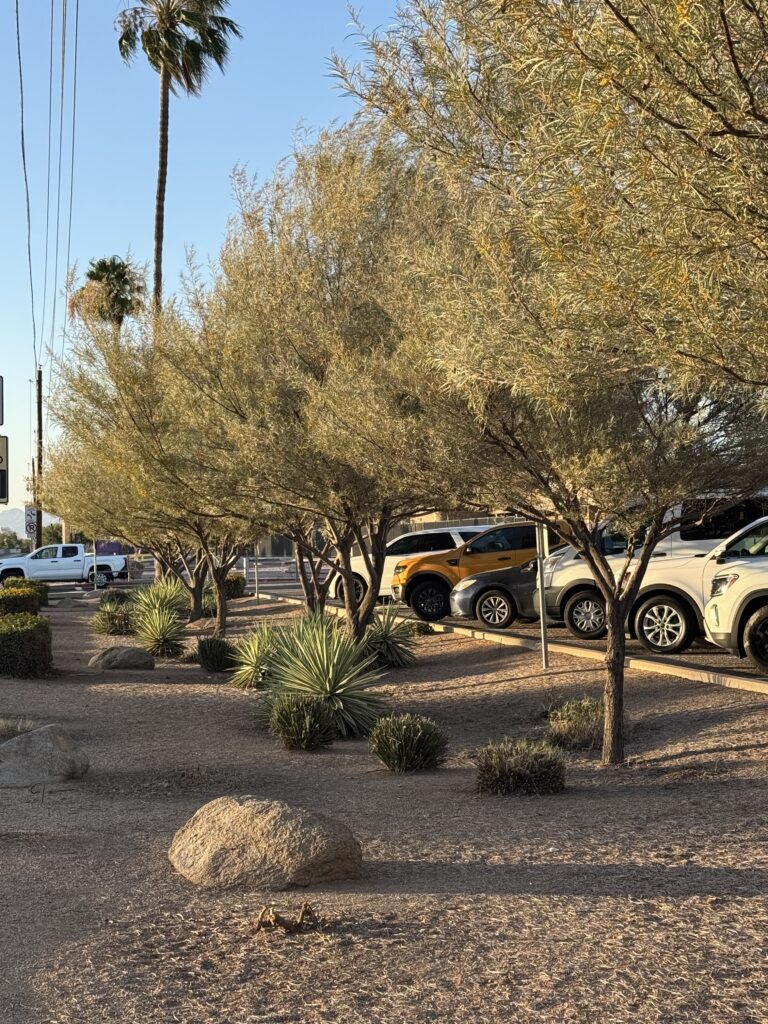
The Mulga Acacia is the tree that commercial and HOA landscapes in Phoenix keep discovering and then wondering why they didn’t plant sooner. It’s evergreen, thornless, drought-adapted, modest in scale, and produces bright sulfur-yellow flowers multiple times a year. It doesn’t heave hardscape, doesn’t create excessive litter, and once established runs on almost no supplemental water. For tight planting spaces — parking lot islands, median strips, entry corridors — it’s one of the most practical trees available in our climate.
But “practical” undersells it. The silver-gray foliage reads as cool and refined in a landscape full of green and brown. The lacy, open canopy filters light rather than blocking it. And the repeated flowering cycles — unlike most trees that bloom once and you wait another year — mean there’s almost always something happening on the tree from spring through fall.
This is one of those trees that works hard and looks good doing it.
What It Is and Where It Comes From
Acacia aneura is native to arid Australia — specifically the interior regions where rainfall is low, soils are shallow and often alkaline, and summer temperatures regularly exceed what most plants can tolerate. “Mulga” is an Aboriginal word with deep cultural roots; the tree figures prominently in Indigenous Australian mythology and has been used for food, tools, medicine, and ceremony for thousands of years. The wood is extremely dense and hard. The seeds have historically been ground into flour. The gum has traditional medicinal uses.
What matters for Phoenix is that the climate this tree evolved in is not that different from ours. Low rainfall, high heat, alkaline soils, and a summer monsoon season that dumps water in a hurry and then stops — the Mulga has been handling those conditions on its own continent for a very long time. It didn’t need much adaptation when it arrived in the Sonoran Desert. It just kept doing what it already knew how to do.
It belongs to the Fabaceae family — the legumes — which means it has the same nitrogen-fixing root associations as Mesquite, Palo Verde, and Desert Ironwood. Like those trees, it contributes to the soil rather than depleting it, building a relationship with nitrogen-fixing bacteria in its root zone that reduces its external nutrient needs and slowly improves the ground it grows in.
Appearance and Growth Habit
The Mulga typically reaches 15 to 20 feet tall with a spread of 12 to 15 feet in Phoenix landscapes — compact enough to fit tight spaces without requiring constant corrective pruning. Growth rate is moderate, meaningfully faster than a Desert Ironwood but not so aggressive that the tree becomes a maintenance problem. In good conditions with supplemental irrigation during establishment, it reaches a usable size within a few years.
The leaves are technically phyllodes — flattened leaf stalks that function as leaves — long, narrow, needle-like, and covered in a fine silvery-gray coating that reflects intense solar radiation. This coating is an adaptation for managing heat and water loss in harsh climates. From a distance, the canopy reads as a soft, cool silver-green — almost luminous in low light, and genuinely distinctive among the trees commonly used in Phoenix commercial landscapes where green dominates.
The branching structure is dense, with reddish-brown to dark gray bark on the branches contrasting against the silver foliage. The canopy naturally extends close to the ground unless the lower branches are pruned up, which is typically done to create the clean umbrella form most commonly seen in landscape applications. Without pruning, the tree can be maintained as a large, dense shrub — useful for screen planting and privacy applications.
The flowers are one of the Mulga’s best features, and the flowering behavior is unusual. Most trees bloom once per year. The Mulga flowers episodically — it may produce three or four bloom cycles in a single year, with the heaviest flush in spring and additional cycles following monsoon rain events in late summer and fall. Each bloom cycle covers the tree in small, sulfur-yellow, rod-shaped flowers about three-quarters of an inch long, brilliant against the silver-gray foliage. The show doesn’t last long per cycle, but the fact that it repeats several times a year means the tree delivers color consistently rather than giving you one week of flowers and eleven months of waiting.
After flowering, small tan seed pods develop and drop — modest litter that’s far less problematic than Palo Verde or Mesquite pods in high-traffic areas.
One important note: the Mulga has no thorns. For commercial properties with pedestrian traffic, parking lots, and areas where people move through plantings, this matters. There’s no conflict between using this tree near walkways and worrying about people getting caught on it.
Sun and Heat Tolerance
Full sun. This tree is built for it. The silvery leaf coating is a direct adaptation for high UV exposure and radiant heat — it reflects rather than absorbs. The Mulga handles Phoenix summers without complaint, including the sustained triple-digit heat of June and July before monsoon breaks, and the combination of intense sun and reflected heat from hardscape that characterizes parking lot and commercial settings.
Cold hardiness is rated to about 15 degrees F — tighter than some trees, but Phoenix rarely tests that limit in most parts of the Valley. In exposed locations that collect cold air during hard freeze events, young trees in their first winter are the most vulnerable. Established trees in normal Phoenix conditions have performed reliably through typical winters. The Arizona State University plant database notes the trees survive normal Phoenix winters without issue.
Water Needs
Once established, the Mulga is one of the more drought-tolerant trees in active use in Phoenix commercial landscapes. The ASU plant database is specific about this: no supplemental irrigation is needed during winter months, and summer irrigation of every one to two weeks is sufficient to maintain strong performance. That’s not a lot of water for a tree that reaches 15 to 20 feet.
The key word is established. During the first one to two years, consistent deep watering is necessary to develop the root system that will sustain the tree long-term. Once that root system is in place, you can taper water significantly and the tree handles the rest.
There are two things to avoid on the water side. First, overwatering. The Mulga is a dry-country tree. Consistently wet soil invites root rot and creates conditions the tree did not evolve for. Well-draining soil is essential — this tree should never sit in saturated ground. Second, overwatering in highly alkaline soils can cause the phyllodes to yellow — the tree shows iron chlorosis when both soil alkalinity and excessive moisture combine. The fix is straightforward: reduce irrigation frequency and apply chelated micronutrient fertilizer. The yellowing clears up quickly once conditions normalize.
Do not plant Mulga Acacia in turf areas or with an understory of high-water plants. The irrigation requirements are fundamentally incompatible.
Soil and Fertilizing
The Mulga tolerates the full range of Phoenix soil conditions — sandy, rocky, clay, alkaline — as long as drainage is adequate. It evolved in Australian desert soils that are not significantly different from what Phoenix delivers. Heavy soil amendment at planting is not necessary. Native soil backfill with modest organic amendment is fine.
Because the Mulga is a legume with nitrogen-fixing root associations, it handles most of its own nitrogen needs through biology. Avoid heavy nitrogen fertilizer inputs — they suppress the nitrogen-fixing relationship without providing anything the tree actually needs, and they tend to produce excessive, weaker vegetative growth.
What does help: organic mulch over the root zone, light compost topdressing in spring, and chelated micronutrients if yellowing appears in highly alkaline conditions. Keep the soil biology active and the tree takes care of most of the rest.
One practical note for irrigation design: spread emitters at varying distances from the trunk rather than clustering them close. This encourages a more dispersed, stable root system and reduces the risk of wind throw — the tree sends roots toward the water, so spreading water sources builds a broader root foundation.
Planting Guide
Best time to plant in Phoenix: Fall — October through November. Warm soil promotes root development while cooler air temperatures reduce stress. The tree gets two mild seasons to establish before its first Phoenix summer.
Planting hole: Wide and no deeper than the root ball — two to three times the root ball diameter. Set at grade. Backfill with native soil or native soil with modest organic amendment. Don’t create a heavily amended planting pocket that drains differently than the surrounding soil.
Spacing: 12 to 15 feet between trees for standalone specimens. The mature canopy spread reaches 12 to 15 feet, so this gives adjacent trees room without crowding. For screen or hedge planting where you want a denser effect, you can tighten spacing to 8 to 10 feet and allow the canopies to grow together.
Island planting: The Mulga is one of the better choices for confined parking lot islands precisely because its mature scale is manageable. Plan for the 12 to 15 foot canopy spread at maturity and give it enough island area to accommodate that without constantly fighting the edges. For very tight small islands, a single tree with no understory keeps it clean and low-conflict.
Mulch: 3 to 4 inches of organic mulch over the root zone, pulled back from the trunk. Organic mulch moderates soil temperature, retains moisture between irrigations, and feeds soil biology as it breaks down. Decomposed granite is common in Phoenix commercial settings but organic mulch is a better long-term choice for the root zone.
Pruning and Maintenance
The Mulga is a low-maintenance tree once established, but the pruning decisions you make early determine the long-term form. Left unpruned, the canopy extends to the ground and the tree reads as a large, dense shrub. For a clean tree form with a raised canopy — the typical commercial landscape application — select your scaffold branches and gradually raise the canopy over the first few years by removing the lowest branches one at a time per season. Don’t rush it.
For ongoing maintenance, periodic thinning is the right approach. Avoid heading back or hedging — cutting branch tips to reduce size — because this stimulates excessive branching at the cuts, creates an unnatural dense outer shell, and weakens the tree’s structure over time. Thin from the inside out instead, removing crossing, rubbing, or crowded branches to maintain the open, airy canopy that makes this tree distinctive.
Do not remove more than 30% of the canopy during summer pruning. Heavy summer pruning removes the foliage that shades the bark, and sunburned bark is an entry point for wood-boring insects. If significant structural pruning is needed, do it in late winter — February through March in Phoenix — before new growth and after cold risk has passed.
The pruning timing and approach here is the same as most desert trees: be conservative, be gradual, use clean sharp tools, and prioritize the tree’s structure over aesthetics in any given season.
Common Problems and Pests
The Mulga is generally clean. It’s been used extensively in Phoenix commercial landscapes for decades and carries a reputation for reliability that it’s earned. That said, a few things come up.
Yellowing phyllodes: The most common issue, and usually the result of overwatering in alkaline soil. Reduce irrigation frequency first. If yellowing persists, apply chelated micronutrient fertilizer. This is not a disease — it’s a chemistry problem that responds to management changes.
Root rot: From consistently wet or poorly drained soil. The Mulga evolved in dry conditions and does not tolerate saturated ground for extended periods. Proper drainage at planting and appropriate irrigation scheduling prevents this. If a tree in heavy clay soil is declining despite normal care, drainage improvement is the first thing to address.
Sucking insects: Aphids, thrips, whiteflies, and psyllids occasionally appear on young trees, most commonly during dry months before monsoon. Spider mites can show up in May and June in dusty conditions. Monitor during the growing season and treat with water spray or insecticidal soap for small populations. For heavy infestation, a systemic soil drench provides longer-term control. These are generally minor and manageable, not the kind of ongoing pest pressure that makes a tree high-maintenance.
Wood borers: The entry point for borers is typically sunburned or stressed bark. Avoid summer over-pruning that exposes bark to direct sun, maintain appropriate irrigation, and keep the tree healthy — a stressed tree is far more vulnerable to borer damage than a well-managed one.
Wind throw: Less common with well-established trees, but possible in young trees that were irrigated only at the trunk base and developed a shallow, narrow root system. Spread irrigation emitters at varying distances from the trunk to encourage roots to range outward. A dispersed root system is a stable root system.
Why This Tree Works for Commercial and HOA Properties
There’s a specific set of problems that commercial landscape managers in Phoenix deal with repeatedly: trees that get too large for their planting spaces, trees that produce excessive litter that ends up in drains and gutters, trees with thorns that create liability near walkways, trees that require high water in a climate where water costs are significant, and trees that go through one bloom cycle a year and look unremarkable the other eleven months.
The Mulga Acacia addresses most of that list. It stays within a manageable scale for most commercial planting situations. Its litter is modest — small seed pods rather than the large messy pods of Mesquite or the flower/seed rain of Palo Verde. It has no thorns. Its water needs after establishment are genuinely low. And it blooms multiple times a year, which means the property looks like something is happening in the landscape more consistently than single-bloom trees allow.
It also photographs well — the silver-gray foliage and yellow flowers against desert hardscape is a combination that reads as intentional and designed rather than utilitarian. For properties that care about curb appeal, that matters.
Frequently Asked Questions
How fast does a Mulga Acacia grow?
Moderate. Meaningfully faster than a Desert Ironwood, not as fast as a Desert Willow in its peak years. In Phoenix with appropriate establishment irrigation, you can expect it to reach a useful landscape size within three to four years. It’s not a quick-shade tree, but it’s also not asking you to wait a decade to see results.
Does the Mulga bloom every year?
Yes — and more often than most trees. It can produce three to four bloom cycles in a single year, with spring being the heaviest flush and additional cycles following monsoon rains in late summer and fall. Each cycle is relatively brief, but the episodic repeat flowering is one of the tree’s real assets compared to single-bloom species.
Are there thorns?
No. The Mulga Acacia is thornless. This is a meaningful advantage in parking lots, commercial corridors, and any planting situation where people move through or around the tree.
Can it go in a parking lot island?
Yes — this is one of the better trees for tight island planting in Phoenix. Its mature scale (15 to 20 feet tall, 12 to 15 feet wide) is manageable in confined spaces, it doesn’t produce excessive litter, and its thornless, moderate canopy doesn’t conflict with pedestrian traffic or nearby structures the way larger trees can. For very small islands, a single Mulga with no understory is a clean, low-conflict choice.
What causes the leaves to turn yellow?
Usually overwatering in alkaline soil — a fairly common combination in Phoenix commercial landscapes with automated irrigation. The Mulga shows iron chlorosis when soil stays too wet in high-pH conditions. Reduce irrigation frequency first. If that doesn’t resolve it within a few weeks, apply chelated micronutrient fertilizer. It’s a management issue, not a disease, and it responds well to the right correction.
How much water does an established Mulga need?
In Phoenix summers, deep watering every one to two weeks is sufficient for strong performance. During winter, supplemental irrigation is generally not needed. After good establishment — typically two years with consistent deep watering — the tree manages well on a low-frequency summer schedule supplemented by monsoon events. This is genuinely one of the more water-efficient trees available in our climate at this size and growth rate.
Is it related to the Desert Ironwood?
Not closely — they’re different genera — but both belong to the legume family (Fabaceae) and share the nitrogen-fixing root biology that makes legume trees beneficial to the soil around them. In the Arrowhead Fountains landscape plan, we use them as companion trees: Desert Willow and Mulga Acacia alternating along Arrowhead Fountains Center Drive, with Mulga as the sole tree in smaller parking lot islands where scale matters.