
Callistemon viminalis (Weeping Bottlebrush) / Callistemon citrinus (Lemon Bottlebrush) | Also called: Weeping Bottlebrush, Crimson Bottlebrush, Scarlet Bottlebrush
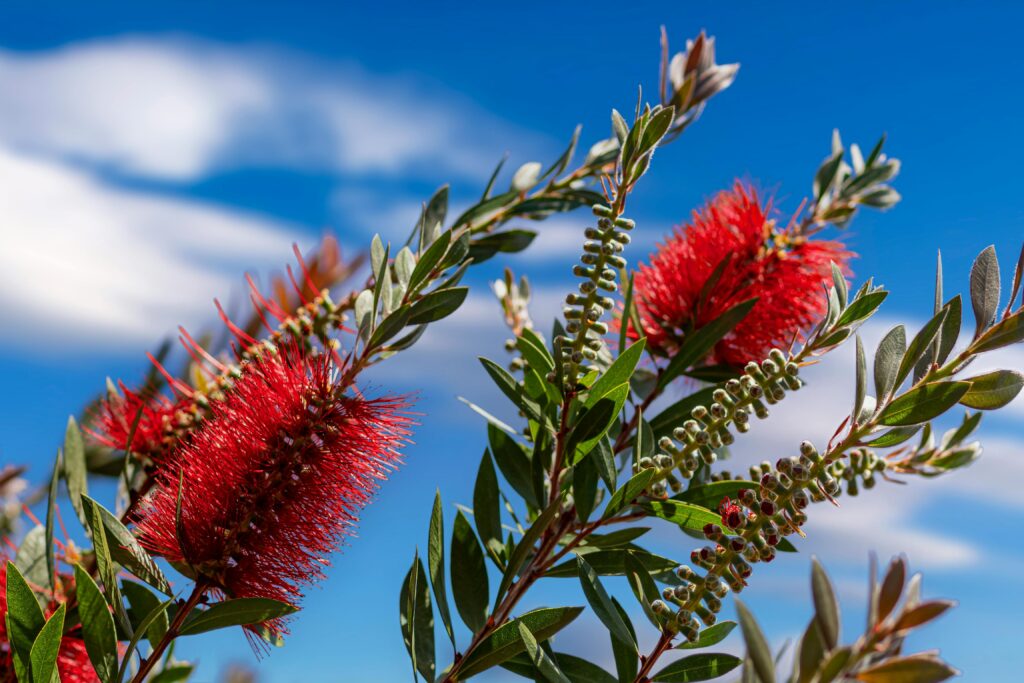
The Bottlebrush is one of those trees that earns its place in Phoenix landscapes on looks alone. The flowers are unlike almost anything else you can grow here – dense, cylindrical spikes of brilliant red stamens that look exactly like the brushes you’d use to clean a water bottle. When this tree is in bloom, it stops people in their tracks. Hummingbirds treat it like a drive-through.
It’s widely planted across the Valley and available at pretty much every nursery. But here’s the thing most people don’t find out until after they’ve already planted one: the Bottlebrush has a genuine compatibility issue with Phoenix soils that needs to be understood upfront. Not to talk you out of it – plenty of beautiful Bottlebrush trees thrive here. But going in with realistic expectations and the right approach from day one makes the difference between a tree that flourishes and one that slowly yellows out on you.
What It Is and Why Phoenix Is a Mixed Bag
The Bottlebrush is native to Australia, and that’s where the complexity begins. Australia is a big continent with wildly different growing conditions across it. The Bottlebrush species most commonly planted in Phoenix – the Weeping Bottlebrush (Callistemon viminalis) and the Lemon Bottlebrush (Callistemon citrinus) – are native to the northeastern coastal regions of Queensland, where they grow along creek beds, in seasonally wet areas, and in slightly acidic to neutral soils. That natural habitat is meaningfully different from the alkaline, low-organic-matter, salt-accumulating soils of the Salt River Valley.
This matters because Phoenix soils typically run 7.5 to 8.5 pH, and Bottlebrush prefers 5.5 to 7.0. That gap isn’t trivial. High pH locks up iron in a form that plant roots can’t access, and the Bottlebrush is notoriously iron-hungry. The result, in many Phoenix yards, is iron chlorosis – the classic yellowing between the leaf veins while the veins themselves stay green. It’s the most common problem people run into with this tree and the one most worth understanding before you plant.
Weeping vs. Lemon: Which One for Phoenix?
These are the two species you’ll most commonly encounter at Valley nurseries, and they’re worth distinguishing.
Weeping Bottlebrush (Callistemon viminalis) is the better choice for Phoenix. ASU’s plant database puts it plainly: the Weeping Bottlebrush is “the best acclimated of the former Callistemon species to the harsh environment of the Phoenix area.” It handles our alkalinity better, it tolerates the heat better, and it’s the one most likely to perform well long-term here without constant intervention.
Lemon Bottlebrush (Callistemon citrinus) is beautiful and widely sold, but it’s more demanding in our conditions. Arizona State University’s plant library at one point described it as “mostly useless in Phoenix” due to soil incompatibility and chlorosis susceptibility. That’s a strong statement, and plenty of people grow it successfully here – but it requires more active management of soil conditions to keep it healthy. If you’re newer to gardening or want lower-maintenance, the Weeping Bottlebrush is the smarter starting point.
Both bloom in shades of red. The Lemon Bottlebrush has a faint citrus scent when you crush the leaves, which is where the name comes from.
Appearance and Growth Habit
The Weeping Bottlebrush lives up to its name. It develops a graceful, pendulous form – upright trunk or trunks with long, arching branches that drape downward, foliage that clusters toward the branch tips creating a curtain-like effect. It’s one of the more elegant-looking trees you can grow in Phoenix, and the weeping silhouette gives it a distinctive character that most desert-adapted trees don’t have.
Mature size is typically 15 to 25 feet tall in Phoenix, though established specimens can push larger. Width varies significantly based on pruning – left alone, the canopy spreads broadly. The bark becomes gray and fissured with age and develops real character.
The leaves are narrow, lance-shaped, and leathery – evergreen, which is a meaningful advantage over the deciduous trees. The Bottlebrush holds its foliage year-round, making it useful as a screen, a privacy planting, or an anchor in a design that needs something with winter presence.
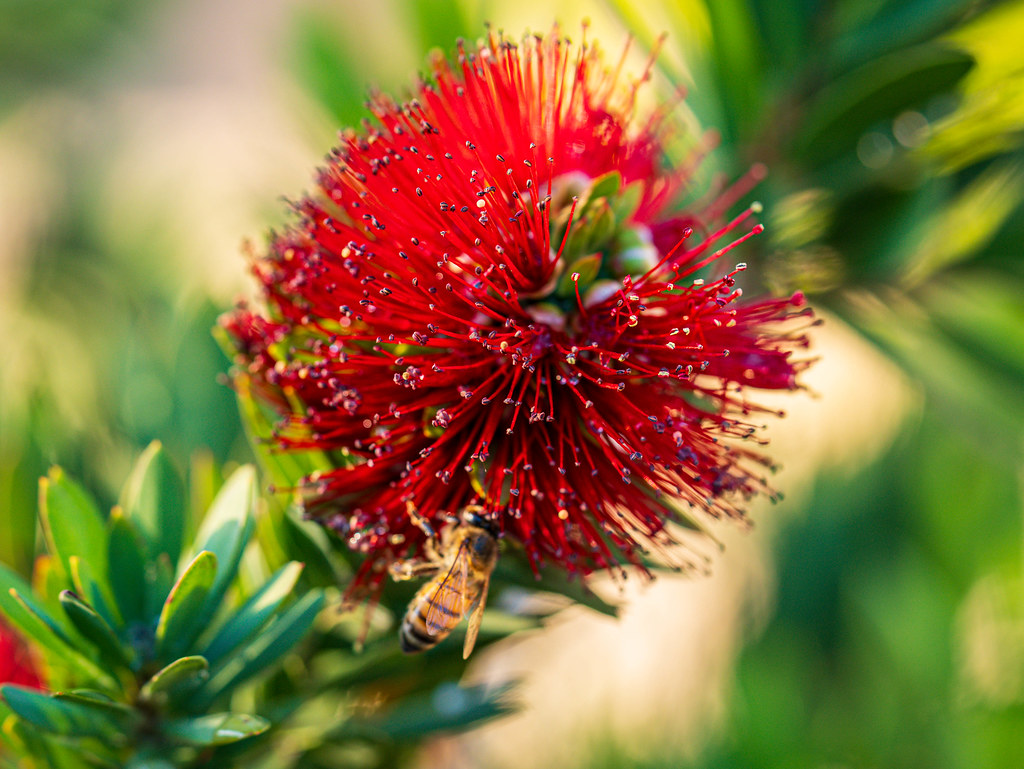
The flowers are the reason most people plant it. Dense, cylindrical spikes of red stamens – typically 3 to 4 inches long – appear in clusters along the branches in spring, with a second flush in fall, and sporadic blooming in between during favorable conditions. The individual flowers are technically tiny, with small greenish petals that drop quickly – it’s the long, showy stamens that create the visual impact and the common name.
After flowering, the tree produces small, hard, round seed capsules that sit along the branches in rows and can persist on the tree for years. They’re not particularly ornamental but they’re not objectionable either.
Sun and Heat Tolerance
Full sun. The Bottlebrush needs at least 6 to 8 hours of direct sun to bloom well and stay healthy. It came from coastal Queensland, which is warm and sunny, and it performs best when given those conditions here.
It tolerates Phoenix heat reasonably well, especially the Weeping species. That said, it’s not as heat-bulletproof as true desert-adapted trees. During extreme heat stretches – the weeks of sustained 110+ degree days in June and July – Bottlebrush trees that are stressed by poor soil conditions, inadequate water, or chlorosis will show it more than a plant like a Desert Willow or a native Palo Verde would under the same conditions. The better the soil health and the more consistent the irrigation, the better it handles summer.
Cold hardiness is around 20 degrees F. Phoenix proper rarely tests that limit, but in colder pockets of the Valley – north and east suburbs, higher elevations – a hard freeze can cause leaf damage or worse. Established trees bounce back from a light frost but a sustained hard freeze can cause significant dieback.
Water Needs
This is where the Bottlebrush differs most from the drought-tolerant trees in these guides. It is not a dry desert plant. It comes from creek-bank environments and it needs more water than a Desert Willow or a Vitex to perform at its best.
During establishment (first 1-2 years): Water deeply every 5 to 7 days during the warm months. This tree is building the root system that will allow it to handle Phoenix summers, and it needs consistent moisture to do that. Don’t let a newly planted Bottlebrush dry out completely between waterings in its first summer.
Once established: Deep watering every 1 to 2 weeks during the growing season. More frequently during the hottest stretches of June and July. Every 3 to 4 weeks in winter. This is a “moderate water use” tree in Phoenix terms – not a water hog, but not a once-a-month plant either.
The drainage requirement: Here’s the tension that catches people in Phoenix. The Bottlebrush wants consistent moisture, but it absolutely cannot sit in waterlogged soil or have standing water around its roots. Good drainage is not optional. In Phoenix’s clay-heavy soils, this can be a challenge to manage – the soil holds water longer than it looks like it should. Consistent moisture without waterlogging is the target.
Overwatering in poorly drained soil is a fast path to root rot with this tree. Underwatering shows up as brown leaf tips and flagging. The sweet spot is regular, deep irrigation with a soil that drains between cycles.
Soil and Fertilizing – The Most Important Section for Phoenix
This is where you have to pay the most attention with Bottlebrush.
Phoenix soils run 7.5 to 8.5 pH. The Bottlebrush wants 5.5 to 7.0. That alkalinity gap means that even when iron is physically present in your soil – and it almost certainly is – the tree can’t access it. Iron at high pH becomes chemically bound in forms that roots can’t take up. The result is iron chlorosis, which if left untreated becomes a chronic condition that weakens the tree over time.
What this means at planting: Unlike the Desert Willow or Vitex, where we say “backfill with native soil and don’t overthink amendments,” the Bottlebrush benefits from more attention to the planting hole. Incorporating quality compost into the backfill lowers the immediate pH around the root zone, adds organic matter that feeds soil biology, and creates a more favorable environment for the tree’s early root development. This isn’t about creating a rich planting pocket – it’s about moderating the pH chemistry the roots encounter as they establish.
Surface mulching with organic material (wood chips, decomposed compost) rather than gravel does the same thing over time – as it breaks down, it adds organic acids and feeds microbial activity that helps make nutrients more available.
Managing iron chlorosis: Even with good planting practices, Phoenix’s alkalinity can bring on chlorosis in Bottlebrush, especially in the first few years and during peak summer heat when soil chemistry is at its most extreme. When you see it – yellow leaves with green veins, starting on the newest growth – don’t ignore it.
The most effective treatment in alkaline soils is chelated iron, not regular iron sulfate. Chelated iron stays in a plant-available form even at high pH, where standard iron compounds become insoluble quickly. Apply chelated iron to the root zone according to label directions, and expect to see improvement within a week or two. This may be an annual or semi-annual practice for Bottlebrush in Phoenix, not a one-time fix.
Building soil organic matter and biology over time is the longer-term approach. Healthy soil biology – the bacteria, fungi, and microbial communities that cycle nutrients – helps make iron and other micronutrients more available to roots even in high-pH conditions. This is why consistent organic inputs matter: compost, worm castings, organic mulch. You’re building the underground system that allows the tree to access what the soil contains.
On synthetic fertilizers: Skip them. They add to the salt load in soil that already struggles with salt accumulation. They don’t address the pH and biology problems that actually limit nutrient availability in Phoenix. And for a tree already managing alkalinity stress, the last thing it needs is more salt competing with nutrient uptake in the root zone. Feed the soil with organic inputs and address iron specifically if chlorosis appears.
Planting Guide
Best time to plant in Phoenix: Fall is the clear first choice – October through November. Three mild seasons ahead for root development before the first real summer. Spring (February through April) is the second option. Avoid summer planting if at all possible; a Bottlebrush going into poorly drained, hot Phoenix soil in June is starting from behind.
Planting hole: Wide and no deeper than the root ball. Two to three times the root ball diameter. Set the crown at grade or very slightly above – you don’t want any settling to put the crown below grade where water pools. Unlike purely desert-adapted trees, a modest amount of compost mixed into the backfill is appropriate here – around 25% compost to 75% native soil is a reasonable ratio. Don’t go heavier than that or you create a drainage boundary between the rich planting mix and surrounding native soil.
Check for caliche: If you hit a hardpan caliche layer during digging, break through it. A Bottlebrush sitting above an impermeable caliche layer with water pooling at the roots is going to struggle. Either break through and plant, or pick a different spot.
Mulch: 3 to 4 inches of organic mulch over the root zone, pulled back from the trunk. For the Bottlebrush specifically, organic mulch rather than decorative gravel is more than aesthetic preference – it actively moderates soil temperature, retains moisture, and breaks down to add organic matter and mild acidity to the surface soil over time.
Training decisions: The Weeping Bottlebrush naturally wants to grow as a multi-trunk shrub. Training it to a single or multi-trunk tree form requires early, consistent attention. ASU’s plant database notes to “train rigorously when young to attain upright form and remove crossing branches.” This isn’t a set-it-and-forget-it process – the form requires real commitment in the first few years to establish.
Pruning and Maintenance
Timing: Prune after the spring bloom flush, not before it. Pruning in late winter or early spring cuts off the flower buds about to open and sacrifices your best show of the year. Wait until the main spring flowering has finished – typically May or June in Phoenix – then do your structural pruning and shaping.
Light summer pruning after flowering encourages branching and can improve the density of the canopy. The Bottlebrush blooms on new wood, so pruning promotes new growth that will carry flowers.
Form maintenance: The weeping form has a tendency to get dense and layered with time, with interior branches that die from lack of light. Periodic thinning of the canopy interior improves air circulation and light penetration, which keeps the tree healthier and reduces disease pressure.
Avoid heavy shearing: Treating the Bottlebrush like a hedge and shearing it into a ball is a common mistake. It removes flowering wood, creates a dense outer shell with dead interior, and turns a graceful tree into something that looks awkward. Selective hand pruning is the right approach.
Suckers and base shoots: Remove them regularly. If you’re growing a tree form, these compete with the structure you’re trying to establish.
Common Problems and Pests
Iron chlorosis: The most common problem by far in Phoenix. Yellow leaves with green veins, starting on the newest growth, appearing during the growing season. Treated with chelated iron applied to the root zone. Prevented long-term through organic matter building, consistent mulching, and attention to pH conditions at planting. This is a chronic management issue for Bottlebrush in the Valley, not a one-time fix.
Root rot: Caused by poor drainage or overwatering. Symptoms look like drought stress – wilting, decline, yellowing – which leads to more watering and a downward spiral. If a Bottlebrush is declining and you can’t attribute it to underwatering or chlorosis, look at drainage first.
Scale insects: Armored scale can attach to stems and branches, feeding on sap and causing yellowing and decline. Small populations often go unnoticed. Larger infestations show up as crusty, barnacle-like clusters on woody stems. In a yard with healthy soil biology and beneficial insect activity, scale populations rarely get out of hand. Horticultural oil applied during cooler months can address established infestations without broad disruption to beneficial insects.
Aphids: Common on new growth, especially in spring. Same management philosophy as with other trees – observe before intervening, give the predator population time to respond. A healthy yard ecosystem handles aphids. Spraying takes out the predators that would otherwise do the job for you.
Cold damage: Below about 20 degrees F, the Bottlebrush will show leaf damage or dieback. In Phoenix proper this is a rare event, but it happens in outlying areas and in particularly hard winters. Established trees usually recover. Young trees in their first winter are more vulnerable.
Lack of flowering: Usually caused by one of three things – too much shade, over-pruning at the wrong time (before the bloom flush), or significant chlorosis weakening the tree. Address whichever applies.
Frequently Asked Questions
Why are my Bottlebrush leaves turning yellow?
Almost certainly iron chlorosis. Phoenix soils are too alkaline for the Bottlebrush to consistently access iron, even when iron is physically present in the soil. Yellow leaves with green veins, starting on new growth, is the classic sign. Treat with chelated iron applied to the root zone. Build organic matter over time to improve soil biology and nutrient availability. This is a recurring management task for Bottlebrush in Phoenix, not a problem you solve once and forget.
How much water does a Bottlebrush need in Phoenix?
More than most desert-adapted trees. Once established, plan on deep irrigation every 1 to 2 weeks during the growing season, tapering to every 3 to 4 weeks in winter. During the hottest weeks of summer, lean toward the more frequent end of that range. The tree needs consistent moisture but cannot tolerate waterlogged soil – good drainage is essential.
What’s the difference between Weeping Bottlebrush and Lemon Bottlebrush?
Both bloom red and both are widely sold in Phoenix. The Weeping Bottlebrush (Callistemon viminalis) is better suited to Phoenix – it handles alkalinity and extreme heat better and is the one most likely to perform well here long-term. The Lemon Bottlebrush (Callistemon citrinus) is more susceptible to chlorosis in our conditions and requires more active soil management. When in doubt, go with the Weeping Bottlebrush.
Does Bottlebrush lose its leaves in winter?
No – it’s evergreen. This is one of its genuine advantages over deciduous flowering trees. It holds its foliage year-round, making it useful as a screen or privacy planting where you need visual coverage in winter.
How do I keep my Bottlebrush from getting leggy and sparse?
Light pruning after the spring bloom encourages new growth and helps maintain density. Avoid shearing it into a ball – that creates a dense outer shell with dead interior and removes the flowering wood. Selective thinning and shaping after bloom is the right approach. Making sure it’s getting full sun also matters – a Bottlebrush in too much shade stretches toward light and loses the tight, graceful form it can have in full sun.
Is Bottlebrush a good privacy screen?
It can work well for this. It’s evergreen, it gets tall and wide enough to block views, and it’s faster-growing than some alternatives. The weeping form means the canopy is fairly dense. Just understand that it needs enough water to stay full and healthy, and in Phoenix’s alkaline soil, you’ll likely be managing chlorosis as a recurring task.
The Bottlebrush is one of the most visually striking trees you can grow in Phoenix – the flowers are genuinely spectacular and the weeping form is elegant in a way that few other trees here can match. The tradeoff is that it’s more demanding than true desert-adapted trees. Iron chlorosis is a real and ongoing management challenge in our alkaline soils, and it needs more water than many Phoenix staples. That’s not a reason to avoid it, but it’s a reason to go in with your eyes open. Plant the Weeping Bottlebrush over the Lemon Bottlebrush, pay attention to soil health from day one, use chelated iron when chlorosis appears, and give it consistent irrigation. Do those things and this tree can be genuinely stunning.