
Vitex agnus-castus | Also called: Chaste Tree, Chasteberry, Monk’s Pepper Tree, Lilac Chaste Tree
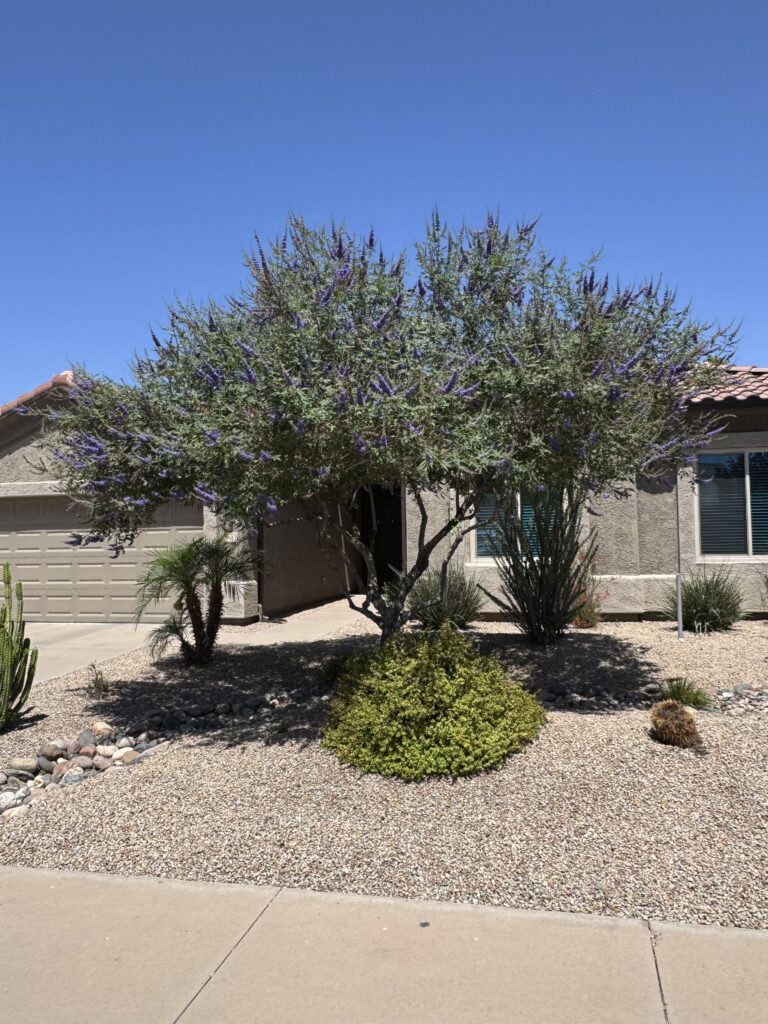
If you want a tree that blooms its head off in the Phoenix summer heat while everything else looks like it’s surviving rather than thriving, the Vitex deserves a serious look. Long, upright spikes of lavender to purple flowers cover the canopy from late spring through summer, the foliage smells faintly of sage when you brush against it, and hummingbirds and butterflies find it reliably. It’s not a native, but it’s about as well-suited to our climate as a Mediterranean import gets.
The Vitex is also commonly confused with being more temperamental than it is. Once you understand what it wants – and more importantly, what to avoid – it’s one of the more straightforward trees to grow here.
What It Is and Why It Works Here
Vitex agnus-castus is native to southern Europe and western Asia, particularly the Mediterranean region. It’s been cultivated for thousands of years – both as an ornamental and for medicinal use. The common name “Monk’s Pepper” comes from medieval monks who reportedly chewed the leaves to help suppress appetite and, according to lore, certain other urges. The name Chaste Tree has the same origin. Whether any of that actually worked is debatable. What isn’t debatable is that the tree thrives in hot, dry climates with alkaline soils and extended sun, which puts Phoenix squarely in its comfort zone.
It belongs to the Lamiaceae family – the same family as mint, sage, and lavender – which explains the aromatic foliage. That Mediterranean origin also explains the drought tolerance and the preference for well-drained soils. This tree evolved where summers are hot and dry and winters are mild. Sound familiar.
One thing worth noting upfront: Vitex has been flagged as a potential invasive in parts of Arizona due to its tendency to self-seed readily in irrigated landscapes. It’s not prohibited, and it’s widely planted here, but it’s worth understanding. The seeds germinate easily, and in a yard with consistent irrigation, volunteer seedlings will show up. Managing spent flowers and staying on top of seedlings keeps this from becoming a problem.
Appearance and Growth Habit
In Phoenix, Vitex typically reaches 15 to 20 feet tall and wide at maturity, though size varies by cultivar and pruning approach. Growth is moderate to fast – this is not a slow tree, especially when young and well-watered. You can expect meaningful size within a few seasons.
The natural habit is multi-trunk and spreading, with an arching, rounded canopy that becomes genuinely beautiful as the tree develops. The trunks are gray and slightly gnarled with age, similar in character to a crape myrtle. In fact, the Vitex is often used as a crape myrtle substitute in Phoenix – same general size class, similar flower timing, similarly dramatic when in bloom.
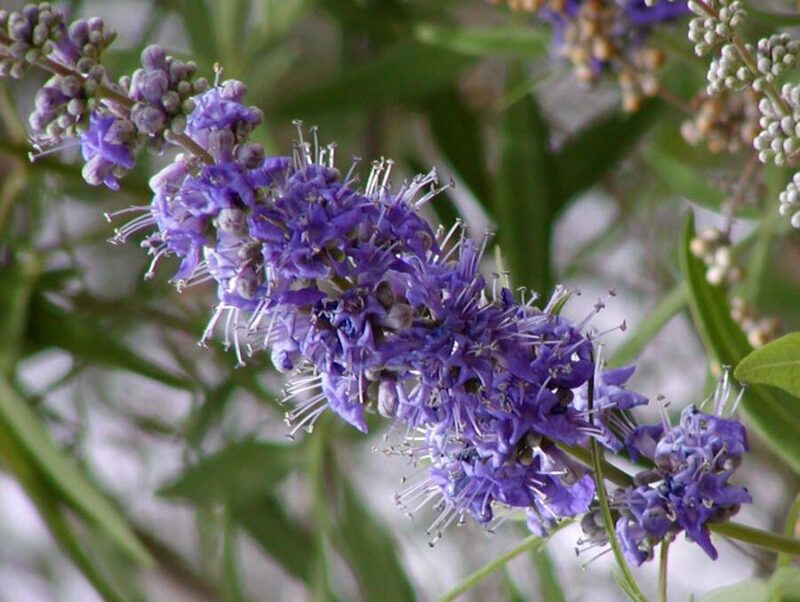
The leaves are palmate and compound – think five to seven narrow leaflets arranged like fingers on a hand, gray-green on top with silvery undersides. The foliage has a pleasant, faintly peppery sage-like scent when crushed. It’s subtle from a distance but noticeable if you brush against a branch.
The flowers are the main event. They appear as long, upright spikes – up to 12 inches tall – at the tips of every branch, packed with small tubular blooms in shades of lavender, violet, blue, pink, or white depending on the cultivar. The primary bloom flush in Phoenix happens in May and June, when the tree flowers intensely. With deadheading, a second flush follows in late summer. Bees, butterflies, and hummingbirds all work the flowers heavily.
Like the Desert Willow, Vitex is deciduous. Leaves drop in late fall and the tree is bare through winter. Plan your placement accordingly – a Vitex in a prominent spot will look great from April through October and very bare from November through March.
A Note on the “Ugly in Winter” Reality
The ASU plant database describes the Vitex’s character as “bimodal” – beautiful in summer, bare and unattractive in winter. That’s an accurate description. The winter silhouette isn’t as sculptural as some deciduous trees. It’s just sticks and seed clusters.
This isn’t a reason not to plant it. It’s a reason to plant it where the winter appearance either doesn’t matter much or where it’s paired with evergreen companions that carry the visual weight from November through March. A Vitex parked alone in the middle of a front yard will catch people off guard every winter. In a mixed planting with something that holds green through the cold months, it’s a non-issue.
Sun and Heat Tolerance
Full sun. The Vitex is not a shade plant and will not flower well in filtered light. It wants direct sun for at least 6 to 8 hours a day, and it actively benefits from reflected heat. This is a tree that blooms harder in Phoenix’s June heat than in cooler climates where it flowers in mid to late summer. Our heat is its accelerant.
Plant it where it gets full exposure. South and west-facing exposures are ideal. Don’t park it on the north side of the house where it’ll be in afternoon shade and then wonder why it isn’t flowering like it should.
Water Needs
The Vitex has a well-earned reputation as drought-tolerant, but like most trees, the establishment period is when you have to pay attention.
During establishment (first 1-2 years): Water deeply every 7 to 10 days during the warm months. Every 2 to 3 weeks during winter. Deep and thorough, not shallow and frequent. You’re building a root system, and shallow watering produces shallow roots that keep the tree dependent on irrigation and more vulnerable to stress long-term.
Once established: Deep watering every 2 to 4 weeks during the growing season. Monthly or less in winter. Some established Vitex trees in the Valley get by on very minimal supplemental irrigation once their roots are down. The tree will survive lean conditions, but consistent deep watering during the growing season produces better growth and more flowers.
The critical variable – water and flowers: This is one of those trees where the water relationship is counterintuitive. More water produces lusher, faster growth, but fewer flowers. The Vitex tends to flower more prolifically under moderate stress – not severely dry, but not kept constantly moist either. Overwatered Vitex trees often put on a lot of leaves and not much bloom. Deep, infrequent irrigation is the right approach both for root development and for getting the flowering performance you planted it for.
What to avoid: Root rot from poor drainage or overwatering is the most common serious problem. This is especially relevant in Phoenix’s clay-heavy soils where water doesn’t drain as fast as it looks like it should. Good drainage is essential.
Soil and Fertilizing
The Vitex is tolerant of our alkaline, mineral-rich Phoenix soils in a way that many non-native trees are not. It handles high pH without the persistent iron chlorosis problems you see in plants that really struggle with alkalinity. It’s also genuinely salt-tolerant, which matters in the Salt River Valley where irrigation water continuously deposits minerals in the root zone.
It prefers well-drained soil above almost anything else. Loose, open soil that doesn’t hold standing water is what this tree wants. Heavy clay that stays wet is its enemy.
On fertilizing: the Vitex doesn’t need heavy feeding and in fact flowers less when pushed too hard with nitrogen. Nitrogen drives leafy growth at the expense of blooms, which is the opposite of what most people are after with this tree. A light organic compost topdress in spring is plenty – you’re feeding the soil biology, which in turn keeps nutrients cycling and available. That’s a fundamentally different approach than dumping synthetic fertilizer at the base and calling it done.
The broader point applies here as it does throughout Phoenix landscapes: our soils aren’t nutrient-poor, they’re biologically limited. Nutrients are present but chemically locked up by high pH, salt accumulation, and low organic matter. Building soil biology through consistent organic inputs is the approach that pays off long-term. Synthetic fertilizers add to the salt load in a soil that already struggles with salt accumulation and don’t address the root cause of nutrient unavailability.
Planting Guide
Best time to plant in Phoenix: Fall is ideal – October through November. The mild temperatures give the root system time to develop before the first real summer. Spring planting after frost risk has passed (February through April) also works well. Avoid planting in the peak of summer if you can help it – the establishment watering demands are much higher and the stress on the plant is significant.
Planting hole: Wide and shallow – two to three times the diameter of the root ball, no deeper than the root ball itself. Set the crown slightly above grade. Vitex does not want to sit in a depression where water pools around the base.
Spacing: Plan for the mature spread. These trees reach 15 to 20 feet wide. Giving them 15 feet of clearance from structures and other large plants isn’t overcautious, it’s realistic. A crowded Vitex will require constant corrective pruning that stresses the tree and reduces flowering.
Soil amendments: Backfill with the native soil. Don’t create a rich planting pocket surrounded by native desert soil – the abrupt transition creates drainage problems as water moves between the two soil types. If your soil is heavily compacted, modest compost addition is fine, but keep it light.
Mulch: 3 to 4 inches of organic mulch over the root zone, kept away from the trunk. Standard practice for any Phoenix tree, and especially important here given the Vitex’s preference for consistent soil moisture without waterlogging.
Form decisions at planting: If you want a tree form rather than a shrub, select 3 to 5 strong trunks at planting and remove the rest. You’ll also need to remove lower branches gradually over the first few years to raise the canopy to the height you want. Do this slowly – removing too many lower branches too soon can stress the tree and lead to sunburn on the exposed trunk.
Pruning and Maintenance
The Vitex blooms on new wood, which means pruning encourages more flowering rather than less. This is important to understand because it flips the usual pruning anxiety – you can’t really over-prune this tree into a non-blooming state the way you can with plants that set flower buds on old wood.
Main pruning – late winter: Before new growth emerges – February in Phoenix – is the time for structural pruning and size management. Remove dead, crossing, and weak branches. Trim back the previous season’s growth by up to one-third if you want to control size and encourage branching. This is when to do any form training and sucker removal as well. The bare winter silhouette makes it easy to see the structure and make good decisions.
Deadheading for a second flush: After the main May-June bloom, removing the spent flower spikes before they set seed does two things. First, it redirects the tree’s energy away from seed production and back into growth and flowering. Second, it encourages a second flush of blooms in late summer. On a young or smaller tree, deadheading is practical and worth doing. On a large, mature specimen, deadheading the entire canopy becomes impractical – do what you can reach and let the rest go.
Suckers: The Vitex throws suckers from the base regularly. On a tree form, these need to come off. Remove them when they’re small rather than letting them develop into competing stems.
Self-seeding: The berries that follow the flowers contain seeds that germinate readily in irrigated soil. If you’re finding volunteer seedlings popping up around the yard, consistent deadheading significantly reduces this. Keeping up with seedlings when they’re small is much easier than dealing with established ones later.
Common Problems and Pests
The Vitex is genuinely low-maintenance once established. The problems that do come up are mostly cultural.
Root rot: Caused by poor drainage or overwatering. Symptoms look like drought stress – wilting, yellowing, decline – which leads people to water more and compound the problem. If a Vitex is declining and you can’t point to drought as the cause, drainage is the first thing to evaluate.
Aphids, whiteflies, scale: Occasional. In a yard with healthy soil biology and beneficial insect habitat, these populations rarely get out of hand on their own. The predatory insects that keep them in check – parasitoid wasps, lacewings, ladybugs – will find them if the ecosystem is in place. Spraying disrupts exactly those populations and tends to produce a rebound pest outbreak worse than the original. Observe before intervening, and give the system time to respond.
Leaf spot: A fungal issue that shows up when conditions are too wet – overwatering, poor air circulation, or a particularly humid stretch. Fixing the watering is the solution, not a fungicide.
Lack of flowering: Usually one of three causes. Not enough sun. Too much water keeping the tree in vegetative growth mode. Or heavy nitrogen inputs pushing leaves at the expense of blooms. Address whichever applies.
Winter appearance: Not a pest issue, but worth repeating – the tree is fully bare from roughly November through March in Phoenix. It’s unattractive in winter. That’s just what it is. Plan your planting location with that in mind.
Self-seeding in the landscape: Not a traditional pest problem but worth treating as a maintenance issue. Stay on top of volunteer seedlings and manage spent flowers if the self-seeding is getting ahead of you.
Frequently Asked Questions
How much water does a Vitex need in Phoenix?
Deep watering every 2 to 4 weeks during the growing season once established, tapering to monthly in winter. During the first two years, water every 7 to 10 days during summer to develop the root system. The consistent mistake is watering too often – deep and infrequent produces a better root system and actually more flowers than frequent shallow irrigation.
Why is my Vitex not blooming well?
The most common causes in Phoenix are too much shade, overwatering, or too much nitrogen fertilizer. All three push vegetative growth at the expense of flowers. The Vitex flowers best in full sun under moderate irrigation. It should be slightly lean on water and fertility, not pampered.
Does Vitex lose its leaves in Phoenix?
Yes. It’s deciduous and drops its leaves in late fall, staying bare through winter before leafing out again in spring. This is normal. The spring leafout in Phoenix can be surprisingly late – don’t panic if it’s still bare in February. March is when things typically get moving.
Is Vitex invasive in Arizona?
It’s been listed as a potential invasive concern in Arizona due to its ability to self-seed readily in irrigated landscapes. It’s not prohibited and is widely planted across the Valley. Managing it responsibly means staying on top of seedlings and deadheading spent flowers to reduce seed production. If you’re planting near a natural desert wash or undisturbed area, that’s worth thinking about more carefully.
Can I grow Vitex as a shrub instead of a tree?
Yes, and it’s actually the tree’s natural inclination. Left unpruned, it grows as a large multi-trunk shrub. Shaping it into a tree form requires consistent early training and ongoing sucker removal. Both forms work well – the choice comes down to what fits your space and how much form maintenance you want to commit to.
How do I get my Vitex to bloom a second time?
Deadhead the spent flower spikes after the main May-June bloom flush. Cut the faded spikes back to just above a leaf node. This removes the developing seed heads and signals the tree to produce another round of new growth and flowers. In Phoenix’s long growing season, a second bloom flush in August or September is very achievable with consistent deadheading.
The Vitex is a reliable, high-performing flowering tree for Phoenix that earns its place in the landscape. The flowers are showy and long-lasting, the pollinators love it, it handles our heat and alkalinity without complaint, and once established it runs on relatively little water. The tradeoffs are real – it’s bare and unattractive in winter, it requires consistent pruning attention if you want a clean tree form, and the self-seeding tendency is worth managing actively. For most yards, those are manageable. If you want bold summer color from a tree that actually belongs in our climate, this one belongs on the short list.