
Chilopsis linearis | Also called: Flowering Willow, Mimbre, Desert Catalpa
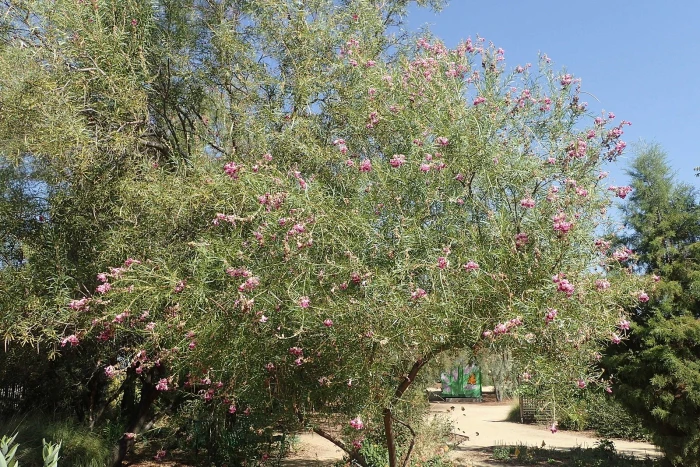
The Desert Willow might be the best flowering tree for Phoenix that most people underestimate. It’s native, it’s tough, it blooms from late spring all the way into fall, it handles 115 degree heat without complaint, and it’s cold-hardy down to about 0 degrees F. That last part surprises most people. This is not a fragile tree. It’s one of the most well-adapted ornamentals you can put in a Phoenix yard.
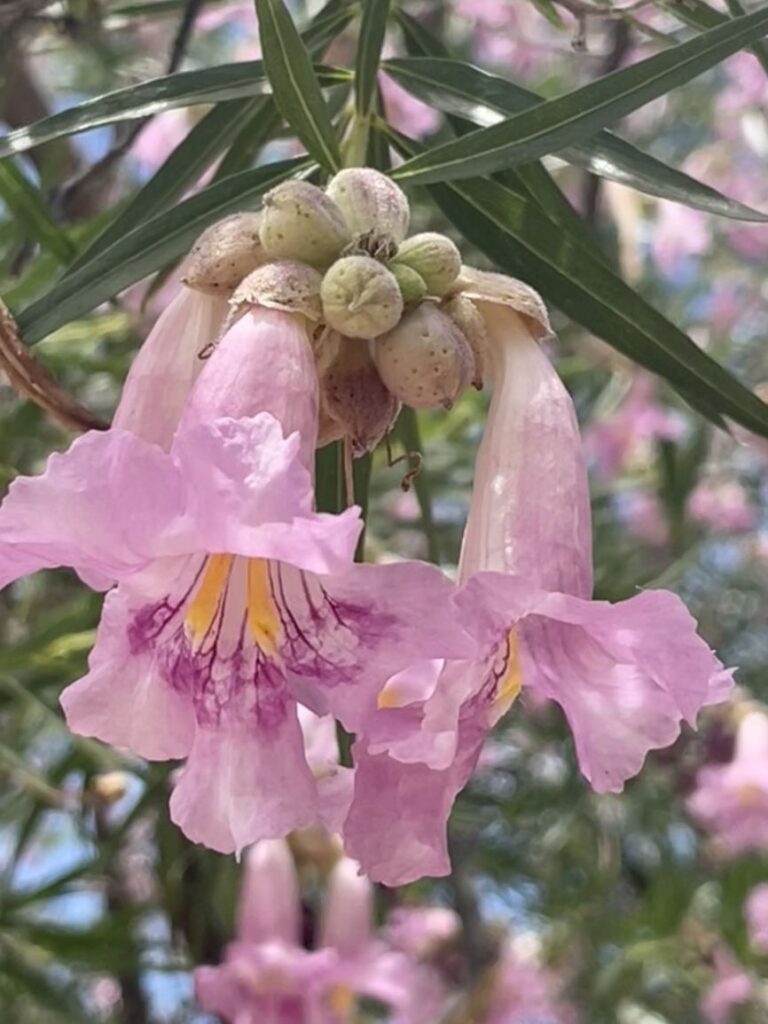
The flowers are the main event – large, trumpet-shaped blooms in shades of white, pink, lavender, and deep purple, depending on the variety, mildly fragrant, and attractive to hummingbirds throughout the season. It’s hard to look at a Desert Willow in full summer bloom and understand why it isn’t in every front yard in the Valley.
If you’ve been trying to figure out whether this tree belongs in your yard, the short answer is almost certainly yes.
What It Is and Why It Works Here
The Desert Willow is not a true willow. It belongs to the Bignoniaceae family – the same family as trumpet creeper and catalpa – which explains why the flowers look the way they do. The willow comparison comes from the leaves: long, narrow, and slightly drooping, similar enough in silhouette that the name stuck.
Its native range covers the desert Southwest and northern Mexico, specifically the dry washes, arroyos, and ephemeral streambeds where water moves through periodically but the soil drains fast between events. That habitat tells you a lot about what the tree wants: sun, heat, good drainage, and water that comes deeply and then allows the soil to dry. It didn’t evolve in a wet environment and it doesn’t want to live in one.
Phoenix sits squarely in this tree’s natural territory. Zone 9b, Sonoran Desert, alkaline soils, intense summer heat. The Desert Willow doesn’t need to adapt to our conditions. It came from conditions just like ours. That’s a meaningful advantage over trees that were bred for somewhere else and merely survive here.
It’s also worth noting that this tree is listed as a protected native plant under Arizona Native Plant Law, which means it can’t be removed or destroyed without a permit. You won’t be purchasing one from the wild, but it’s good context for understanding that this is genuinely part of our regional ecosystem.
Appearance and Growth Habit
The Desert Willow is a deciduous tree, typically reaching 15 to 25 feet tall and 10 to 20 feet wide at maturity in Phoenix, though some specimens push larger with age. Growth is moderate to fast when young – you can expect 1 to 2 feet per year under good conditions – and slows as the tree matures. It’s not the tree you plant for instant shade, but it gets there faster than most people expect.
The form is open and airy, with a naturally spreading canopy and branches that have a slight weeping or arching character. The bark is smooth and gray, becoming more furrowed and attractive with age. Left to its own devices, the tree grows as a multi-trunk shrub. With some training early on, it can develop into a clean single-trunk tree form – more on that in the pruning section.
The leaves are long and narrow – 4 to 8 inches long and less than half an inch wide – a pale to bright green that moves easily in a breeze. The overall effect is light and graceful, not dense. This matters in Phoenix: the open canopy provides summer shade while still letting enough light through that it doesn’t create a dead zone underneath.
The flowers appear in clusters at the tips of the branches and keep coming as long as the tree is putting out new growth. Bloom season typically runs from May through September, with flushes of flowers throughout. They’re roughly 1.5 to 2 inches long, trumpet-shaped, fragrant enough to notice, and genuinely showy. Hummingbirds find them reliably.
After flowering, the tree produces long, narrow seed pods – 6 to 10 inches long, pencil-width, slightly twisted – that last through winter and into spring. They attract songbirds and add some structural interest to the bare winter silhouette, though some people find them untidy. If you want to avoid the pods entirely, the cultivar ‘Art’s Seedless’ produces sterile flowers and no fruit.
In winter, the tree loses its leaves completely. This is normal and healthy. It’s also worth planning around: a Desert Willow parked alone as a focal point looks bare from roughly November through March. Plant it where the winter silhouette works, or group it with evergreen companions that carry the visual weight during that period.
Cultivars Worth Knowing
If you buy a Desert Willow from a generic nursery flat without a name tag, you’re getting a seedling with unpredictable flower color and growth habit. Named cultivars give you consistency. A few that perform well in Phoenix:
‘Lucretia Hamilton’ – Deep lavender to purple flowers, long bloom season, compact form. This is one of the most planted cultivars in the Valley and consistently performs well.
‘Art’s Seedless’ – Light pink to nearly white flowers, and no seed pods. Good option if the pod litter bothers you or you’re planting near a pool.
‘Bubba’ – One of the larger-growing selections, good if you want more canopy and shade. Flowers are lavender-pink.
‘Warren Jones’ – Pink flowers, fast-growing, develops a nice tree form.
‘White Storm’ – Pure white flowers for those who want something different from the typical pink-to-purple range.
The flower colors are real differences – if you have a specific palette in mind for your yard, it’s worth seeking out the right cultivar rather than buying whatever’s available and hoping for the best.
Sun and Heat Tolerance
Full sun. This tree doesn’t want partial shade and it doesn’t need protection from reflected heat. In fact, more heat tends to mean more flowers. A Desert Willow planted on a south or west-facing exposure with wall heat will often outperform one in a cooler, shadier spot.
Its narrow leaf structure is actually an adaptation for managing heat load. Less surface area per leaf means less solar absorption. This is why the tree handles sustained 115 degree weeks without the leaf scorch you’d see on something like an orange tree or a ficus under the same conditions. It’s built for exactly what we throw at it.
Water Needs
Understanding the Desert Willow’s native habitat makes the watering strategy intuitive. In the wild, it grows along washes – places that get periodic flushes of water that percolate deep into well-drained soil, and then dry out between events. That’s the irrigation model to replicate.
During establishment (first 1-2 years): Water deeply every 5 to 7 days during the warm months. Every 10 to 14 days during winter. The goal is deep root development. The tree is building the root system it will rely on for the next few decades. Shortcut the establishment phase and you’ll have a permanently dependent, underperforming tree.
Once established: Deep watering every 2 to 4 weeks during summer, tapering to once a month or less in winter. Some established specimens in the Valley get by on almost no supplemental irrigation once their roots have found deeper moisture. That said, consistent deep watering during the bloom season will produce noticeably more flowers than a tree kept on the leanest possible program.
What to avoid: Frequent shallow watering is the wrong approach for this tree. It keeps the root zone near the surface where heat concentrates, discourages deep rooting, and never lets the soil dry enough between cycles. Desert Willow roots want to go down. Give them a reason to.
Overwatering is also a real risk, especially in clay-heavy Phoenix soils. Consistently wet soil leads to root rot, which shows up as yellowing, wilting despite adequate moisture, and gradual decline. Good drainage is not optional.
Soil and Fertilizing
The Desert Willow evolved in low-fertility, well-drained desert soils – limestone-based washes and sandy arroyos with minimal organic matter. It’s genuinely adapted to nutrient-poor conditions and does not need heavy fertilizing. In fact, too much nitrogen pushes fast, weak growth and can actually reduce flower production.
That said, Phoenix soil is still Phoenix soil. The issues we deal with across the board – high pH locking up nutrients, salt accumulation from irrigation water, low organic matter limiting soil biology – don’t disappear just because this tree handles them better than most. The Desert Willow is tolerant of alkalinity and salt, but tolerance doesn’t mean immunity.
The approach here is the same as it is for most trees in the Valley: feed the soil, not just the plant. A light application of organic compost in spring gives the soil biology something to work with and keeps nutrient cycling moving. That’s about all this tree needs on the fertilizing front.
Avoid synthetic fertilizers. They’re not necessary, they add to your soil’s salt load, and pushing too much nitrogen at a Desert Willow is how you get a lot of leggy growth with fewer flowers. Let the biology do the work.
One specific note on drainage and our soils: if you have caliche close to the surface, it can create a perched water table effect in the planting hole – essentially a bathtub that holds water around the roots. If you hit caliche while digging, break through it before planting. A tree with good drainage will outperform one planted on top of a hidden caliche pan every time.
Planting Guide
Best time to plant in Phoenix: October through March. Fall is ideal – the tree has mild temperatures to establish roots before its first real summer. Spring works, but you’ll be watching it closely through the first hot season.
Planting hole: Wide and shallow, not deep. Two to three times the diameter of the root ball, and only as deep as the root ball itself. Set the root crown slightly above grade to allow for settling and to keep the crown out of any potential standing water. This tree does not want to sit in a depression.
Spacing: Plant at least 8 to 15 feet from structures, walls, and other trees. The canopy spreads and you want air circulation. Too close to a wall and you’ll have ongoing pruning battles as it matures.
Mulch: 3 to 4 inches of organic mulch over the root zone, pulled back from the trunk. Mulch moderates soil temperature, slows evaporation, and feeds soil biology as it breaks down. In a Phoenix summer, bare soil around the root zone gets brutally hot – mulch is real protection.
Form decisions at planting: If you want a tree form rather than a multi-trunk shrub, select a dominant leader at planting and remove competing stems. Do this in the first year or two – it becomes much harder to correct later. You’ll also need to stay on top of basal suckers throughout the tree’s life. They’ll keep coming, and if you ignore them for a season or two, what you thought was a tree form will start reverting toward a shrub.
Pruning and Maintenance
This is where the Desert Willow requires the most consistent attention, at least during the first few years.
Form and structure: The tree blooms on new wood. That’s important – it means pruning actually encourages more flowering, not less. A light pruning in late winter before new growth emerges promotes branching, which produces more flower-tipped shoots. You can also do a light trim in summer to encourage a second flush of new growth and more blooms.
Suckers: The Desert Willow throws basal suckers persistently – new shoots emerging from the base and root zone. If you want a clean tree form, these need to be removed regularly. Pull them rather than cut them when possible, which discourages regrowth. This is ongoing work for the life of the tree.
Timing: Primary pruning in late winter before leafout, while the structure is visible and before the tree is spending energy on new growth. Light shaping anytime during the growing season is fine.
Winter dieback: Tip dieback in winter is normal, especially after a cold snap. Don’t rush to prune it out – wait until spring when you can clearly see where live growth begins. You’ll often find that more of the wood survived than it looked like.
Seed pods: Remove them if you want to reduce litter or prevent self-seeding. Removing pods also redirects the tree’s energy back into growth and flowers rather than seed production. The pods are not harmful to leave on – it’s purely an aesthetic and management decision.
Common Problems and Pests
The Desert Willow is about as pest- and disease-resistant as a tree gets. Most problems that come up trace back to cultural issues rather than something attacking the tree.
Root rot: The most common serious problem. Caused by poor drainage, overwatering, or both. Symptoms look like the tree is thirsty – yellowing, wilting, poor vigor – which leads people to water more, making it worse. If your Desert Willow is declining and drainage is suspect, that’s the first thing to investigate. There’s no fixing root rot once it’s established; the solution is prevention through proper planting and watering habits.
Aphids and spider mites: Occasional, usually on new growth during warm months. In a yard with decent soil biology and some beneficial insect habitat, these populations rarely build to damaging levels – predatory insects find them. If you feel the need to intervene, a strong stream of water to knock them off is often enough. Reaching for a spray disrupts the predator populations that would otherwise take care of the problem naturally.
Litter: This tree drops flowers, leaves, and seed pods. Not a pest issue, but a real thing to account for when deciding placement. Near a pool or a high-maintenance patio, the litter is notable. In a planting bed or a less formal area, it’s a non-issue.
Self-seeding: In favorable conditions, Desert Willow seeds readily and seedlings pop up in surrounding soil. Not invasive in the traditional sense, but worth monitoring. The ‘Art’s Seedless’ cultivar eliminates this entirely.
Winter appearance: Not a problem, but worth mentioning. The bare, pod-covered winter silhouette surprises people who planted the tree for its flowers and forgot it was deciduous. Plan for what it looks like in January before you commit to a prominent placement.
Frequently Asked Questions
How much water does a Desert Willow need in Phoenix?
Established trees need deep watering every 2 to 4 weeks during summer, tapering to monthly or less in winter. During the first two years, water more frequently – every 5 to 7 days in summer – to develop a strong root system. The consistent mistake is watering too often and too shallow. Deep and infrequent is the right approach.
Why is my Desert Willow not blooming?
A few possible causes. Not enough sun is the most common – this tree needs full sun to bloom well, and a shadier location will produce fewer flowers. Insufficient water during the growing season can also reduce blooming. Finally, too much nitrogen from fertilizer pushes leafy growth at the expense of flowers. If you’ve been fertilizing heavily, back off.
Does a Desert Willow lose its leaves in Phoenix?
Yes. It’s deciduous and will drop its leaves in winter, typically November through March. This is completely normal. The tree leafs out again in spring and by late May it’s back in full form.
How big does a Desert Willow get in Arizona?
In Phoenix, most specimens reach 15 to 25 feet tall and 10 to 20 feet wide at maturity. Growth is faster when young and slows as the tree matures. Named cultivars vary – ‘Lucretia Hamilton’ stays on the compact side while ‘Bubba’ is one of the larger selections.
Is the Desert Willow a messy tree?
Honestly, yes. It drops flowers during the bloom season, seed pods in late fall and winter, and leaves in winter. Near a pool or clean hardscape, the cleanup is real. In a planting bed or a yard where litter isn’t a concern, it’s a non-issue. The ‘Art’s Seedless’ cultivar reduces the pod problem specifically.
Does it attract hummingbirds?
Reliably and throughout the bloom season. The trumpet-shaped flowers are exactly what hummingbirds are looking for, and if you have Desert Willows in bloom from May through September, hummingbirds will find them. Butterflies and native bees also work the flowers consistently.
The Desert Willow is one of the best ornamental trees you can plant in Phoenix. It’s native, cold-hardy, heat-adapted, genuinely drought-tolerant once established, and produces more flowers over a longer season than almost anything else in its size class. The tradeoffs are real – it’s deciduous, somewhat messy, and requires attention to form early on – but for most yards, those are manageable. If you’re looking for a flowering tree that actually belongs here, this is a very short list, and the Desert Willow is near the top of it.