
Caesalpinia cacalaco (also listed as Tara cacalaco) | Also called: Cascalote, Mexican Bushbird
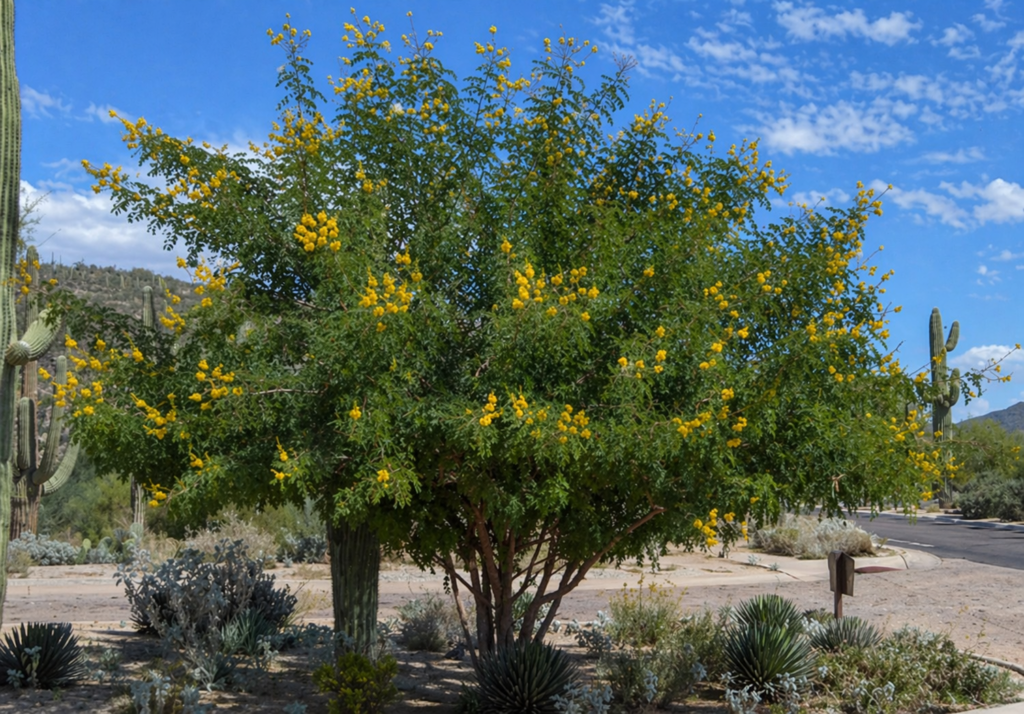
Most trees in Phoenix do their best work in spring and summer. The Cascalote does the opposite. It saves its flower show for late fall through winter – big, upright spikes of bright sulfur-yellow blooms at the tip of every branch, right when most of the landscape has gone quiet. Against a clear December sky in Phoenix, a Cascalote in full bloom is something to stop and look at.
That alone would be enough reason to pay attention to it. But the Cascalote also happens to be one of the most well-adapted, low-maintenance ornamental trees you can grow here. It handles our alkaline soil without complaint, it’s genuinely drought-tolerant once established, it’s nearly pest and disease free, and it’s the most cold-tolerant tree in its genus for Phoenix landscapes. The one thing you need to know going in is the thorns – and there’s a solution for that too.
What It Is and Why It Fits Here
The Cascalote is native to central and southern Mexico, where it grows in warm, dry conditions not unlike the Sonoran Desert. It belongs to the Fabaceae family – the legume family – which includes a lot of desert workhorses like Palo Verde and Ironwood. The name Caesalpinia honors Andreas Caesalpinia, chief physician to Pope Clement VII in the 16th century. The common name “cascalote” is the Mexican Spanish name for the tree, and it’s been an economically important plant in Mexico for centuries – the seed pods are exceptionally rich in tannins and gallic acid, used heavily in the tanning industry. The city of León alone reportedly consumed over 13,000 pounds of cascalote pods daily at the height of that trade.
In Phoenix, it’s valued purely for what it does as a landscape tree: reliable winter color, handsome evergreen foliage the rest of the year, good structure, and almost no drama.
Appearance and Growth Habit
The Cascalote is a slow-growing, small to medium-sized tree that typically reaches 15 to 20 feet tall and equally wide at maturity in Phoenix. Slow-growing is an understatement with this one – don’t plant it expecting quick results. What you get in return for the patience is a tree that develops real character over time: multiple trunks with textured, dark bark that thickens and becomes more interesting with age, a naturally vase-shaped to rounded canopy, and an overall structure that looks deliberate and refined rather than rangy.
The leaves are bipinnate and compound – meaning each leaf divides into pairs of smaller leaflets, and those leaflets are themselves divided, creating a fine, lacy texture that reads as deep green from a distance. The overall effect is denser foliage than you might expect from a desert-adapted tree. In mild Phoenix winters, the Cascalote stays evergreen. In colder stretches or following a hard freeze, it can drop its leaves temporarily before recovering.
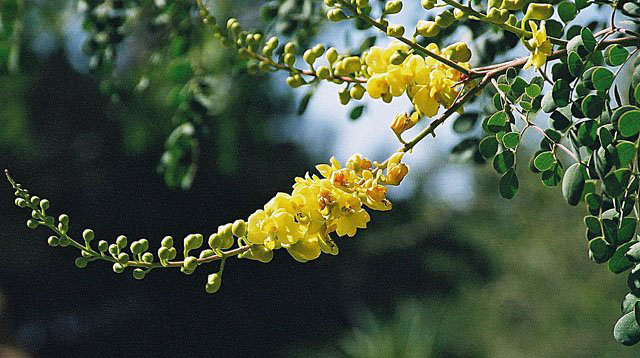
The flowers are the defining feature. Large, upright spikes of clear yellow blooms – sometimes described as sulfur yellow – emerge at the tips of every branch from late fall through winter, typically November through January or February in Phoenix. The individual flowers are small but dense, and the spikes can reach 6 to 8 inches long. The fragrance is mild but present, noticeable when you walk past. After flowering, the tree produces attractive copper-colored to reddish-brown seed pods that add another layer of ornamental interest as they develop.
Then there are the thorns. The standard Cascalote has curved, rose-like thorns along its stems and branches – maroon-colored on young growth, becoming larger and more ornamental as the wood matures. They’re not subtle. They are, as many people describe them, genuinely ornamental in their own right – the texture and color they add to the branching structure is part of the tree’s character. But they are also real thorns that will catch you if you’re not paying attention.
If the thorns are a dealbreaker – for households with young kids, dogs, or high-traffic planting areas – there is a thornless cultivar called ‘Smoothie’ that solves this entirely. More on that below.
The Thorns Question – Smoothie vs. Standard
This deserves its own section because it’s the first practical decision you’ll make about this tree.
The standard Cascalote has thorns. They’re present on stems and branches throughout the tree’s life. The thorns are genuinely ornamental and add to the tree’s visual texture, but they make pruning more involved, they will snag you if you’re working near the tree, and they’re a real consideration anywhere kids, pets, or foot traffic are regularly present.
‘Smoothie’ is a thornless cultivar developed by Mountain States Nursery. It has all the same qualities as the parent plant – same flowers, same foliage, same growth habit, same cold tolerance – without the thorns. ASU’s plant database describes it as “a wonderful, very popular small tree for water-conserving landscape gardens in the lower deserts of the Southwest” specifically because the absence of thorns makes it more versatile in residential settings.
The practical guidance: if you’re planting near a sidewalk, patio, children’s play area, or anywhere people will regularly walk within arm’s reach of the canopy, get ‘Smoothie’. If you’re planting as a background specimen, in a mixed border with clearance around it, or you actively like the texture the thorns provide, the standard tree is a fine choice. Both are excellent trees.
One note: ‘Smoothie’ is grafted, which means it’s slightly harder to find and typically costs more than standard Cascalote seedlings. It’s worth seeking out at a specialty nursery if the thornless option is important to you.
Sun and Heat Tolerance
Full sun, and this tree genuinely thrives in reflected heat. A south or west-facing wall exposure that would stress many plants is ideal for the Cascalote. ASU’s plant database notes it “thrives in Phoenix” for heat – this is a tree that came from the hot, dry interior of Mexico and performs accordingly.
It’s worth noting that the Cascalote is cited as the most cold-tolerant tree in its genus (Caesalpinia / Tara) for Phoenix landscapes. Cold hardiness is approximately 18 to 20 degrees F, which makes it more frost-tolerant than its close relative the Mexican Bird of Paradise. In Phoenix proper, this rarely matters. In colder pockets of the Valley, it’s meaningful.
When a freeze does damage the Cascalote – primarily affecting the flower spikes and sometimes causing leaf drop – the tree recovers well once temperatures moderate. The woody structure is tougher than the flowers, and new growth comes back in spring.
Water Needs
The Cascalote is a genuinely low-water tree once established. This isn’t marketing language – it’s a tree from dry Mexican hillsides that naturally grows on limited rainfall and handles our conditions well.
During establishment (first 1-2 years): Water deeply every 10 to 14 days during summer, every 3 to 4 weeks in winter. The Cascalote establishes more slowly than a faster-growing tree, so don’t rush this phase. Consistent deep watering during the first two summers builds the root system that will carry the tree for decades.
Once established: Every 2 to 3 weeks during summer, every 3 to 4 weeks in winter. Some established specimens in Phoenix get by on even less – monthly irrigation and residual monsoon moisture. The tree will tell you when it needs water: slight leaf curl or flagging on the newest growth is the first sign of drought stress, well before anything serious develops.
What to avoid: Overwatering, especially in poorly drained soil, is the main risk. The Cascalote handles dry conditions comfortably but is susceptible to root rot if kept in consistently soggy soil. Good drainage matters. Don’t plant it in a low spot where water collects after rain or irrigation.
The classic Phoenix mistake – watering too frequently and too shallowly – produces a shallow root system that keeps the tree irrigation-dependent and more vulnerable to summer heat stress. Deep and infrequent is always the right approach, particularly during establishment.
Soil and Fertilizing
This is genuinely one of the easiest trees to manage in Phoenix soils. The Cascalote is adapted to our alkaline, low-organic-matter desert conditions and doesn’t fight them the way acid-loving plants do. You won’t be chasing iron chlorosis with this tree. You won’t need to heavily amend your soil or create special planting conditions to give it a fighting chance.
What does matter:
Drainage: Well-drained soil is the primary soil requirement. The Cascalote grows naturally in loose, rocky soils with good infiltration. It does fine in Phoenix’s clay soils as long as drainage isn’t severely impaired. If you have a particularly compacted or heavy clay planting site, breaking up the area around the planting hole is worth doing.
Nitrogen fixation: As a legume family member, the Cascalote fixes atmospheric nitrogen through root associations with soil bacteria. This means it’s contributing to its own nitrogen supply and to the soil biology around it – a meaningful advantage in low-fertility desert soils. It’s one reason this tree doesn’t need aggressive fertilizing and does well in conditions that would stress a non-legume.
Fertilizing approach: Light organic inputs in spring – a compost topdress, some worm castings – are sufficient to support soil biology and keep the tree performing well. This isn’t a heavy feeder and doesn’t need it. The same principle applies here as elsewhere in Phoenix landscapes: build the soil, and the soil supports the tree. Synthetic fertilizers add salt to a soil that already accumulates salt from irrigation water, and they don’t address the underlying biology that determines long-term nutrient availability.
Mulch: 3 to 4 inches of organic mulch over the root zone, pulled back from the trunk. Standard practice, and especially useful for moderating soil temperature and retaining moisture during Phoenix summers.
Planting Guide
Best time to plant in Phoenix: Fall is the best window – October through November. The tree gets mild temperatures to establish roots before its first summer. Spring (February through March) also works. Avoid planting in the peak of summer heat if you can; the Cascalote’s slow growth rate means it takes longer to develop the root system it needs to handle sustained 110-degree weeks.
Planting hole: Wide and no deeper than the root ball. Two to three times the diameter of the root ball, set at grade or very slightly above. Backfill with native soil – no need for heavy amendment. If caliche is present at a depth that would impair drainage below the root zone, break through it before planting.
Spacing: Give it room for the mature spread. These trees reach 15 to 20 feet wide and don’t appreciate being crowded. Ten to fifteen feet of clearance from structures and other large plants is appropriate. Because of the thorns on standard varieties, think carefully about proximity to walkways, gates, and areas where people regularly pass.
Staking: Generally not necessary for smaller nursery sizes. If you plant a larger boxed specimen, light staking for the first season helps the root system establish before the tree has to handle wind load on its own. Remove stakes after the first growing season.
Pruning and Maintenance
The Cascalote is low-maintenance, but it does need guidance, especially in the first several years, to develop a tree form rather than reverting to its natural large-shrub habit.
Timing: Prune in spring after the bloom has finished – typically February through April in Phoenix. This protects the flower show, allows you to see the full structure while flowers are present, and lets you make cuts before the flush of new spring growth begins.
Form training: Left alone, the Cascalote produces low branches and basal suckers that push it toward a multi-trunk shrub form. If you want a tree form, you need to remove suckers consistently and gradually raise the canopy by taking off the lowest branches over several seasons. Do this gradually rather than all at once – removing too many lower branches too quickly can stress the tree and expose the trunk to sunburn.
Ongoing sucker removal: This is the primary recurring maintenance task. The tree throws new shoots from the base regularly, especially when young. Staying on top of them while they’re small is much easier than letting them develop into competing stems.
Light annual thinning: The canopy benefits from periodic interior thinning to improve air circulation and light penetration. This keeps the center of the canopy healthy and reduces dead-wood buildup over time. Nothing aggressive – just removing crossing branches and interior congestion during the spring pruning window.
Thorn management on standard varieties: If you have the thorned variety and want to work near it more comfortably, the tips of the thorns can be clipped without harming the tree. This doesn’t eliminate them but makes them less aggressive. Wear long sleeves and thick gloves when pruning regardless.
Common Problems and Pests
The Cascalote is about as trouble-free as Phoenix landscape trees get. Most issues that come up are minor or management-related rather than actual disease or pest problems.
Whiteflies: The only pest of any note, and ASU describes it as only a minor problem. In a yard with decent soil biology and beneficial insect activity, whitefly populations rarely build to damaging levels. The predatory insects that keep them in check – parasitoid wasps and other beneficial insects – do the job if the ecosystem supports them. Intervening with sprays disrupts those populations. Observe before acting.
Root rot: The main cultural problem. Caused by poor drainage or overwatering. This tree doesn’t want wet feet. If a Cascalote is declining and you can’t attribute it to drought or freeze damage, drainage is the first thing to look at.
Freeze damage: Flower spikes are more cold-sensitive than the woody structure. A hard frost can damage or kill the current bloom flush without harming the tree itself. Leaf drop after a cold snap is also common and temporary. In both cases, the appropriate response is to wait – don’t prune damaged growth until you can clearly see where live wood begins, which may not be obvious until spring.
Slow establishment: Not a problem so much as a reality. The Cascalote grows slowly, especially in the first couple of years. This isn’t a sign that something is wrong. It’s just what this tree does. Patience is part of the deal.
Toxicity: The University of Arizona lists Cascalote as poisonous, and a related species is flagged by the ASPCA as toxic to dogs, cats, and horses. The specific risk level isn’t well-documented, but it’s worth knowing if you have pets that chew on plant material. The seed pods are the primary concern.
Frequently Asked Questions
When does the Cascalote bloom in Phoenix?
Late fall through winter – typically November through February, with the peak usually in December and January. This is its defining characteristic and the main reason to plant it: it flowers when almost nothing else in the Phoenix landscape is blooming. On a clear winter day, a Cascalote in full bloom against a blue sky is one of the better things you can put in your yard.
How fast does a Cascalote grow?
Slowly. This is one of the slowest-growing ornamental trees commonly planted in Phoenix. Expect modest progress in the first few years. The trade-off is a tree with real longevity and increasingly good structure as it matures. If you need fast results, this isn’t the right tree. If you’re thinking long-term, it’s worth the wait.
Should I get the thorned or thornless variety?
Depends entirely on placement and your household. The thornless ‘Smoothie’ cultivar is the better choice for anywhere near foot traffic, play areas, pools, or pets. The standard thorned tree is fine – and arguably more visually interesting in a naturalistic planting – where clearance isn’t a concern. If you’re not sure, lean toward ‘Smoothie’ since it eliminates the one real inconvenience of this tree without losing anything else.
Does the Cascalote lose its leaves?
In mild Phoenix winters, it stays evergreen. In colder winters or following a significant freeze, it may drop leaves temporarily before rebounding in spring. It’s described as semi-evergreen for this reason – evergreen in most years, deciduous under cold stress.
Is it similar to the Mexican Bird of Paradise?
Yes, closely related – both are in the Caesalpinia family and share the yellow flower color, lacy compound foliage, and multi-trunk growth habit. The main differences: Cascalote blooms in winter while Mexican Bird of Paradise blooms almost year-round; Cascalote is larger and slower-growing; and Cascalote is harder to find at standard nurseries. Mexican Bird of Paradise is a good alternative if you want similar aesthetics with easier availability and year-round flowers.
Does it attract hummingbirds?
Yes, though the bloom timing (late fall and winter) means hummingbird activity around it depends on whether they’re still in the area. In recent years, warmer Phoenix winters have meant more hummingbirds sticking around through the bloom season. Butterflies and bees also work the flowers.
The Cascalote fills a gap that almost nothing else in Phoenix horticulture does: a well-adapted, genuinely low-maintenance tree that puts on a serious flower show in winter, when the rest of the landscape is at its quietest. It asks for full sun, decent drainage, patient establishment, and consistent sucker removal. In return you get a tree that handles our alkaline soil and summer heat without complaint, rarely has pest or disease problems, and gets more beautiful with age. The only real decision is thorns vs. no thorns – and ‘Smoothie’ makes that an easy call for most residential settings. This is an underused tree in Phoenix yards and it deserves more attention than it gets.