
Your Planting Plan, Steve

Here's the proposal, Steve. The main project is a ficus hedge running the full 158 feet of your back wall, planted 3 feet apart so it closes into a solid green screen fast. Below that are the plants you talked through with Jeromy, priced out so you can see where this lands.
We're planting the hedge from 5 gallon stock on purpose, and there's real research behind that choice. I've explained it below, because it's the difference between a hedge that thrives and one you replace in five years. Every plant we put in gets the hole built with quality compost and organic fertilizer, and every root flare gets set at the right height. That's what makes these take off instead of just hang on.
158 feet of ficus along the back wall
Planted 3 feet on center, which is tight for ficus and intentional. At that spacing the canopies knit together in a season or two instead of leaving you looking at gaps for years.
Ficus, 5 gallon, 53 plants
Ficus is the standard for a tall, dense, evergreen screen here, and nothing else fills in quite as fast or as solid. At 3 foot spacing along 158 feet, that's 53 plants. They'll grow together into one continuous hedge, and you can keep them anywhere from 8 feet to well above the wall depending on how much height you want.
Two things to know going in. Ficus wants regular water, more than the natives do. And it can burn back in a hard freeze, though along a block wall with the heat the wall holds, this is about as protected a spot as you can give it.
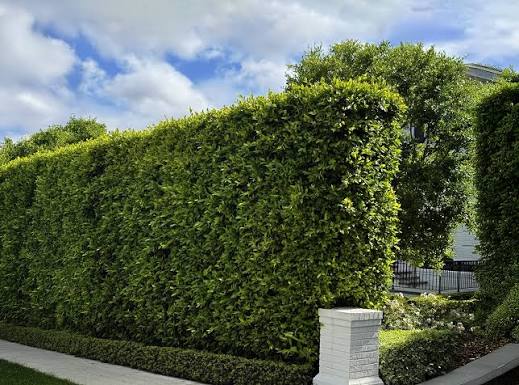
Ficus
Evergreen, dense, glossy dark green leaves, and it holds its color year round. Left alone it becomes a tree, but planted in a row and kept trimmed it makes the most solid privacy screen available in this climate. Takes shearing well, so you set the height and width you want and it holds it.
Smaller trees outperform bigger ones
A bigger container looks like a head start. It usually isn't. A plant that's been sitting in a large container for years has roots that hit the wall of that pot a long time ago, turned, and started wrapping around themselves. That's girdling. Those roots don't straighten out once they're in the ground. They keep growing in that same circle, and years later they can choke the trunk or strangle the roots around them. It shows up as slow growth, wind failure, or a plant that declines for no obvious reason.
A 5 gallon plant hasn't been in the pot long enough for that to happen. The roots are still young and straight, so when we plant them they push straight out into the surrounding soil and build a real root structure from day one.
The research
Texas A&M grew chaste trees, red maples, and bald cypress in five container sizes from 1 gallon up to 45 gallon, then planted them all in the same field. The trees from the smallest containers caught up to the trees from the largest containers in three years. Same species, same site, same care.
A separate six year red maple study found the same thing from the root side. The trees planted from the biggest containers grew the slowest for the first three years, mostly from water stress, and tilted more when tested for anchorage. The larger the container at planting, the less the roots pushed out into the surrounding soil.
- Texas A&M container size study: treefund.org, with a plain language summary at csuhort.blogspot.com
- Red maple root growth and anchorage study (Gilman & Grabosky, Arboriculture & Urban Forestry): auf.isa-arbor.com
Root flare exposed, hole built right
Most plant failures in the Valley trace back to how the plant went in the ground, not to what was planted. The most common mistake is planting too deep. The root flare is where the trunk widens and turns into roots, and it belongs at or slightly above the finished soil line. Buried, the bark stays wet, the plant can't breathe properly, and roots start circling the trunk. It's a slow decline that most people never connect back to planting day.
- We find the flare in the container first. Nurseries often pot plants too deep, so the top of the soil in the pot is not always the top of the root ball. We dig down in the container until we find it.
- We correct circling roots at planting, cutting or straightening anything that's begun to wrap, so it never becomes a girdling problem later.
- We dig wide, not deep. Two to three times the width of the root ball, with the bottom left firm so the plant can't settle and sink.
- We build the backfill with quality compost and organic fertilizer worked into the native soil, so the soil biology is active around the roots from the first week.
- We set the flare above grade and mulch over the root zone, keeping mulch off the trunk itself.
Here's a short video where I show what a buried root flare looks like and how it gets fixed.
If the video doesn't load, watch it here: youtu.be/mLCVVxdvxU8
The ficus hedge
158 feet, 53 ficus at 3 foot spacing
Includes compost and organic fertilizer in every planting hole, root flare set correctly on every plant, and cleanup. A 50 percent deposit starts the job.
The plants you went over with Jeromy
Here's what each one is and what it costs installed. I've put quantities on these so you can see real numbers, but treat them as a starting point. We can move any of them up or down before anything is final. Once you decide to move forward, we'll walk the yard together and place everything. The plumeria, hibiscus, and pygmy palms would all go around the pool, which is exactly where they belong.
Tropical color at the water's edge

Hibiscus
Big tropical blooms in red, pink, orange, or yellow, almost continuously through the warm months. Glossy evergreen leaves, 4 to 6 feet. Loves the humidity and warmth around a pool. Wants afternoon shade in July and frost cloth on the coldest nights.
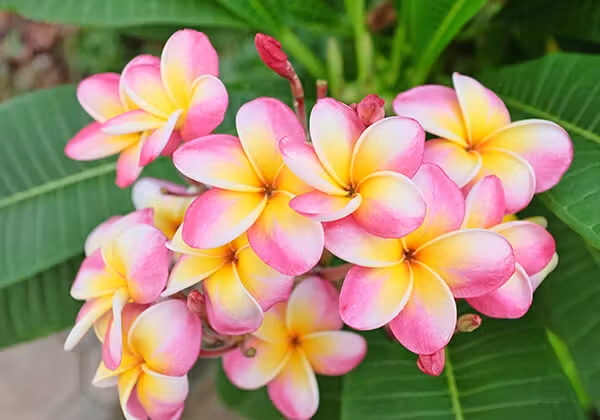
Plumeria
The classic tropical scent. Thick sculptural branches with clusters of fragrant white, pink, or yellow flowers all summer. Drops its leaves in winter and goes dormant, which is normal. 8 to 12 feet over time and does well in a pot if you'd rather move it.
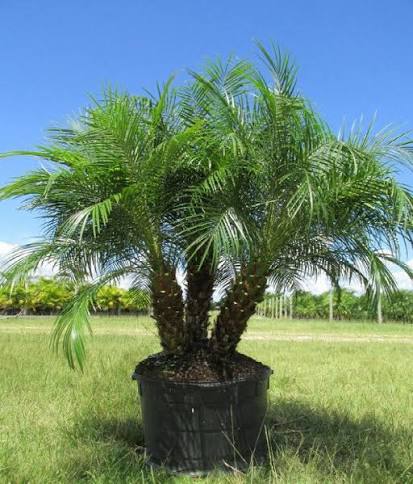
Pygmy Date Palm
Small, well behaved palm, 6 to 10 feet, with fine feathery fronds and a slender trunk. It stays in scale with a pool deck instead of taking it over, and it's one of the few palms that looks right in a small space. Single or multi-trunk.
Shade and structure
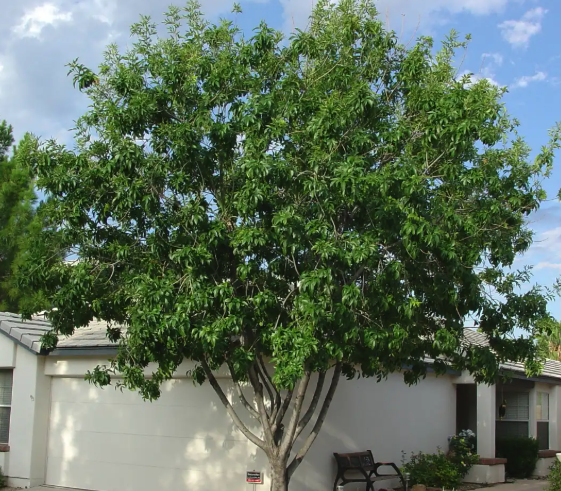
Bonita Ash
A selected form of our native Arizona ash. Upright, symmetrical, 30 to 40 feet with a broad canopy and yellow fall color. Deciduous, so it shades hard in summer and lets the sun through in winter. Fast growing and a genuinely good shade tree here.

Hong Kong Orchid
Large purple-pink orchid-shaped flowers from fall into spring, which is when most things here are quiet. Semi-evergreen, 20 to 25 feet with a wide spreading canopy. A showpiece tree. Frost sensitive when young, so it wants a warm spot and cover its first couple of winters.

Banyan
A dramatic tree with glossy leaves, a heavy spreading canopy, and the aerial roots that make it famous. Same family as your hedge ficus, and it wants similar water. The thing to know is scale. Given room and time this gets very large, both above and below ground, so it needs to go well away from the house, pool, and any hardscape.
The rest of the list
Each price covers the plant itself plus our planting labor, with compost and organic fertilizer in the hole and the root flare set correctly. These quantities are just a starting point so you can see what it looks like on paper. Change any of them and I'll rerun the number.
Installed pricing
Hedge plus plant list
A 50 percent deposit of $3,539.25 starts the job. Every price here includes the plant, our labor, compost and organic fertilizer in the hole, correct root flare placement, and cleanup.
Where this goes next
Text me and let me know if this looks right, or what you'd like to change on the quantities. Nothing here is locked in. Once we land on the numbers I'll get you on the schedule and we'll walk the yard together to place everything. Fall is the best planting window here, so the sooner these go in, the better established they'll be before next summer.
Questions on anything here, just reach out. You can also read more about how we plant at thegardennerd.org.