
Karen, here's what we covered
1025 E Hoover Ave, Mesa, AZ 85204Thanks for having me out to walk the yard. I put this together in the same order we walked it, backyard through front. As a consult client you're already in the Garden Nerd Club, so I'm happy to keep working through this list with you whenever you're ready.

A pool someday, or a little fruit tree grove
This open stretch of the backyard is really flexible. If a pool ends up going in down the road, great, but if not, this is a great spot for a few fruit trees. Pomegranate, mulberry, citrus, and fig are all tough enough to handle our climate on their own, but if you go this route, I'd mulch around all of them. They don't strictly need it to survive here, but it makes a real difference in how well they grow and how little you have to fuss over them.
Of the group, pomegranate and mulberry are the easiest to grow and the most forgiving if you get busy and miss a watering here and there. Fig is fairly easy too and gives you a heavy crop with very little fuss. Citrus is the toughest of the group, it's pickier about cold snaps and wants more consistent care. Mulberry also gets the biggest by far, so give it plenty of room to spread out, while pomegranate and fig stay more compact. Mulberry and pomegranate are both deciduous and will drop their leaves and go bare over winter, that's normal and nothing to worry about, and fig does the same. Citrus stays green year round.
All of these should go on bubblers rather than regular spray or drip emitters, and I'd put them on their own irrigation line separate from the rest of the yard so we can water them on their own schedule as they establish.
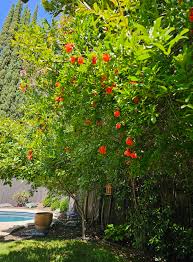
Pomegranate (Parfianka)
Easiest of the group, compact size, deciduous. I'd go with Parfianka over Wonderful, it holds up better against leaf-footed bugs here.
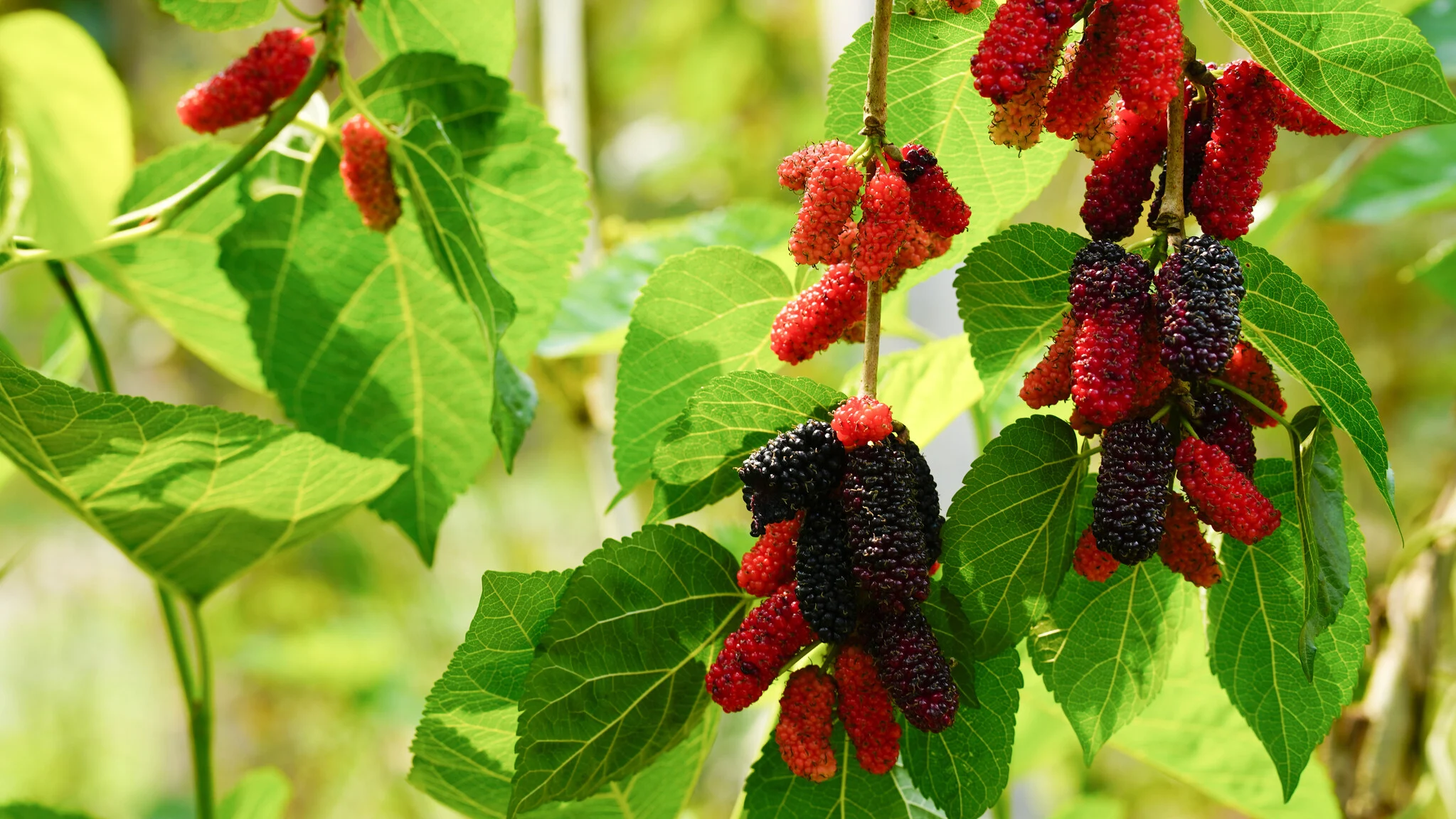
Mulberry
Easiest to grow and the biggest of the group by far, deciduous, doubles as a shade tree with a heavy fruit crop in spring.

Citrus
The toughest of the group to keep happy, evergreen year round, several varieties to choose from.

Fig
Fairly easy going, stays compact, deciduous, and gives a heavy crop with very little fuss.
No rush on this decision, keep it open until you know if the pool is happening.

One plant, the full length of this wall
For this wall I'd pick one of Hopseed, Orange Jubilee, or Arizona Rosewood and run it the entire length rather than mixing them together. A single variety planted in a row grows in as a clean, even hedge, mixing different shrubs on the same wall tends to look patchy since they all grow at different rates and shapes. You've got three walls back here total, so this is a good chance to use a different plant on each one and still keep everything looking intentional.

Hopseed
Fast, thick, and fills in quickly at the base of the wall.

Orange Jubilee
Fast growing with orange blooms most of the year.

Arizona Rosewood
Dense, upright, and built for full sun against a wall.
Pick one for this wall and stick with it end to end, then choose separately for the other two walls. Plant at 5-gallon size.

Same rule here, one plant for the whole wall
Same as the other walls, pick one variety and run it the full length rather than mixing. Hopseed and Arizona Rosewood are both Arizona natives, so they'll grow the fastest and use the least water once they're established, that's usually where I'd point you first. Orange Jubilee is another solid option, fast and covered in blooms most of the year, though it's not a native so it'll want a bit more water than the other two. Red Bird of Paradise is the one you mentioned liking, and it's an easy, colorful grower, but it's worth knowing up front that it won't form the same dense, tight hedge the others will, so it gives you less real privacy even at full size. If privacy is the priority, go with Hopseed or Rosewood. If color is the priority and you don't mind a looser look, Orange Jubilee or Red Bird of Paradise are great choices. Whichever you pick, space plants about three to four feet apart so the wall fills in evenly.
Hopseed
Arizona native, dense and thick, doesn't need much water once established.
Arizona Rosewood
Arizona native, dense and upright, doesn't need much water once established.
Orange Jubilee
Fast growing with orange blooms most of the year, wants a bit more water than the natives.
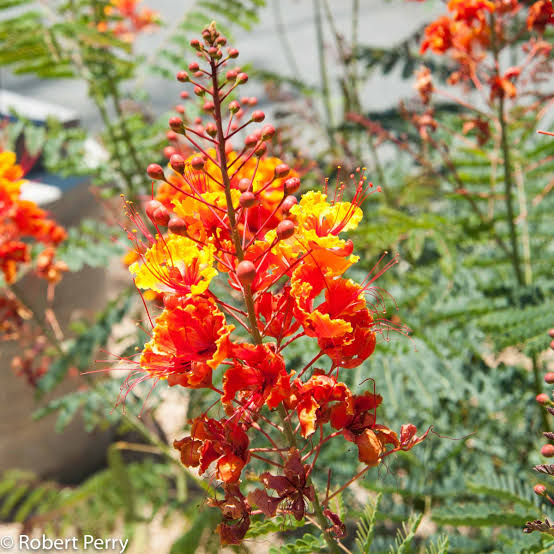
Red Bird of Paradise
Bright orange-red blooms all summer, easy to grow, but stays looser and won't give the same privacy as a true hedge.
Pick one for this wall, space three to four feet apart, plant at 5-gallon size, and let it run the full length.

One large shade tree here, desert adapted
This is a good spot for a single large shade tree. Mesquite and Palo Verde are both Arizona natives that don't need much water once established, grow fast, and cast a light, dappled shade that's easy to plant under later on. Chinese Elm grows into a bigger, denser canopy for heavier shade, but it wants more consistent water than the natives to look its best. Red Push Pistache grows a bit slower than the others but gives you vivid red fall color that none of these other three offer. All four drop their leaves in winter, so expect some bare branches for a couple months each year, that's normal and they'll leaf back out in spring. For the tree itself, whatever you're able to get through the SRP program works great, otherwise 15-gallon size from A&P Nursery is the right starting point.
This area isn't all grass, it's really just some Bermuda trying to establish itself in a few patches. You only need to cardboard over those Bermuda patches specifically, not the whole area, then pile mulch on top and stack it high. It'll feel a little rough to walk on at first, but it breaks down over time, feeds the soil as it goes, and you won't have to keep adding more once it settles in.
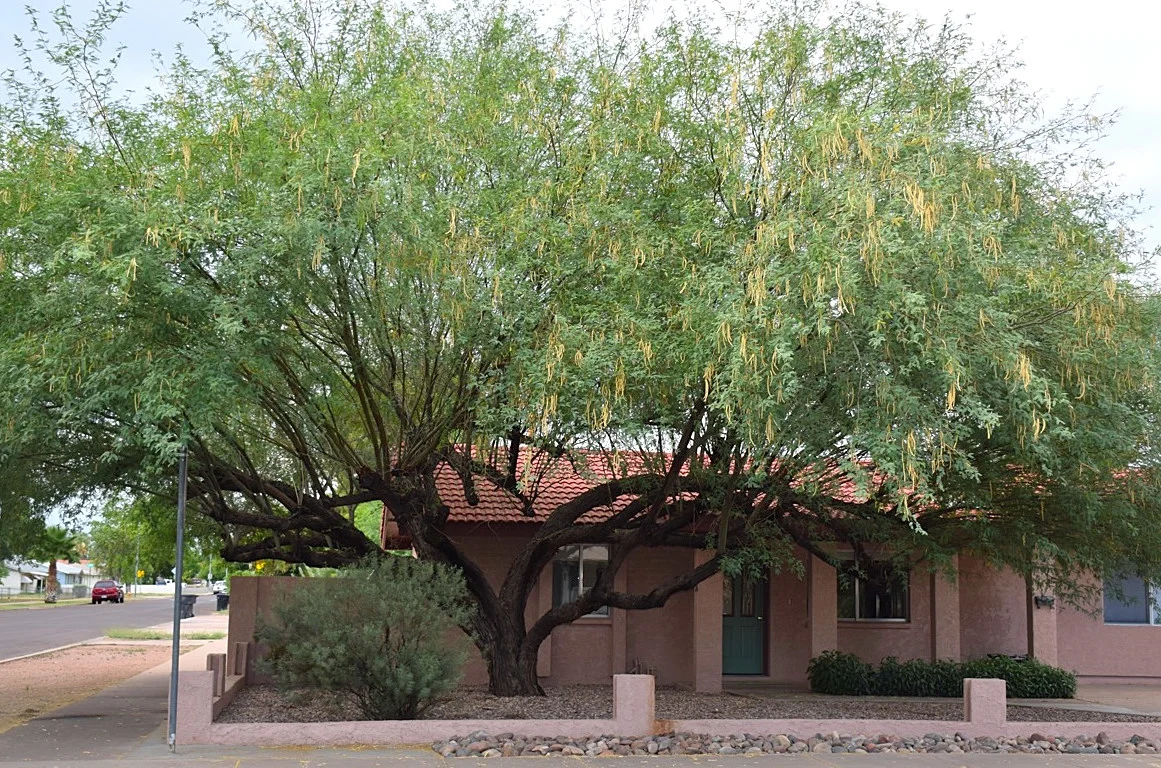
Mesquite
Arizona native, fast growing, light dappled shade, doesn't need much water once established.
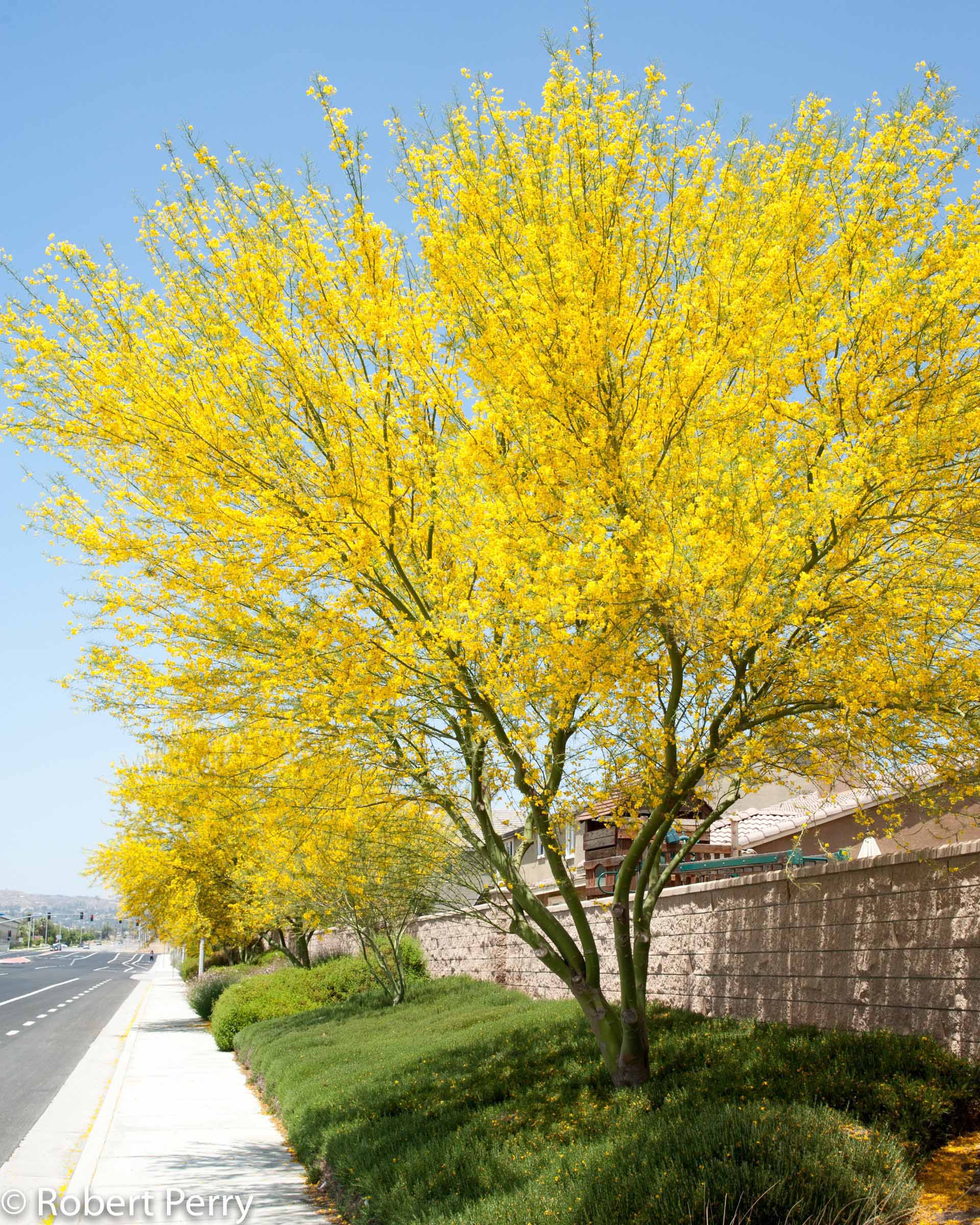
Palo Verde (Desert Museum)
Thornless Arizona native, fast growing, yellow blooms every spring, doesn't need much water once established.

Chinese Elm
Fast growing with a dense canopy for heavier shade, wants more consistent water than the natives.

Red Push Pistache
Slower growing than the others, vivid red new growth and fall color, well-shaped canopy.
Just pick one of the four, no need to plant them all.

A second tree here to match the first
Same list applies here, Mesquite, Palo Verde, Chinese Elm, or Red Push Pistache. Aesthetically I think it looks best to plant the same variety you pick for the other spot so the two trees read as a matched pair across the yard, but it's completely fine to mix it up if you'd rather have some variety. Same guidance on mulch here too, cardboard down over any Bermuda patches first, then mulch piled high on top. It'll settle in and improve over time just like the other spot. Same sizing applies as well, whatever you get through SRP, or 15-gallon from A&P Nursery.

Curb it off, then grass, but grass goes in last
In this area, I'd set curbing around the perimeter to clearly define the space, then bring in grass inside that border. You've got a couple routes for the grass itself. Bermuda is easy to grow from seed and it looks like you've already got some established, so we can just encourage what's there to keep filling in. It's a warm season grass and will go dormant and brown up over winter, which is normal. St. Augustine is the other option if you like a thicker, greener look, but it needs to go in as sod rather than seed since it doesn't establish well that way.
Spring is the best time to seed grass, so I'd get everything else on this list done first, walls, trees, beds, and save the grass for last.

Grape vine here, Torch Glow Bougainvillea on the other side for symmetry
I'd run a grape vine up this wall, either Thompson Seedless or Red Flame, both are great eating grapes and easy to grow here. You'll just need to put up a trellis for it to climb, and only one vine is needed for this space. Fall through winter is the best window to get it in the ground. Like the fruit trees, it should go on its own bubbler with deep, infrequent watering rather than frequent shallow watering.
On the other side of this same wall you've already got a Bougainvillea established, so I'd add a second one over there to match it, specifically Torch Glow, to keep the whole wall feeling balanced and symmetrical from both sides.
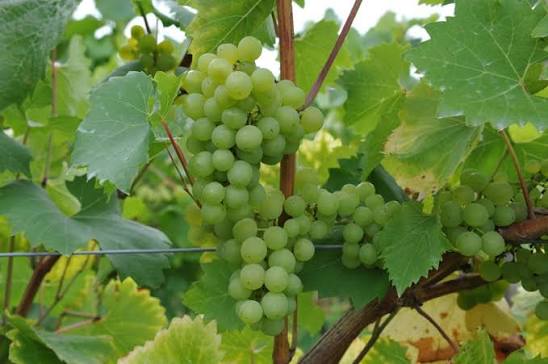
Thompson Seedless or Red Flame Grape
Climbing edible vine, needs a trellis, just one plant needed.

Torch Glow Bougainvillea
Vivid color and fast coverage, matches what's already established on the other side.

Raised beds between the two new trees, mulch everywhere else
This spot sits right between the two shade trees we're adding in sections 04 and 05, and that positioning works out perfectly for a garden bed. In summer, when the trees are fully leafed out, the bed gets the filtered shade it needs to keep vegetables from scorching in our heat. Then in winter, once those trees drop their leaves, that same bed gets more direct sun coming through, which is exactly what most winter vegetables want. That's the beauty of this system, the trees do the work of adjusting the light for you across the seasons without you having to move anything.
I'd fill the beds with compost from Arizona Worm Farm to give them real soil biology from the start, and for what and when to plant, my Maricopa County planting guide will walk you through it season by season.
For everything in between, I'd put down mulch. Anywhere there's still grass, lay cardboard down first to smother it, then mulch right on top. That combination builds soil health as it breaks down instead of just sitting there like rock does.

A hedge along the wall for shade and privacy
You mentioned wanting a little gardening potting area back here, so up against this wall I'd plant a hedge that will grow tall enough to give it some shade and privacy while you're working. Hopseed, Orange Jubilee, and Arizona Rosewood would all get the job done, same rule as the other walls, pick one and run it the full length rather than mixing.
Hopseed
Fast, thick, and fills in quickly at the base of the wall.
Orange Jubilee
Fast growing with orange blooms most of the year.
Arizona Rosewood
Dense, upright, and built for full sun against a wall.
Pick your favorite of the three for this wall, run it the full length, and plant at 5-gallon size.

Milkweed in this front yard planter
This little brick planter out front is a great spot for Desert Milkweed. It's low maintenance and brings in monarchs and other pollinators right at the entry. It'll need regular watering to get established here, so we'll want to make sure this planter is on its own zone or getting hand watered until it's settled in.

Desert Milkweed
Tough, upright, and a magnet for monarchs and other pollinators.

A large shade tree, native pollinators underneath, color by the windows
Out front, I'd plant a large desert adapted shade tree like Palo Verde, whatever you get through SRP or 15-gallon from A&P Nursery. Underneath it, in that filtered shade, there's room for a nice mix of native pollinator plants and desert color. Desert Milkweed, Perry's Agave, and Chuparosa are all great, and I'd also throw in Globe Mallow, Texas Sage, Lantana, and Baja Fairy Duster for more color and texture through the bed.
In front of the bathroom and bedroom windows, I'd go with Red Bird of Paradise or Texas Sage, both get a little taller than the other options here and will give you some presence at that height. It doesn't need to sit right up against the house either, give it a few feet of breathing room so it has space to grow and doesn't crowd the windows.
You mentioned wanting to knock down the pony wall out front by your door, I wouldn't recommend that. Pony walls like this are usually tied into the entry's structure, so removing it can lead to foundation issues you don't want to deal with. Instead, I'd soften it with a low shrub planted at the base, something that won't need much water and stays small enough to never cause foundation problems. Emu Bush is a great fit here, go with whichever variety grows a little taller so it has some presence against the wall.
Palo Verde (Desert Museum)
Thornless, fast growing, covered in yellow blooms every spring.
Desert Milkweed
Tough, upright, and a magnet for monarchs and other pollinators.
Perry's Agave
Sculptural blue-gray rosette, right at home under a filtered canopy.
Chuparosa
Red tubular blooms hummingbirds can't resist, thrives in full heat.

Globe Mallow
Bright orange blooms, tough and easy, great pollinator draw.

Texas Sage
Silvery foliage with purple blooms, doesn't need much water once established, grows a bit taller too.
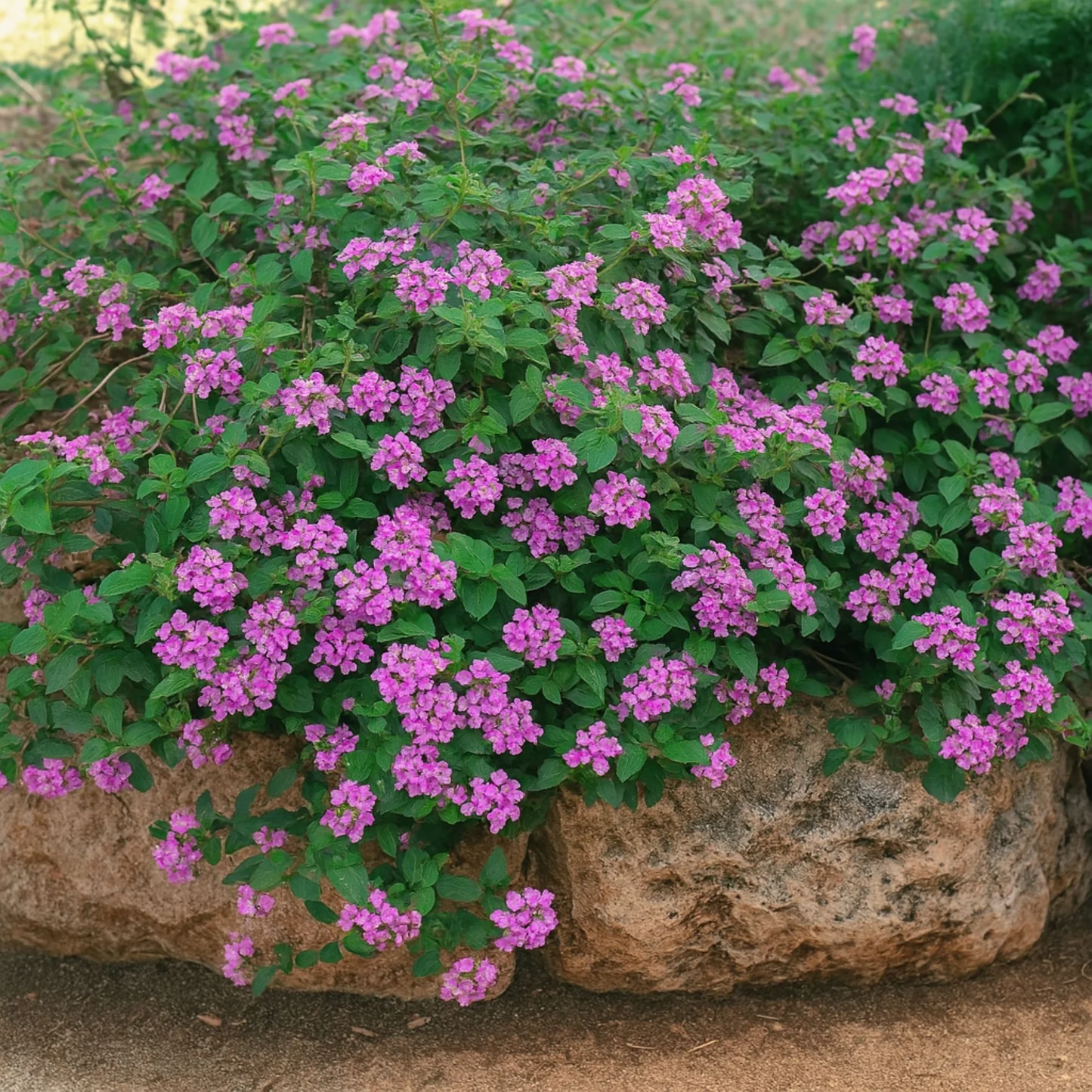
Lantana
Long bloom season and low, spreading habit, easy color for the front bed.
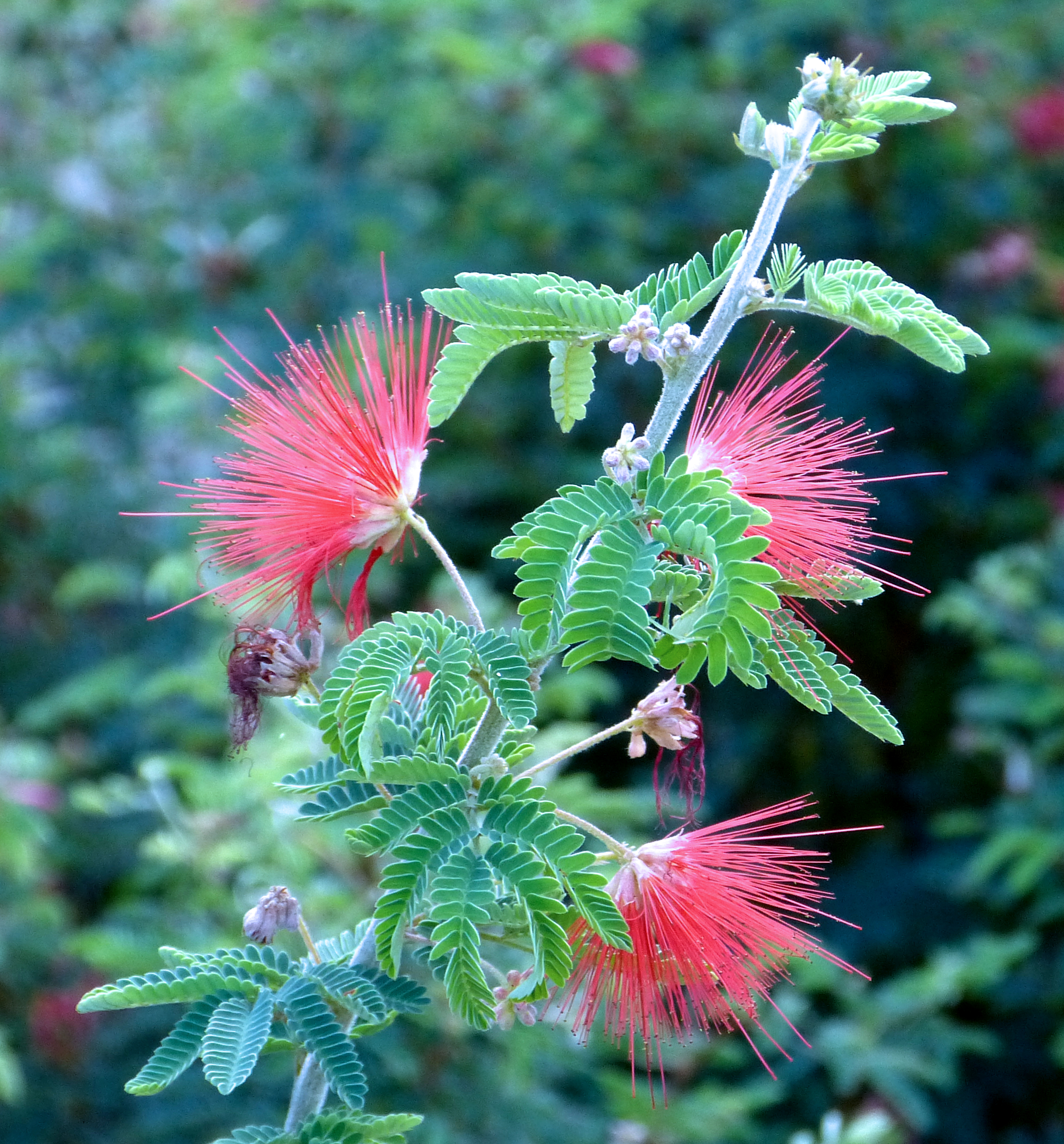
Baja Fairy Duster
Wispy red blooms, stays small and compact.
Red Bird of Paradise
Bright orange-red blooms all summer, grows a bit taller, good in front of the windows.

Emu Bush
Low, doesn't need much water once established, a good way to soften the pony wall without foundation concerns.
You don't need all of these, pick your favorites to fill in underneath, plant shrubs at 5-gallon size.
Start with the trees, then irrigation, then everything else
I'd start with the shade trees first, whatever you're able to get through SRP or 15-gallon from A&P Nursery. Get those in the ground now, ahead of everything else on this list. Before we move on to the walls, the beds, or the grass, you'll want irrigation squared away for those new trees and any new areas, so that needs to happen next. If you'd like pricing on the planting itself, just let me know and I can get that to you, but let's get irrigation handled first.
For irrigation questions, Garrett is my go-to, you can reach him directly at 480-678-9121.
You can also read more about how we plant at thegardennerd.org.